Showing posts with label Stars. Show all posts

Sunday, 19 February 2012

Ions are the 99%


Remember what you were taught in chemistry at school? It was very exact. Water is solid at 0°C, gas at 100°C, and liquid in between. Metals are solids; oxygen and nitrogen are gases. Gases like oxygen, nitrogen, hydrogen and chlorine are invariably molecules containing two atoms of each element. Atoms like their outer "shells" to be "full" and join up with other atoms to reach this stability. Oxygen is electronegative: it likes to grab electrons. You never hear of an oxygen giving up its electrons to some other type of atom.

But there is nothing universal about this.


These are what, by A level at any rate, we call "standard conditions" - 25°C, Earth's atmospheric pressure, Earth's gravity, and with all the protections of Earth's atmosphere from the violent radiation from space.

Of course, we learn that it's not like that everywhere. The pressure at the bottom of the sea, for instance, is intense - "if you went there, you'd end up the size of a chip," my Chemistry teacher told us when we were about 13. And up at the top of the atmosphere, in the ozone layer, you hear about photodissociation and ultraviolet light (the type that is dangerous if you're out in it too long) snapping ordinary two-atom oxygen molecules in half, leading to each single oxygen atom joining up with a normal two-atom pair to make a three-atom molecule of ozone.

But all this is just on our little planet Earth: a tiny, tiny place in our great Universe.


(The Pale Blue Dot.)

What about on other planets? Well, we know the gas giants, such as Jupiter, are made largely of hydrogen. Jupiter is almost 318 times more massive than Earth, though less dense; and its gravity is gigantic. It is therefore hypothesised that hydrogen in its core is likely to be solid, behaving like a metal. (If you look on the Periodic Table of the elements you'll see that hydrogen, H, actually rests right above lithium, sodium, potassium etc. - due to having one electron in the outermost "shell"; and arrangements in common like this create characteristics in common.)


(Jupiter from NASA/JPL/Cassini's Photojournal. The Great Red Spot is on the right. On the left is a black circle - it's the moon Europa's shadow. It's worth zooming in!)

But Earth and Jupiter are planets. That means they're compact, cold and - in our cases; not in the case of Mercury, for example - there is a protective atmosphere. Off a planet, this stabilising gentleness is gone.

In space, you often get one atom - or fewer - knocking about in every cubic centimetre (it varies, of course, for example whether you're near a star or in a nebula or inside or outside a galaxy, etc. etc. In the meantime, you might enjoy this little bulletin of interstellar medium facts, from a lecture in Ohio). At sea level, the "standard conditions" on Earth, you get 100,00,000,000,000,000,000 or so. Marcus Chown likes to remind us that atoms are so numerous that every breath that you take will contain an atom breathed in by Marilyn Monroe!

This of course makes it pretty easy for molecules to find and bond with each other. In space, to be able to do this is very rare.

Apart from on nice cool compact places like planets, the only places you're likely to find actual molecules are inside nebulae. It wasn't until last August that it was announced that molecular oxygen - the type of oxygen we breathe in - was discovered in space. Molecular hydrogen of course is better known, and carbon monoxide - the same type of carbon monoxide that is poisonous - is a good "tracer". That means that it's easy to find by its spectrum, so astronomers look for it as an indication of what else is going on around the place.


There is, according to the APOD I nicked it from anyway, molecular gas here. It's been able to form molecules because - although even though those dark "pillars", similar to the marvellous "Pillars of Creation", are devastatingly empty and thin compared to what we know - the environment is dense enough to block out a lot of light. ("Light" is a loose term for what stars give out. You've probably heard of ultra-violet radiation damaging your skin. That's the same type of thing as light, but it's a shorter wavelength we can see. Shorter still are X-rays. Hot stars and energetic environments give those out too. Longer include microwaves, infra-red, etc.) This does two things. Firstly, it allows the gas to cool and condense. Secondly, a lot of light in space (electromagnetic radiation) is "ionizing": it knocks the electrons' atoms right off!

99% of atoms in space are ions. Lone electrons, or (as "ion" usually means) a charged nucleus - a proton if it's hydrogen, or a ball of protons and neutrons if it's anything else. Some of these nuclei may retain some of their electrons. This completely changes their properties - they become much more affected by electric and magnetic fields, for example.

Stars are almost all ions - unless they're incredibly cool stars. So is most of the interstellar medium. All that radiation flying around is no match for poor lonely atoms. They might find an electron and combine with it, but chances are it'll be knocked off again before too long.

And this is the norm. The orderly, neutral molecules that make up the Earth we know behave as only 1% of the matter in the Universe behaves. The upper atmosphere is full of ions that bear the brunt of the stronger radiation from the Sun. By having their electrons knocked off, they absorb the energy and let the rest of the planet go relatively unmolested!

This ionization is what we noticed going on when we discovered the "Pea" galaxies: that oxygen, that really electronegative atom that loved electrons, was present and getting two electrons knocked off. (Of course there was a great deal more hydrogen, but oxygen shows up better in the spectrum.) This happens pretty frequently in space, of course, but things were really firing up in those peas!

One of the units I'm studying this semester is called "Astrophysical Plasmas". You'll have heard that matter is a solid, a liquid or a gas. If they taught you much science, you'll have heard of the fourth state: plasma. Plasma, as you've probably guessed by now, is the state of matter when some or all of the atoms' electrons have been torn off, whether by radiation or electricity or intense heat. It behaves like a gas - even in the centres of stars where it is millions of times denser than any environment you get on earth. Most of the Sun is a plasma, as is the solar wind that triggers the Aurora.

You'll have seen gorgeous pictures of the Aurora from the ground, for example this lovely picture from Alaska Photographics - and also this footage of the Aurora in real-time from the Bad Astronomer is breathtaking to watch.

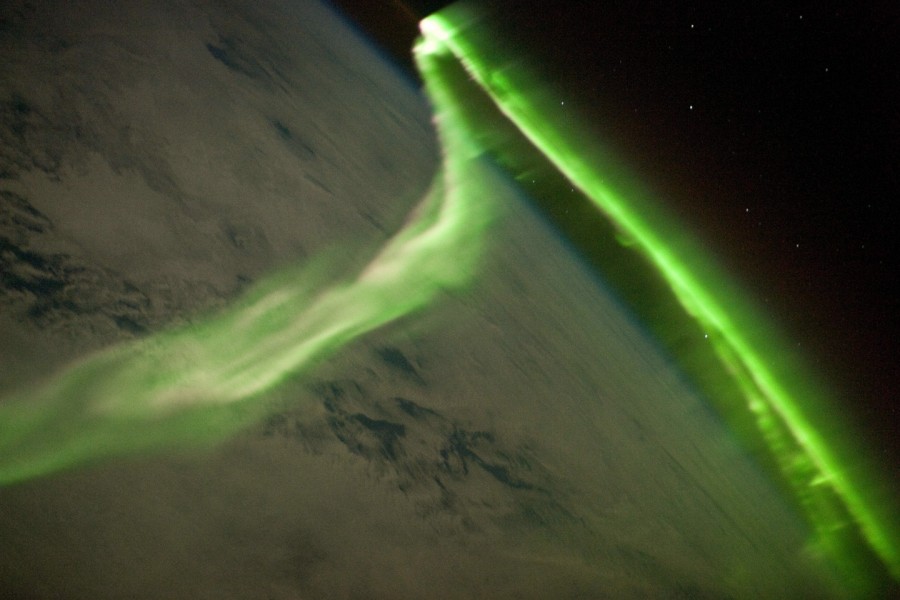
Looking at it from space, you can see that it's going on very high up in the atmosphere . . .


. . . and, in fact, that the Earth's magnetic field direct the charged particles from the solar wind to form rings around the poles (in this case, the South pole - the Aurora Australis).


The Aurora is caused when charged particles strike oxygen and nitrogen in the magnetosphere of the Earth's upper atmosphere. The molecules don't zoom around in those dancing curtains. It's different areas being struck at different times - like the light from a torch moves around when you point the torch in different directions.

What happens is ionization, or excitation of an electron - the same mechanism, but without enough energy to actually kick the electron free! Two charged particles from the Sun strike, say, two nitrogen atoms. One loses its electron altogether - and becomes an ion, one of the "99%". The other's electron gets "excited", into a higher energy state, but doesn't actually lose the electron. Later, the nitrogen ion finds an electron (maybe the one it had before, maybe another) to recombine with. This releases energy in the form of blue light. The other nitrogen atom's electron also falls back into a lower-energy state, releasing red light. (This process is described here.)

The oddness of ions doesn't stop there. Our lecturer gave us the example of a gyroscope: that when you push it forwards, it will move left or right; and charged particles can behave in this counterintuitive way, too. (We write about parallel and perpendicular vectors quite a lot in Astrophysical Plasmas - and, if you don't mind, I'm not going to go into that here, for I may well make a fool of myself.)

I mentioned earlier that the properties change and that magnetic fields have an effect on them. Ions in a magnetic field will gyrate as if they are sliding along a spring: round and round (in opposite ways depending on their charge!), and along, sometimes at right angles to forces acting on them. And sometimes they will reach a point in the magnetic field where they are "mirrored" - it is as if they hit a brick wall and are bounced straight back in the other direction.

And this is what helps create the van Allen belts around our little blue planet.


The van Allen belts, although - like the Earth's upper atmosphere - help protect us from solar radiation, are dangerous areas spacecraft have to watch out for. They are lobes of ions from the solar wind and our own atmosphere that are held in place by the Earth's magnetic fields. Some ions travel along in a banana-shaped object from the North Pole to the South, and vice versa - because when they stray too near the pole, the Earth's magnetic field lines become closer and closer together, and eventually this causes the "mirroring" of the particle - and it will zoom back off in the banana-shaped orbit. It's a bit like a skateboarder on one of those amazing curved platforms in the park, who doesn't go quite fast enough to get to the top and rushes back down again. He speeds up as he reaches the bottom and zooms his way back up the other end - but slows again towards the top. It's a constant motion, like a pendulum; potential and kinetic energy swap places again and again as the particle goes back and forth.

Charges make particles do very strange things.

Wednesday, 14 September 2011

Why do stars live in galaxies?

Coma Cluster from SDSS

This post is dedicated to David Allen Green, who asked me after seeing my PubSci talk why the Universe is full of galaxies - stars living in "cities" - rather than stars being evenly spread around, so the Universe is one big galaxy.

People often remark that the Big Bang sounds like an explosion, or is described as an explosion - and that is a violent, chaotic, destructive event, so why did it produce so much order? I have written about the Big Bang itself in more detail here. David knew this was not the case. His question is, in more scientific terms, this: if it produced so much order, and everything expanded - why did it expand with some areas being denser than others?

I'm not going to answer in the traditional way a scientist would expect. I have a tendency to answer things by telling the story in the opposite order from the traditional way. Rather than starting with the Big Bang, I'm going to start with stars.

The Big Bang did not emit stars. It did not even emit atoms. All this stuff came later - when things had cooled and been able to clump. Paradoxically, a star cannot form from hot gas, only cold, because the atoms (or molecules, or ionised atoms and electrons) of a hot gas or plasma are whizzing around too fast to be able to stick together and condense.

So, how can gas cool down? There not being fridges readily available in outer space, it basically needs to be shielded from radiation. This happens in dust clouds. We can't see the centre of our own Milky Way Galaxy because of all the dust in the way. Longer wavelength radiation can get through a lot of it, but not optical (visible light). Where the dust or gas is thick enough, it can cool. And that's when it gets affected by gravity. It contracts.

Star formation typically occurs in clumps, turning the whole area apparently blue. Take a look at these two galaxies and you'll see where the star formation is occurring:


In the spiral galaxy (left), the stars are moving in the same direction. In fact, they move into and out of dense areas, rather like cars moving into and out of traffic jams. This allows regular shock waves to pass through gas clouds, triggering their gravitational collapse and setting off star formation. In the elliptical, on the other hand, each star is going on its own route (see here - click the arrow on the right - for some rather silly star orbits which still remain stable, like a ball falling back to the Earth after being thrown upwards). This leads to the gas being in pretty much a mess, too. There's nowhere it can comfortably clump and cool without being disturbed for a while. Indeed there are no gas clouds left - an elliptical is known for having used up all its gas and having no fuel left. (There is some, but it is too hot and thinly spread to form stars.)

When stars do form, they often start in clusters like the Pleiades:

Digitised Sky Survey; Wiki

The nearest area to us where star formation like this is occurring now is in Orion's Belt. Next time you see the familiar hunter and those three stars lined up, you can relish the knowledge that although it looks dark around them, there's a churning gas cloud there and a great deal going on inside it - APOD has a gorgeous picture collection here.

Star formation stops in the cluster once the stellar wind from the young stars blows off the rest of the gas; we know the Pleiades are young because there is still a lot of gas surrounding them. Due to the gravity of stars in their local neighbourhoods, these young clusters then tend to drift apart. While in Boston I heard one theory that we may have captured some of our comets and even planets from our sister stars in the Sun's infancy. It was an odd talk . . .

Anyway - this was not the question, but I hope it demonstrates that star formation is not straightforward, and that things need to happen to get it going. I suppose one could say space needs to settle down and get ready.

It does demonstrate why stars don't live outside galaxies: basically, they need to form from gas clouds, and any self-respecting gas cloud that happens to collapse in space won't just generate one star at a time - it'll generate lots! The closest we can get to these is an irregular galaxy. These are clumps of star formation without a local supermassive black hole, and without a defined structure such as spiral or elliptical. They are also far smaller than the big monster we live in and the sort the Zoo has been studying. (This is why Richard's project is so exciting from a purely scientific as well as a citizen science point of view - well, duh, if it wasn't good science, it wouldn't be good citizen science either. But you know what I mean. He has already found that irregular galaxies are much more starforming even than beautiful blue spirals.)

Irregular galaxy from SDSS

So, stars form when gas clouds collapse. And a good thing too, or we wouldn't be here - not only does the Sun give us light and heat and keep the Earth in a stable orbit, but it's nuclear fusion in stars that creates heavy enough atoms and molecules to form rocks and iron and organic molecules and water and so on that are needed to create life. (As Carl Sagan put it in Pale Blue Dot, it's funny that we consider this the anthropic principle when it might just as well be called "the lithic principle", that the Universe was primed to create rocks, too.)

But why should there be clouds of gas in the first place? If the Big Bang sent everything out in its own direction, and the force of the explosion was equal, sending everything in a sphere (assuming there are three dimensions - in any case, sending equal quantities of everything in equal directions) - then everything should be the same space apart.

Picture a given area of atoms, say of hydrogen. Each is the same weight and has the same gravity. Each is equally spaced from all the others. Each is pulling on the ones around it - so each feels a force from all of its neighbours in every direction. Like a tug of war whose sides are entirely evenly matched, nothing goes anywhere.

But the Universe did not expand quite evenly. Its evenness - its homogeneity - is very, very nearly complete. Especially after inflation. When we look back at the time before any atom was cool enough to get near another, the differences were less than one part in ten thousand.

That time is called "the dark ages" and it's the limit of how far back we can see. There's something in the way. And that's another sort of cloud - or to be exact, a plasma. A plasma is a seething mass of ionised atoms and their electrons - atoms whose electrons have been torn off. (There's probably no net electric charge, since for every negative electron zooming around, there's a positively charged atom somewhere.) The Sun is a plasma. And the one at the edge of the visible Universe is called the Cosmic Microwave Background.

We can't see through it because its edge marks the end of a time in the Universe when it was so hot that light couldn't get through it. (Recall that as you look deep into space, you look back in time. When we look at the Cosmic Microwave Background, we look at a time over 13 billion years ago. When you look at the Sun, you look at a moment 8 minutes ago - and hurt your eyes, incidentally, so I don't recommend that.)

Space was so hot and dense then that whenever a photon of light went anywhere, it promptly collided with an atom or an electron and was sent off elsewhere. It would have been like looking through a thick cloud - or, indeed, the Sun itself, where the same thing happens. (This is why the light that shines down on us is millions of years old. It took that long to escape.) But once the Universe had cooled enough, electrons were able to bind with protons and neutrons, to form neutral atoms. At that point light could get through. We cannot look back any further than that boundary; we have to look at the rest of the Universe and work out what happened before that point.

The COBE satellite, which launched in 1989, made a discovery about the Cosmic Microwave Background that explained our existence: some parts of it were hotter than others. Just a bit. And you've read earlier what hot particles do. They whizz around, they bounce off each other - they don't clump together as easily as cold ones. So everywhere in the Cosmic Microwave Background that was a tiny bit cooler got that tiny bit denser.

And that's where gravity set in. That's where the clouds of hydrogen and helium started to fall together. I have yet to read an astronomy book that doesn't jokingly relate this to capitalism - that the rich get richer and the poor get poorer - in other words, any area with just a bit of density will, over time, attract more and more material. And, conversely, the empty areas get empty. Marcus Chown has written a whole book about how the Cosmic Microwave Background was discovered, and the tiny, tiny fluctuations in it - Afterglow of Creation.

(I once asked Chris if heat alone could account for the fluctuations. Things were very hot then, and as in Brownian motion - the random motion of water molecules that kicked a pollen grain around and therefore allowed Einstein to demonstrate that atoms did exist, and measure their size - there would be a certain amount of randomness: particles moving now one way, now another, like waves on a lake. Would that alone be enough to account for the fluctuations? Chris said no. They were caused by something more, some other irregularity in the Big Bang. I don't know what.)

Stars and galaxies soon formed; the furthest - that is, the earliest we can find - you can read about here. Look at the Hubble Deep Field, a region of space containing vast numbers of very early galaxies, and you'd think that all that uniformity you'd expect from the Big Bang hadn't happened at all.

NASA; Wiki

And yet . . . David was also not wrong. Not at all.

Before writing this blog post, I dug out Horizons of Cosmology by Joseph Silk, which Astronomy Now had kindly sent me in exchange for a review, and which prompted this blog post. I thought it would probably remind me of a few useful things, and it did.

Galaxies live in clusters. Our own Milky Way does - and it is steadily zooming towards a larger cluster, even while the Milky Way and Andromeda circle each other, ready to merge. And clusters live in superclusters. Superclusters are the largest objects in the Universe. They are like bright filaments through the blackness of space. An accident and emergency doctor and dedicated galaxy classifier once remarked to me that they look remarkably like neurones in the brain.

NASA and Universe Today

Silk describes some of the deep sky surveys, the search to understand inflation and the minute differences in temperature that seeded the unevenness, and goes on:
"The larger the region, the more the universe approaches homogeneity. On average, the universe is completely homogenous. There is no dense centre, no rarified boundary region. Yet everywhere there are galaxies. In some regions, there are slightly more than the average, and in others, slightly fewer. We describe these variations as fluctuations in the average density of the Universe. Some are positive, some are negative.

When we measure the strength of the density fluctuations, in other words, we find that the overdensity or underdensity is smaller with increasing scale . . ."
Float away from our world, and look down at it: it will seem huge. Further, and it will shrink, and so too will the Sun, melding into our local group of stars. Later will come our Galaxy's spiral arm, then the galaxy itself. Then the cluster. Then strings of superclusters . . . the further you go, the more you see, the more similarity you will see. It's like when you break the world down to see atoms, and then electrons and quarks. Nature is simple. The Universe is vast. And I love it.

(You may notice I have created a silly new hashtag called Fizzicks Questions. I hope to answer more - and tell you about some good answers I have been given to my own astronomy questions - in the future.)

Sunday, 13 March 2011

Wandering stars and 24/7

[The] collection of seven gods, seven days, and seven worlds - the Sun, the Moon, and the five wandering planets - entered the perceptions of people everywhere. The number seven began to acquire supernatural connotations. There were seven "heavens", the seven transparent spherical shells, centred on the Earth, that were imagined to make the worlds move. The outermost - the seventh heaven - is where the "fixed" stars were imagined to reside. There are Seven Days of Creation (if we include God's day of rest), seven orifices to the head, seven virtues, seven deadly sins, seven evil demons in Sumerian myth, seven vowels in the Greek alphabet (each affiliated with a planetary god), Seven Governors of Destiny according to the Hermetists, Seven Great Books of Manichaeism, Seven Sacraments, Seven Sages of Ancient Greece, and seven alchemical "bodies" (gold, silver, mercury, lead, tin, and copper - gold still associated with the Sun, silver with the Moon, iron with Mars, etc.). The seventh son of a seventh son is endowed with supernatural powers. Seven is a "lucky" number. In the New Testament's Book of Revelations, seven seals on a scroll are opened, seven trumpets are sounded, seven bowls are filled. St Augustine obscurely argued that for the mystic importance of seven on the grounds that three "is the first whole number that is odd" (what about one?), "four is the first that is even" (what about two?), and "of these . . . seven is composed. And so on. Even in our time these associations linger.

The existence even of the four satellites of Jupiter that Galileo discovered - hardly planets - was disbelieved on the grounds that it challenged the precedence of the number seven. As acceptance of the Copernican system grew, the Earth was added to the list of planets, and the Sun and Moon were removed. Thus, there seemed to be only six planets (Mercury, Venus, Earth, Mars, Jupiter, and Saturn). So learned academic arguments were invented showing why there had to be six. For example, six is the first "perfect" number, equal to the sum of its divisors (1 + 2 + 3). Q.E.D. And anyway, there were only six days of creation, not seven. People found ways to accommodate from seven planets to six . . .
- Carl Sagan, "Pale Blue Dot", 1994
And that was before Harry Potter and the seven Horcruxes, not to mention seven Weasley siblings, and George R R Martin's "A Song of Ice and Fire" series in which a major religion is centred on seven gods and whose holy book is called "The Seven-Pointed Star". Not to mention seven colours in a rainbow. If you can take a really good photograph of one, and distinguish blue from violet in colour, and the two of them each take up as much room as any of the other colours, I'd love to see it - I honestly have yet to see a rainbow like that (much as I like blue and indigo).

Anyway, doing some totally unrelated research, I stumbled upon the Babylonians. I knew they were responsible for 360º , 60 seconds a minute and 60 minutes an hour, and probably for popularising algebra (I recommend Marcus de Sautoy's "The Story of Maths"!), and I knew they were very meticulous astronomers, but I hadn't previously come across the intricacy of their days of the week system.

It was in a book I was reading, and not one recently published, so being an incorrigible skeptic I had to go online to get an independent corroboration. (No, that's honestly nothing to do with the trolls on the Guardian comments pages accusing me of "getting all my information from the Guardian" when in fact I was getting most of it from the Sense About Science website! Although one does wonder what they were doing there if they so despise it . . .) It was quite a trawl. I found plenty of sources confirming that each of the ancient "planets" (in those days, "wandering stars" - stars that did not move across the sky at the same speed as other stars) had its own weekday, such as here, here and here. And I ended up reading part of an interesting book about the origins of weekdays. Following the French Revolution, a ten day week was imposed - but it just didn't work.

Ancient Inventions even claims that "when the Babylonians invented the seven-day week, they anticipated the findings of 20th century biologists. It has recently been discovered that the human body is governed by a seven-day biorhythm, which is detectable from small variations in blood pressue and heartbeat as well as response to infection and even organ transplants. The same biorhythm affects other life-forms, even simple organisms such as bacteria."

I'm not entirely sure I buy this. The only source it cites is a book (which may or may not be correct but I am not going to go and ask my library for before I post this!), but furthermore their wording makes no differentiation between cause and effect. The shells of some coastal critters or other that grew near towns during the Industrial Revolution show layers of growth like tree rings - and every seventh layer is palest, i.e. the ones they grew on Sunday when the factory was shut. (Source: memory of a lecture in my degree. Take with pinch of salt to suit your taste, but I have a nerdy memory for random facts.) Besides, human timekeeping is not to 24 hours - it's longer. This is not even a relic of a past when the Earth was spinning faster, or it would be shorter. And in any case, seven is not a universal special number - in China, for instance, the "lucky number" is eight.

Still, it could be true. I'm guessing the bacteria in question are influenced by the same things humans are influenced by - pollution, for instance, probably occurs at different timescales and intensities at weekends. But you never know.

So, in attempting to research one thing, I came across the Babylonians and their planetary systems and timekeeping, and in attempting to research that, I came across a lot of other things, and I hastily stopped there. Research is great fun, though! And by the way, it isn't something I have a clue how to do academically. So don't feel unqualified to go looking things up.

Sorry, but after all that, the best pages I have to show you are Wikipedia: Planetary Hours and Week-Day Names. The latter at least has obviously had a lot of source verification put into it. (Wiki can actually be very strict - Rick Nowell on the Galaxy Zoo Forum found that creating the "Peas" page was a huge task due to the very tight sourcing rules. My research of the entire project - which was used, for example, in selecting names to go in the acknowledgements on the papers - was disallowed because it was a blog post.)

Anyway, to summarise on the ancient deities to whom the planets were assigned. Sunday of course was the Sun, Monday the Moon - those are obvious. Tuesday is Mars. In Latin languages this is more obvious - for example, in Spanish (a handy reference, since it's similar to Latin and I speak it), Martes. English is based on the Anglo-Saxon/German equivalent, known as Tiw, another god of war. Wednesday, or Miercoles in Spanish, is Mercury (in German, Mittwoch, or midweek - there is an older connection to Woden or Odin). Thursday is Thor or Jupiter (Jueves in Spanish). Friday, Viernes, is Venus, or Freitag or Freya's day. Saturday invariably sounds like Sabbath or Saturn. All well and good, you probably knew some or all of that. But why do they come in that order?

Since all these "heavenly bodies" moved around in their "heavenly shells", they each crossed the background of apparently static stars and made a complete circuit of the heavens. It is easy to instinctively reject this as the Sun and Moon surely do that every 24 hours, except that that's a circuit of the sky - not the entire background of stars, for example starting in the constellation Taurus (to the right of Orion) and all the way around until they get back again. From that point of view they do it in a funny order: the Moon is fastest, then Mercury, then Venus, then the Sun, then Mars, then Jupiter, then Saturn. All right, some of those are in the order in which the planets are really spaced from the Sun. But not all.

But the weekdays don't follow that, or they'd go in the order of Monday, Wednesday, Friday, Sunday, Tuesday, Thursday, Saturday. And this is where the 24 hour timetable comes in.

Each "hour" is supposedly "controlled" by a planet or deity. For example, midnight on Monday is controlled by the Moon. Then after that we go to Saturn - the "god" who takes the longest time to cross the entire heavens (or ecliptic). Then Jupiter, the second-longest. Then Mars, and so on. The table at the bottom of this section shows the system, as does this table I wrote myself to see if it worked before I found that one:
. . . and so on. (The page ran out.)

Of course, one website - I now can't remember which - threw a spanner in the works by claiming that the Babylonians only had 12 hours, which stops the system working. Sources seem to differ as to whether or not they bought into astrology and predictions. On the one hand, one cites as 11th century writer as claiming that "predictions are a new science", and on the other, we've got this really detailed and prescriptive table of what all the hours are supposed to mean - for example, you should ask a lady out on a date during one of Venus's hours. (Detailed and prescriptive is also exactly how I would describe the ridiculously large array of different labels on homeopathic products, all of which basically just contain sugar.) All I can say is, if you ask me on a date at 6am on a Monday morning, I will not rush to my astrological chart and swoon obediently because of some arbitrary rule, I will wonder (unless we have been up all night talking for example) what the heck is going on!

Sadly, most of the websites I found, whilst trying to make some sense of this fascinating history of people who made such detailed records, were trashy horoscope sites, so do please indulge me and let me make a little bit of fun. Some of the discoveries ancient people made, as well as the time and care they took with compiling massive records, are really incredible achievements. Incidentally, just a few of those are what I'll be talking about at Cardiff Skeptics on Monday next week - I hope to see some of you then.

Friday, 18 February 2011

Duck! The sun's throwing bits of itself around!

It's pelting down with rain outside and Cassie the tortoiseshell fluffball is squeaking disconsolately at the cat flap, not wanting to go out in that. I'm irked, too, but for different reasons. There might be an aurora, you see, but there's not a chance of seeing it in this weather. Grrrrrrrrrrrrrr.

On Monday this week, the Sun let off a huge solar flare. That's a massive explosion on its surface. Surprising as it may sound, the Sun has a magnetic field, just as the Earth does - but it's not static. Sometimes, two magnetic fields which previously weren't lined up can suddenly realign themselves, releasing a huge amount of energy. Matter on the surface of the Sun can suddenly be accelerated to close to the speed of light. If the event is powerful enough, this gives rise to a coronal mass ejection - a great burst of matter heading out of the Sun.

Now, at 93 million miles away from the Sun and comparatively extremely small, it's not often the Earth gets in the way of coronal mass ejections. But occasionally we do - and this is just what's happened this week. The matter, of course, does not travel at light speed, so we get a few days' warning.

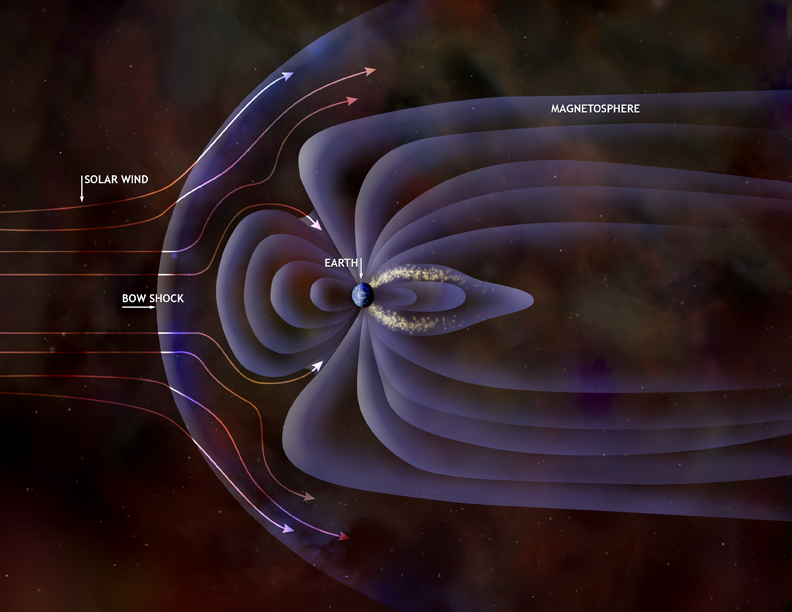
What happens when such a thing hits the Earth? Don't worry. Nothing lethal. Because all these particles are charged, they're affected by magnetic fields - and Earth has one of those too. This is what happens:

(From Chandra.)

Incidentally, Jupiter and Saturn too have spectacular magnetic fields and aurorae - indeed, Saturn's magnetic field might be responsible for all kinds of odd effects among its moons.

Although Earth's magnetic field directs the charged particles away from most of the Earth, it directs them towards the poles. But those don't suffer mass destruction. Rather, they shimmer with the Northern Lights, or the Aurora Boreolis.

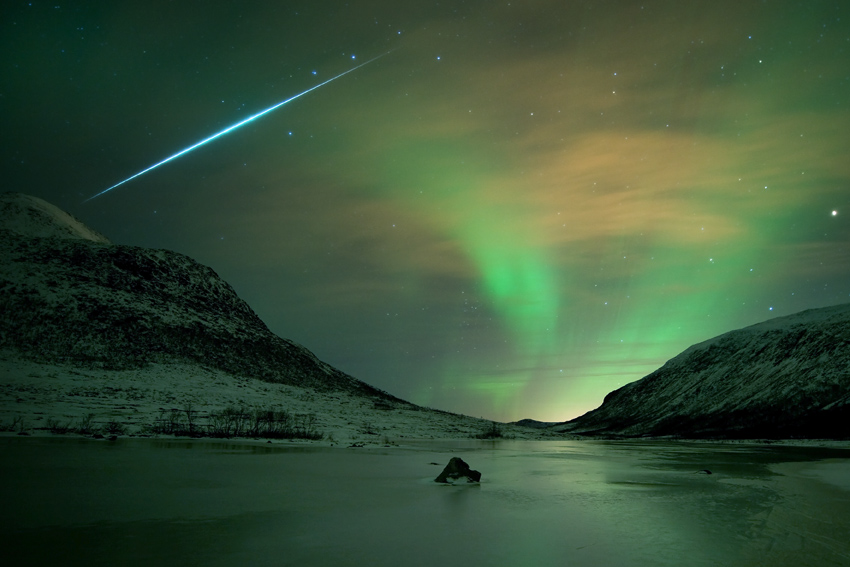
The Aurora over North Norway, from APOD.

The Aurora from above, photographed by astronauts aboard the Interntional Space Station. APOD.

I went to Norway when I was 20 but have never seen the aurora, and that's one of the things I really long to do. It annoyed me that Philip Pullman turned it into something supernatural in "Northern Lights", but he certainly expressed a silent, throat-tightening beauty about it that made me want to go and see it even more. They move around - I don't know how fast. The green light is from excited oxygen atoms. "Excited", in this case, means that one or more electrons have jumped up to a higher energy state (you can think of that like jumping up to a higher electron shell). More rarely, it emits red light. Nitrogen, too, glows in different colours - blue and red. There's a nice little description of the chemistry here.

A coronal mass ejection is not needed to produce the aurora - it occurs anyway because of the solar wind. The Sun is in fact hurling ionised matter at us all the time. A coronal mass ejection is just a great glut in one go. This can result in the "northern lights" being seen much further south than usual - it seems they have already been seen in Northern Ireland.

The problem with coronal mass ejections is that they can disrupt communications. In November 2003 there was a particularly large one, which was not only hazardous for space observatories such as SOHO but also for aircraft. There's a good write-up in the introduction Dr Stuart Clark's "The Sun Kings" about the things that took place then: radios that aided expeditions, forest firefighters, marine emergency calls and the like became unreliable; aircraft had to fly below 25,000 feet and at a lower latitude than north Scotland; Sweden suffered blackouts; nuclear power plants in America reduced their power in case of damage. Compasses, too, no longer knew which way was north and swung about wildly. As luck would have it, Cassini, ten times further away, got a bashing too!

Infuriatingly, I missed this whole thing. I was in Granada, southern Spain, at the time, on a year abroad for my degree, and only using the Internet in cafes every few days (Galaxy Zoo did not then exist and I didn't even hear of Facebook for another few years). I think it must have been around Halloween - I recall walking round Granada with a friend terrified of masks that night, and listening to her worries about love and commitment. Then the 2006 solar eclipse happened when I went back to Spain for a TEFL course - we would only have seen a partial eclipse, but I missed it then, too.

The most spectacular coronal mass ejection to hit Earth on record is the one that occurred in 1859 - again, as detailed in Stuart Clark's book. In that one, auroras appeared, it seems, all over the planet. You could read a book at night - if you weren't busy being terrified of the end of the world, as it seems many people were. Hilariously, however, there were so many charged particles in the air that this happened:
Boston telegraph operator (to Portland operator): "Please cut off your battery [power source] entirely for fifteen minutes."
Portland operator: "Will do so. It is now disconnected."
Boston: "Mine is disconnected, and we are working with the auroral current. How do you receive my writing?"
Portland: "Better than with our batteries on. - Current comes and goes gradually."
Boston: "My current is very strong at times, and we can work better without the batteries, as the aurora seems to neutralize and augment our batteries alternately, making current too strong at times for our relay magnets. Suppose we work without batteries while we are affected by this trouble."
Portland: "Very well. Shall I go ahead with business?"
Boston: "Yes. Go ahead."
I first heard of this conversation in an Astrofest lecture - it was especially amusing because the lecturer showed us the code used first! In any case, it's rather like an msn conversation with the Internet switched off (so if anyone tells you that the Internet's a new and unnatural thing, remind them about telegrams).

Coronal mass ejections do not appear entirely randomly. The Sun has a cycle of its own: an eleven-year period that alternates between a "quiet" time of mostly steady shining, and a less-quiet time of more sunspots and flares. These changes correspond to changes in solar output - in other words, how much heat and light we get. There have been efforts to link this changing activity with climate change, but the trends are weak - if that. In the short term, it does work to some extent - there have been arguments for decades over whether you can correlate solar activity with the price of wheat. And it is possible that a few decades of warmth or chill (the Little Ice Age; the time Britons grew grapes, etc.) are due to changes in solar activity - but they were not global events but local ones, suggesting that conditions on the Earth itself, just like now, were the driving forces in those cases.

Going back to Stuart Clark again (as you can see, I must finish his book - I'm the dreadful kind of person who starts six books at once and falls asleep while reading them, awarding myself an ever-more-toppling booklist!), he has this to say about studying the Sun and its eleven-year cycle:
Like a heart, the Sun pulsates. This is not a visible movement but rather a gradual buildup in strength and subsequent weakening of the giant magnetic bubble that emanates from within the Sun and surrounds all the planets. As befits a celestial body of some 4.6 billion years in age, each one of these magnetic heartbeats takes a leisurely eleven years, or thereabouts, to complete.

So, in the average career of a scientist, he or she can expect to see this happen four times. This makes understanding the Sun as difficult as a biologist trying to deduce the life cycle of an unknown creature by observing it just long enough to witness four beats of its heart. As a result, solar astronomy is a multigenerational science. Each new cohort works to build a finger legacy of observations for those yet to come.
In any case, things are looking interesting. National Geographic says this is the largest flare for some time. Aviation Week has some mind-boggling pictures of what our local star is up to right now:


Pete Lawrence got an astonishing photograph of the flare. You can also watch a quick clip here on the BBC. And check out AuroraWatch to see if it might be worth nipping outdoors . . . please let me know if you see anything!

PS And if you are really into solar storms, you can now join Solar Stormwatch to map them properly. It's concentrating on past ones - but Zooites work through things very quickly, so you never know, soon enough you may be working on them as they happen!