Showing posts with label Conservation and Wildlife. Show all posts

Sunday, 30 January 2011

England's forests for sale

I declare an interest: I love trees. I don't seem to find that many of them these days, especially not in the same place - and they're often found put there on purpose, or the space around them adapted to our tastes. Here's a little collection, though. Three are in a public woodland, Idless Woods in Cornwall. The others are from Kew Gardens, my old university campus, and a patch of ground near where I live in Wales . . .


This country was not always like that. Once upon a time, it was covered with forests. That was the natural thing. (Is it just me or is our hero in many fairy tales a poor woodcutter?) Have you heard about succession? It was a beautiful little concept I learnt of in first year A level Biology - take a barren area, perhaps rocky, or a beach, with no fertile soil. Start with the faintest sprinkling of a few tiny, hardy plants. As they drive their roots into the ground, they create airholes, a good soil texture (not with particles so large that the water all drains away, such as pure sand, or so small that it clogs and floods like clay), fix nutrients, and generally set up a complex ecosystem. Plants and bacteria and animals - first tiny ones, and later larger ones - find their homes there.

A forest, if I understand correctly, is pretty much the last stage of that. Trees reach for the light. When the rain hammers down from the sky, the trees' leaves break its fall, softening the raindrops' impact on the soil and preventing if from being washed away. Moss grows on trees. Dead leaves provide nutrients for next year. When a tree dies, its dead wood is home to hundreds of creatures. A rainforest is a symbol of perfect recycling and order - evaporation from the plants even often control the weather, and set off predictable and regular cloudbursts - a temperate forest is certainly less dramatic, but the same general processes go on.

But what such a system is not - like so many things ecological - is speedy. A tree takes hundreds of years to grow. Some forest ecosystems have been suggested to be adapted to forest fires. But a wipeout of an area of trees in a forest not so adapted would take years and years to recover. Vast as it may seem, and remote, an ecosystem is a delicate thing.

Gradually, forests were cut or burnt back to make way for farms, and then towns. Gradually, more and more of what is now the UK was invaded by one horde after another, and land became something owned by humans, to do with as they liked. Of course, so many animals have ways of "owning" their territory - by patrolling and spraying it, and chasing off competitors; and I have the feeling from my faraway biology studies there are a great many plant species that barely survive or have been driven to extinction by relentless chomping or wanton destruction by local critters. But ecosystems have had time to adapt to that. No animal, to the best of my knowledge, has the desire or the means to eliminate all plants that grow around it. I think the only time this happens is when a fairly large animal is tethered or enclosed in a small space, and tramples all the grass.

Not that humans generally have, either. We all love to see a bit of greenness. When I was 20 I visited Norway, and my guidebook was pretty exact on how forests were regarded there. (I cannot recommend enough a visit to Bergen on the west coast, and a trek round the forests and up the mountains that surround it. That was one of the most magical days of my life.) A walk in the woods was supposed to cure all stress and misery. There was an indestructable tradition of collective ownership - I think it even had a name (if only I knew where that guidebook was now!) - and of the right of all people to walk through the woods, pretty much anywhere. As long as you were further away than 200m from the nearest fence around a property, you could camp anywhere, too. It's possible that the book was exaggerating or romanticising madly, and I was young and impressionable then; but as I walked through Norwegian woods and met others doing likewise, I felt a sense of almost sacredness, of a collective treasure that nobody could be denied.

This all sounds very woolly and hard to pin down in today's world. Everything has to be owned by someone, and to have some utilitarian, measurable, monetary purpose. To today's government, collective ownership of what forests England has left is something that can be dispensed with. "We're going to make billions of pounds this way! We need to reduce the deficit! Oh, and yes of course they'll be sold to really responsible owners, who'll let you all still enjoy them. In fact, private ownership is a guarantee of improvement. They will be managed more efficiently this way." Or something like that.

I say England, because Wales is keeping out of it for now (I don't know what is going to happen to us, but my hopes are not high) and here is the map of the forests that are up for sale:
(Source)

Just who are these responsible owners? "The controversial decision will pave the way for a huge expansion in the number of Center Parcs-style holiday villages, golf courses, adventure sites and commercial logging operations throughout Britain as land is sold to private companies," reports the Telegraph.

A spokesman for David Cameron claims that "We are not going to sell off our heritage forests to the highest bidder, we are not going to remove public access to forests – there will be strict rules in place to prevent that happening. There is a consultation. We are going to have that consultation and listen to people's views and then come to some conclusions." I'm sorry, spokesman, but I simply don't believe you. Once someone has bought a forest, and it's their property, how are you going to stop them then cutting the whole thing down? You couldn't. And money would have exchanged hands; they'd be your mate. You wouldn't want to upset them. That's the way you people do things.

The government claim the issue is not private versus public ownership, while a large segment of the public argue that it is. Typically, there are the usual howls about how some woods under public ownership haven't managed them perfectly, and therefore privatisation necessarily will. Funny how you never hear the opposite being suggested in cases where private companies do a bad job - apparently, competition is the cure-all to that . . .

(As an aside, this "consultation" about "how we would like our forests sold" is exactly the same as what Labour were fobbing us off with regarding our National Health Service, when they were closing Accident and Emergency departments in the name of efficiency. They designed a survey which asked people all about choice, and then concluded that the public wanted choice. Someone wrote to the Independent to remark that the survey would have failed as A level Psychology coursework. It was like asking, "Do you like tea or coffee?", ignoring those who said "orange juice", and then reporting triumphantly, "Buyers exclusively like hot drinks! Let's dispense with fruit juice in the name of consumer choice!")

OK, I'm stereotyping my head off here, but as another aside, trust them to be going for golf courses. I'd love to see a library, youth club or community centre being the thing to replace a forest. But no, again, if anyone benefits from this sell-off, it will be the ultra-wealthy few.

Our forests are more than pretty trees, more than a nice walk that doesn't get the economy going. They're lifeblood of the biosphere. They're what keeps our soil good, and they help prevent floods. They're the precious remaining homes of millions of innocent creatures. They're a place to keep people sane amidst the stress of a noisy, utilitarian world. They release oxygen and soak up carbon dioxide, maintaining the delicate balance of our atmosphere. They're a tiny bit of our world that has every right to remain. Too much will die if it's lost.

I suppose none of what I've said here can sway anyone who thinks only of money. But I know I'm not alone. About 300,000 people have now signed 38 Degrees's Save Our Forests petition. The National Trust and the Woodland Trust have both made their views clear. I feel horribly conscious that my science on this topic is rusty. And that we'll have difficulty phrasing our arguments in a capitalist, government-impressing, management-speak way. But I don't believe that invalidates them.

It's well summed up here in the Independent, and by a commenter on the BBC website: "Woodland does not 'belong' to people. We are stewards who safeguard it for the benefit of all creatures. The idea of our remaining precious public access woodland being sold off to the super rich to barr families who enjoy being in the woods is totally unthinkable. This government is taking reckless, far-reaching decisions, which will impact on many generations to come. Once the woodland is sold off that's it - there is no going back."

You can catch up with all the media stories here on 38 Degrees - there's quite a bit of history, too, especially on the subject of how the Forestry Commission was set up after the wreck of the First World War. People knew what damage was then. They should bear in mind what damage is now. Modern society needed to progress to a certain extent to realise that human beings should not be put up for sale - perhaps there are other things, and forests fall into that category, that should receive similar exemption.

If you agree, please sign that petition and tell everyone you know. It's particularly interesting that whenever I see it mentioned, or mention it myself, along comes someone else who turns out not to have known and is aghast. Parliament will be making the decision very soon - a lot of people are making their voice known one way or another these days; please add yours!

Update, 12th February 2011: The bill did go through - but now they're rethinking. So there's still time to act.

Update, 17th February: LOOK!!!!!

Friday, 24 July 2009

Shell, grass, articles, and rootless solutions

I recently applied for a journalism job which required submitting a 400-word environmental article. I didn't get the job, so I'm going to put the article here instead, as I discovered something very sad - and well worth finding out - whilst researching it.

Can science put down roots in an old problem?

“We can't solve problems by using the same kind of thinking we used when we created them,” Albert Einstein is reported to have said many years ago. Like relativity, some statements remain up to date whatever the year.

Upon Peter Voser’s rise to CEO of Shell last week, Amnesty International released a 141-page report on the many-decades-old problem of oil spills and other pollution in the Niger Delta. The report suggests no particular remediation method, but points to successful technology in the Trans-Alaska Pipeline and Shell’s repeated failure to meet governmental deadlines to cease gas flaring. Shell refuted Amnesty’s prior accusations of human rights violations. Can science help?

J. N. Okereke and two other scientists from Nigeria’s Federal University of Technology studied the ecological effects of oil spillage. Grasses, they found, invariably die altogether, while some fungi thrive, as do different species of bacteria from non-contaminated areas. They believe this is due to oxygen depletion from petroleum’s presence and from increased carbon in the soil. The soils were also more acidic after oil spills.


In 2002, a hopeful article appeared on at least four websites, claiming that indigenous plants were the solution. A non-government organisation (NGO), The Centre for Environmental Resources and Sustainable Ecosystems (CERASE), was piloting a new project in the community of Ogbogu.
Sheets of kenaf (Hibiscus Cannabinus), also used in paper production, act as absorbers of the oils. The perennial vetiver (Vetivera Zizanioides) removes contamination in the long term; it is a grass, but apparently very tolerant. Local people were encouraged to “make nurseries” for these two plants. Uzo Egbuche, CERASE’s director, stated that “this highly sustainable rural development approach will create multiple avenues for poverty alleviation.”

“We aim to promote the use of local resources and provide technical and funding support to individuals and groups,” says Shell’s website now. But there has been no mention of CERASE since early 2002. Later that year, Chijioke Evoh wrote in NigeriaWorld that NGOs suffer from corruption and a lack of transparency even while they appear to do more than governments whose influence is weakening.

Sadly, perhaps Amnesty International has the right approach; no science or creativity will solve this old problem until it can break free from the type of thinking and acting that produced it in the first place. Mothers may have to cook contaminated meals on burning oil leaks for some time yet.

Here is a picture from Amnesty International:

It was very difficult to find any scientific literature on the Niger Delta or its many environmental problems. If ever mentioned, it's usually in passing, along the lines of "renewable energy's not realistic, but in the meantime we really ought to build oil pipelines carefully - the Niger Delta ones keep exploding and killing people". Top Google hits include a moving article from the Independent almost a year ago, and a military report on the area's problems whose tone I thought fell somewhere between disapproving and dismissive.

The indigenous plants article which cropped up in at least 4 places - probably several more - was this one. It's true; I wasn't able to find any more references to the idea or the organisation after 2002. This is the article critical of NGOs. Prestigious online scientific journal places, such as ScienceDirect and arXiv, returned "no results" in their searches again and again. The Okereke et al paper is just under 3 pages long and quite basic (not to suggest they didn't work very hard, which they seem to have done). In short, infamous as this environmental problem is, it doesn't seem to be receiving much scientific attention.

So why on Earth did I choose to write about it for a job application? On show-what-I-can-do grounds, it may have been a mistake. But I never have been one for trendiness and worrying about "what's hot"; and I suspect there's a larger niche for "what's-also-important-but-merely-lacks-glamour" in journalism than a lot of editors realise. If you picked up some magazines you hadn't read before, you'd think each one was reporting half a dozen world-changing revolutions. Pick it up again a few times, and the cumulative effect becomes desperate, unfulfilling, and lame. (I recently had a conversation with a scientist about how ludicrously their discoveries get reported by some magazines - each one has to be blown out of proportion and then hastily forgotten.) I'd sooner go for something of real substance.

But deeper than that, the environment isn't about trendiness or new things that are "hot". The world is big and old. Large problems have filtered into large areas and won't be fixed-quick with some amazing new solution which you can forget about next week. To see people make an attempt to fix a problem, and then struggle to survive by making silly promises about how planting grasses will earn the locals money and education without explaining how (is there a market for them? who will buy them? where does the money come from?), is either another of these quick-fixes - or a sad story of a well-meant effort that was then choked off before it could get anywhere. To solve a problem, you have to study it first, and then - sorry, there's no way out of it - work hard. And stay where you are for a long time, running like Alice and the Red Queen all the while.

To download the Amnesty report, click here. It's over 100 pages but very informative.

The Niger Delta crisis is, at present, on the Amnesty website's front page. This is its page with more information, and how you can help.

Tuesday, 7 April 2009

If you were wondering, they're lorikeets at Paradise Park

This month, there is a 4 page spread in the Astronomy Now magazine about Galaxy Zoo 2. Sadly, it's not available online, but it's worth a read (you should be able to get it at some newsagents or supermarkets). It begins with the wonderful Carl Sagan quote: "Somewhere, something incredible is waiting to be discovered." We start off with the basics of galaxy classification and how Kevin and Chris turned our "problem" of too much data into the public project we now know and love. It then discusses the red spirals, switching-off of star formation and the effects of the environment, and goes on to "odd" features and whether perhaps the Hubble classification should be a continuum rather than discrete "E" and "S" classifications. There's a lot of information in the article, not all of which is on the forum yet. Tantalising hints again . . . !

There is a nice box about the work of one of our new astronomers, Ben Hoyle, and another box about how one zooaholic became addicted, with the following picture:

This is a huge cage named "Flight of the Rainbows" in a conservation zoo named Paradise Park in Hayle, Cornwall. I've been goodness knows how many times in over 20 years, and it never fails to produce that big daft grin on my face. The birds are lorikeets, and they are adorable! They live in a huge flock and scream to high heaven, and love perching on people. You can go and buy a little tub of glucose and cod liver oil for 50p and they'll come and sit on you and often shriek in your ear, climb in your hair, etc. When I was about 16, one of them got very attached to this particular jumper and spent a good hour or so climbing around in it. (Yes, they can be a bit messy, so take a spare shirt and a lot of tissue paper . . .) They have the most amazing tongues, like thick pipe-cleaners with a bit of grey-blue fluff on the end!
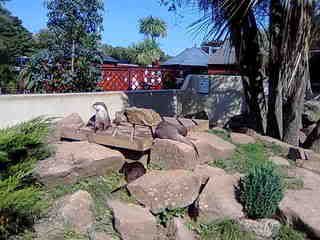
Paradise Park is also home to otters, pretty much my favourite wild animal, which used to be very endangered by miserable sadists hunting them (remember Tarka the Otter and Ring of Bright Water?):


Do you remember the red panda who escaped from his zoo in Birmingham? A couple of them live at Paradise Park, too. They have the sweetest faces, but don't turn them to the public very often. I got a shot of the most amazing tail, though . . .
(I knew my cat Cassie reminded me of something . . .)
One of their features is flying displays. There are birds of prey every day - I'll never forget watching a lanner falcon fly; my childhood memory supplies me with a speed of over 100 m.p.h. stated by the devoted keeper and demonstrator. Or their beloved old barn owl, Barnaby. Sometimes children in the audience can try on the glove and have the bird sit on their hand. The only problem is how devastating it is for little ones not to be chosen! More recently they've added demonstrations of parrots flying, and the stories about them - their natural habitats and behaviour, or their mistreatment (or well-meaning lack of luck) with their former owners. They've trained cockatoos to collect pound coins from visitors' hands. Believe me, it is well worth paying £1 to have a cockatoo come and pick it out of your hand with its beak!

There is also a play area called the Jungle Barn, a sweet little steam train (yes, I did go on it aged 26), a nice pub just outside the park (and they stamp your hand with a parrot or monkey so you can go back in again), a flamingo-filled garden, and a farm with goats and pigs. Again, you can buy a bag of food to feed them. (They get a set amount of food every day so presumably feed them whatever people don't buy.) Just before you get to the farm, there is a nice hot washbasin on the left, and a reminder to wash your hands after doing this. And on the right is a shed full of rodents - rabbits, chinchillas etc. The chinchillas have a long, long drainpipe spanning not only all around the shed, but out of the shed and into another little hutch across the path. You never know when a chinchilla might zoom above your head while you amble innocently along, perhaps laughing at the ginger pigs or the goat who ate a hole in your jacket pocket to get at the paper bag! They really zoom, so you can see they need the racing track. I dread to think what happens if two collide - CERN springs to mind - but I expect they hear each other's footsteps . . .

Anyway, it's a wonderful day out, and easy to find. It's also doing a great job with conservation. One of its projects is the World Parrot Trust. A third of all parrot species worldwide are threatened; I remember a heartbreaking statistic from when I was little, showing a beautiful bird with the label "Only 15 left". They're threatened both by the destruction of their habitat and by poaching. Birds are a good indicator of how the environment is doing generally; if they're flourishing, probably the plants and insects and other, less noticeable wildlife is, too. And on a more personable (but less fair or scientific) level, parrots are so intelligent and sweet! The World Parrot Trust is an international effort, with a great many projects under way. So if you ever happen to get a card or letter from me, it might well have a parrot or two for decoration - which will most probably have come from the Paradise Park shop!