You've probably noticed that Skeptics in the Pub invariably takes place in a city. For us rural oiks living at the end of the world - at least, until we create the Skeptical Nomadic Circus - that means a bit of travelling. We're not the only ones, though: I know people on Twitter whose work shifts clash with their local Skeptic evenings, for example.
My solution to both is to take a couple of days off work when you can, and travel to several events taking place in quick succession! You can find a list of all Skeptics in the Pub events on the bottom right of Simon Perry's website. Train tickets are cheap if booked well in advance, and you don't have to stay at an expensive hotel - youth hostels are fine in my experience, and more often than not a nice skeptic will happily put you up. You could of course combine all this with any Galaxy Zoo meet-up or other science events. And visit all these various places you've been planning to visit for years, and throw in the odd museum or restaurant or whatever takes your fancy. I actually love this. I enjoy travelling alone, which gives me immense space and freedom, and it really doesn't work out that expensive. It also allows me to compare one Skeptics with another and see which ones I like best, as well as meet a great many excellent people.
Anyway, I've just got back from one of those jaunts. The first event was Talkfest, which was much talked about on Twitter including at the time. There was a large screen behind the panel, onto which all talkfest tweets appeared (transcript here) - some witty, some snide, some interesting. Excellent and fresher-than-this summaries are at Noodlemaz and Jon Butterworth's blogs - update: I have to add this brilliant and thought-provoking reaction from Stephen Curry. It also included very interesting cakes - chocolate, pink and green, with glittery icing! I hope our toilets don't get too sparkly. The chocolate ones were delicious, the pink decidedly odd. It was lovely to catch up with some Twitterers and meet others I'd only exchanged 140-character sentences with! It was a free event, and we were all issued with badges which gave our real names, our Twitter names and our workplaces. My workplace did not make much sense - I might put "Cardiff Skeptics" or "Galaxy Zoo" next time. I had a laugh with the girls about how we weren't supposed to be looking at each other's chests all the time. We were also asked, in the online form, to put our favourite blog; I put Jack of Kent, whose taking-apart of Gillian McKeith's latest weirdness and delicious dissection of Hackney Council's clumsy abuse of libel law I very strongly urge you to read - though that did not get onto our badges!
The subject was science blogging. The panel began by telling us about their favourite blogs. I was most gratified to note that two or three of the panel specifically mentioned "a great community" or "a civilised atmosphere" as a blog's special asset - it's not only Galaxy Zoo that appreciates that, then!
Alice Bell, the organiser, then opened the questions. These - and the subsequent talk - focussed heavily on "why"s, and little on "what"s and "how"s of blogging, so I think there's scope for another great evening. The first two, sent in by e-mail, were "Why do you blog?" and "What impact does your blogging have and how can you tell?" Profound reasons to blog included wanting to put information out into the public domain, and wanting to engage people with science who would like to be engaged but haven't the privilege to be involved.
We were encouraged not to let anyone tell us our blog was trivial. I was reminded of a wonderful e-mail I had nearly 18 months ago from one of my readers who went to the library and got out books about astronomy, which he'd never have done were it not for my writing. Ed Yong beat me hands down, though, with a story of a priest who left the Church to go and study particle physics!
Jack of Kent asked some delightfully provocative questions. We got to the point where the media came up - how they are often pushed with deadlines and have to make a story quickly, while a blog can admit not having an answer yet. (Now if that was relaxed in the media, science could be represented far better!) He asked: What is impact? Does it in fact drive the media, rather than follow it - that is to say, does the media sometimes follow up something from the blogosphere? There have certainly been cases - such as the Trafigura scandal and Simon Singh versus the BCA! The next question, towards the end of the evening, was even more fun: are science bloggers particularly different from other bloggers? History and law, for instance, should be doing exactly the same as science: constantly checking sources and evidence, as he was inspired to do by science blogs . . . Dr Petra pointed out that the general public doesn't know how peer review works. I didn't know, either, despite a four-year science degree, until the zookeepers were kind enough to explain it on the Galaxy Zoo Blog.
There was quite some discussion about the media - what it can and can't offer, how being edited is exceptionally helpful (and how blog comments are also helpful), and whether bloggers would benefit from media experience. David Waldock asked why science is not represented in "engagement" sections of newspapers, i.e. the agony aunt columns. There was then the question: Who would you trust to pay a science blogger? Dr Petra told us how much of her time blogging can take. Once you have enough readers, you find yourself using more and more of your personal time in obtaining references, answering questions - she would like it to be part of her job; but departments - including one she used to work in - can be openly hostile about their members having blogs. Going to conferences should be free, but she usually has to pay for childcare. There are PhD students who feel a duty to engage with the public and who end up cramming their writing at 1am. (I'm writing this at 2.30 a.m., but that's because I was tired earlier and didn't get round to it.) Dr Evan Harris disagreed that that is what scientists should spend their time doing - some may be great communicators, but others may be far better at research or teaching. Fair enough!
I spent the next day wandering around London. I met a Twitter friend for lunch, who is going to end up being interviewed on the Young Astronomers website hopefully soon - she used to work in zero gravity! Besides that, I went to the British Museum - an absolute must, I don't remember ever having gone before and it's mind-blowing. I'm going to have to go again, several more times, as I could never see let alone absorb the whole thing in one day. (That's one great thing about free museums - you can keep going back!)
So I followed it up with the Wellcome Collection which was decidedly weird. They're currently doing an exhibition on skin. I went up to a gallery which included the various things Henry Wellcome collected in his life, which - the sign said - included Japanese sex toys and Napoleon Bonaparte's toothbrush. Obviously I went off looking for both of these and was unable to contain my laughter at the little note that stood in the place of the latter: "Napoleon Bonaparte's toothbrush has been lent to a Dutch museum. We apologise for any inconvenience."
Sir Wellcome must have been a very eccentric and fascinating man - he did a great deal for medicine and seems to have collected all kinds of paraphernalia, which I hope his house was big enough to contain. But that paraphernalia also included, for example, a torture chair. Its seat was three blades, pointing upwards, as was its footrest. Its wood was lovingly decorated. I go cold thinking about it. (This is what I think of torture, if you're interested.)
Later in London, I saw seven rickshaws - I hadn't seen one of them outside Tintin and the Blue Lotus. I also did a bit of plane-watching. It always strikes me how slowly the low-flying ones seem to move across the sky. As if it takes several seconds for them to cover their own length - like a bicycle moving very, very slowly. Do they really move that slow, or is it a trick of our eyes? It suddenly occurred to me that if I compared them with something still, I could work it out. The ideal opportunity for this came with a particularly low-flying plane disappearing behind a wall. From its nose appearing to touch the brick to its tail took, I think, just over 1 second. I kept thinking of first contact, second contact and so on during a solar eclipse. The less ideal part of this opportunity was the fact that this occurred while I was crossing a road, but it was only a bicycle that nearly ran me over. Now I must find out how long a plane is, and watch several more (yes, from a safe place, I promise).
The second event of my travels was seeing Simon Singh speak at the Hay Festival in Bristol. I'd hoped to meet Hayley Stevens there, but something came up and she couldn't make it. I attempted (and failed, I fear) to cheer her up with texted reports, such as that Brian Cox's double works in the Old Vic theatre. It was lovely to meet Chutzpah84, anyway. I arrived early, not knowing how long it would take to get from the youth hostel to there, and bemused the bar staff by ordering coffee and later tea. I went and sat down in what I hoped was an unobtrusive spot, only to be warned that that was the book-signing table and someone might come and ask for my autograph any minute now! I was tempted, but just managed to resist. Simon himself then came past, and stopped right in front of me when a voice from a long way off cried "SIMON!" I got a chance to say a quick hello before someone rushed to him, threw his arms around him and said "I haven't seen you since you won!" I was delighted to be wearing my Keep Libel Laws out of Science T-shirt.
I think, though am not sure, that it was Simon's friend who introduced him on stage. This chap began by asking us if there were any of us who were not familiar with Simon's tussle with the BCA. Nobody raised a hand, which, as he joked, allowed us to get on with things faster! As he said, lots of people know what a great speaker Simon is, "but few people realise what a nice guy. The thing that's happened to him today that made him happiest is that he saw a seagull . . . . catching a mouse."
Simon gave a quick talk about the book he co-authored with Edzard Ernst, Trick or Treatment - and the thing that inspired him to write a book about alternative medicine, a BBC program from 2006. He showed us a clip of a lady in China having major open heart surgery - who was conscious. Her eyes were moving and aware, and her arms were covered with acupuncture needles. The claim was that the acupuncture was sufficient anaesthetic. To cut a long story short, after a great deal of investigation it turned out that she had been given a local anaesthetic and a massive cocktail of other drugs - but none of this was even hinted at, which to say the least gives the viewers a rather misleading impression.
The next part of the talk was, of course, on the BCA case - how, at every step, he'd had to consider throwing in the towel, and how the odds are stacked against the writer - but how much support he'd had from the science and blogging communities. He's likely to recover perhaps 80% of his costs; the time which he could have spent writing another book and enjoying himself, he will never get back. He is concerned that for every libel case that makes it to trial, there will be a great many more that never go to trial because the writer caves in and apologises (so as to be out of thousands rather than tens or hundreds of thousands); and for every case like this, there will be dozens more that never get published or even never get written due to self-censorship from the worry. The editor of the BMJ, he tells us, has dozens of articles that should be published and are in the public interest - but which would only invite these crippling lawsuits. His talk was quite short, in order for us to ask him lots of questions. Naturally, a lot of these were about the BCA case!
My question was economic. In the UK, libel cases are 140 times more expensive than they are in the rest of Europe. (Scroll down to the bottom of this page to see.) This is one major reason - besides very illiberal laws - that it is much worse for a writer to be sued for libel in London than elsewhere, and why the powerful use London as their suing venue whenever they can. But why? What makes them so? And what can we do about that? I'm sure Simon would rather have talked about physics, but he took a lot of trouble to answer my question. For one thing, libel cases have to go to the High Court, and are almost invariably seen by Judge Eady or a jury, rather than a simple tribunal. (That is also why they take so long.) The no-win, no-fee cases mean that the other side bears the cost - although I'm still confused by this; if you lose, you don't have to pay your lawyer, but then how can the winner do so? Someone enlighten me, please. Also, rather like house prices, the wealthy can drive up prices simply by having a lot of money to offer. "Here's a million pounds in advance, go and sue these people." It's hardly a level playing field.
Some of the laws relating to suing are especially archaic. There's an example from at least the Victorian era, if not before (I forget) - the Duke of Brunswick, anyway. A publisher had printed a pamphlet criticising him. Now, libel laws say you have to sue within a year of publication. This Duke was six years too late. However, he sent his manservant to London to obtain a new copy of this pamphlet - and he sued and won, because this method of obtaining it counted as a new publication. It is this tradition which has now had an impact on the Internet: every download of a document, no matter how old, counts as a fresh publication! So now, I suppose, an organisation could be sued for something written 200 years ago.
It was a terrific talk, well worth an uncomfortable next day sitting around on trains and waiting over an hour at Cardiff and over half an hour at Carmarthen in the rain. I bought a copy of Trick or Treatment for Simon to sign, as did several others. He let me buy him a (soft) drink - I told him I felt I owed it to him, as his case may have paved the way for making my life as a science writer easier in the future. His decision to fight, which came at a great cost, was a sacrifice that must have benefitted thousands! Simon's just as nice a chap as the person who introduced him said he was. He urged me to return to teaching. But I'm not going to do that, at least not for some years. I think my niche is getting to people outside schools and, indeed, outside formal education altogether (it is one of my bugbears that people are ordered to stay in education until they're 18, but once they're older than that, it's very difficult and expensive to return). I, and others, wanted to know what book he's going to write next. He doesn't know yet (or if he does, he wants to keep it to himself). But he is going to come and do Cardiff Skeptics for us any time from December onwards!
A wonderful couple of days full of skeptical learning - and my purse did not get stolen this time!
Showing posts with label Notes. Show all posts
Showing posts with label Notes. Show all posts
Tuesday, 20 July 2010

Monday, 3 May 2010
The "She is an Astronomer" Conference: Day 1

Whoops, sorry it took over a week to get round to the actual conference write-up. Already it seems like a long time ago - perhaps because I've had so many surprises then, mostly requests for guest blogging. Strangely, what I remember the most about the start of the day is the beautiful sun, and the lacy patterns of the trees in Green Park. I set off just before 8 so as to be there in time, arrived before 8.30, so went and sat in the park to ring my mum and tell her I'd been asked to write an article - and, for the first time, am actually being paid for it. Just like a fresh university student, just starting out . . . But it's never too late.
The buildings of central London rose up white and friendly out of the traffic, their eaves high, giving their tall windows a look of their eyes being wide open to admire the rich blue sky. I love central London. It's always like coming home.
The RAS building is at Burlington House, an impressive collection of royal societies around a courtyard which seems to keep changing its (for want of a better word) decoration (all these silver baubles have mysteriously vapourised). I sat on one of the wavy white benches and soon Helen arrived, full of friendliness and enthusiasm. We started setting up our banners, which required my height and her knowing how to actually do it. The one we put in the hallway to welcome everyone in was a picture of a woman looking through a telescope. We agreed that it was blatantly a model rather than a real astronomer, since she was caressing the telescope rather than having a good old fight with it!
The inside of the RAS is more like a very smart, luxurious house than its museum-like inside would suggest. There is the Fellows' Room on the bottom floor, with comfy chairs, unobtrusive lamps, cushions with Jupiter-like stripes, a table full of leaflets, and a coffee machine which needs a mystic's degree to operate - but in the room opposite is always a very friendly person or two who has such a degree and is glad to help out. There's a kitchen full of crockery downstairs, and a toilet with taps like waterfalls and a massive window seat, which I've never seen in a toilet before. The stairs are endless; a spiral is etched into the glass of one of the windows, and mysterious wire objects purportedly representing structures such as black holes hang from the faraway ceiling. The whole building is made of marble (or some kind of stone; I don't really know), and looks as if it will last forever. On the first floor is a library enough to make one gasp: books up to the ceiling, which includes a black spiral metal staircase to reach, amazing instruments, and heavy tables on which the librarian displays impressive texts or pictures as he chooses. The floor above that is also stacked with books, golden instruments, and a coffee machine whose mysteries are entirely different from the one downstairs; and that's where the posters were and where we put our stuff and ate lunch. But the best thing is the lift. I recommend you visit the RAS just to see it. Start at the bottom floor and watch the Moon, the planets, galaxies, nebulae, Fluffyporcupine's avatar, and the Cosmic Microwave Background go by!
Helen and I took our stuff upstairs. The posters were already up - far fewer than we'd expected, but a range of subjects nonetheless: people's research, what it was like being alone as a female astronomer in your whole country . . . Helen showed me a pretty little orange calendar, made by the Spanish She is an Astronomer team for 2009. It was 12 historical female astronomers. "That's going to be the prize for the best poster," she told me.
We were soon joined by Quentin, Emily, Anita and Hanny. An awful few minutes passed waiting for Pedro Russo to arrive; he'd been standed in Germany and had all the badges and books of abstracts! Thankfully he did, and dumped two heavy cardboard boxes on the tables. We unloaded the books of abstracts (of our talks and posters), and started trying to sort the name badges into alphabetical order. The table promptly turned into a sea of blue ribbons. We ended up taking those off, and giving all the arrivals one badge, one blue ribbon, one book of abstracts, one survey (of a question about what they thought would help female astronomers the most. Sorry, Helen, I never did hand mine in), one programme, and so forth. I got terribly thirsty and asked one of the RAS staff where I could get some water, as I didn't know about the kitchen at that point. He angelically went and got me some! Minor, but nice things like that should be noticed. They often don't happen, unless you're in a position of power.

The lecture theatre is on the right as you go in, a surprisingly small room compared to the awesome library upstairs. We filed into the seats to hear Jocelyn Bell-Burnell give the opening address. Sadly I'd left my notebook upstairs, so I couldn't write down anything she said. She was rousing and impressive, though, of course! She never needed to mention having been passed over for the Nobel prize (which makes me cross every time I think about it). She was the first female president of the Institute of Physics, which says a lot, she says: physics is more hostile to women than astronomy. The higher you go in the academic career ladder, she reports, the more male-dominated it becomes, though "cooling-out" starts of affect women before they even finish their PhD. She told a wonderful story of an excellent male role model: a professor of chemistry who often left the department early to pick his young kids up from school. The tone of the department matters a lot. "There have been a lot of programs to support women," she told us, "but they all said the same thing: that we women have to change, and they're there to teach us how to adapt. In other words, they assume that it is women who are deficient." Pause. "GET LOST." Whoopee! She went on to explain that women are just as good at science and astronomy as men; we simply do it in a different way - and while we should adapt, so should men, and so should science, so that we all meet each other half way.
The lectures that followed contained many questions, many statistics - some things I disagreed with, some things that were revelations, and all things giving me a great deal to think about. Some lectures had to be skipped because of the presenter being unable to come; a few talks were read out by others as I'd suggested to everyone by e-mail (this suggestion was met with mixed views!). There was some debate over whether to train so many PhDs, the reason being that very few stay on in academia anyway. Or, should PhDs be changed to provide additional job skills? Personally this made me groan; for starters the question seemed to answer itself since PhDs are very valuable in the job market and give you great skills anyway. For another thing it drives me mental to hear constantly about academic learning only "really" being for jobs. It's not. There is such a thing as intellectual curiosity. But maybe I live on the moon. Though on the other hand we later heard, in a talk about the career paths of PhD students, that they all choose to do a PhD because they love their subject. So there you go . . . We also heard how hard it can be to get accurate statistics about women at various levels of academia; they are very different between, for example, physics and biology. Also many websites are out of date, the department hasn't compiled the statistics, and so on.
One interesting trend that came up in several talks was the contrast between the "Catholic" countries (such as France, Spain, Greece and Italy) versus the "Nordic" countries (such as the UK, the Netherlands, Finland and Germany). In the former, there are more women in science and fewer in politics; in the latter, vice versa. There was some discussion whether this was due to whether science was regarded as a respectable profession in these countries or not. Interestingly, France allows professors (male and female) to obtain permanent academic positions earlier than the UK or Germany; this certainly makes it easier for female scientists to have children!
There are some glaring exceptions. Lots of women in India get PhDs, but the culture there discourages them from continuing work after they get married. Jocelyn went to Malaysia and said she wanted to get more women into science; they asked her why - and she found out that 60 to 70% of scientists over there are female! She also found a high proportion of female scientists in Mexico and asked a Mexican lady why; the lady responded in one word: "Maids." There are many poor women glad of a job looking after the house, which frees up the wife to go to work. This was uncomfortable hearing. I'm hopeless enough at housework (except cooking) as it is, and would love someone to do it for me. And yet, as Elaine Morgan would say, this only amounts to liberating half of women at the expense of the other half. But then, and this is my personal view and it did not get discussed, is it really necessary for scientists to work such incredibly long hours? Couldn't there be more scientists to do the same amount of work? Couldn't that, indeed, apply to quite a lot of jobs?
Some of the statistics were quite anger-rousing; for example, women very rarely get any awards - and those that do are on average 2.5 times as productive as the men who get similar awards! I don't know what the parameters were for the 2.5 times, though.
Towards the end of the morning I was making general points about all the lectures. The gist of all was that there is no point in pretending women and men are the same, because we're not. As Danielle Alloin put it, "Diversity is strength." There is a good mix of men and women doing PhDs generally. Men tend more to go into the private sector and women the public, but there is not a large difference. Also, people who do a theoretical PhD tend more to go into the private sector. Claims of how many PhD students stayed in academia varied throughout the day, from two out of a hundred to 46%! The famous experiment of asking a child to draw a scientist was brought up a couple of times - I don't buy much into that as children are pretty random, not generally aware of discrimination, and also may be trying to please the adult; but maybe I'm missing Something Significant, etc. We were warned that the media can distort general perceptions by always talking to the same people (you can say that again!), and advised not to base our social lives around our work, because that only leads to something along the lines of the "Old Boy Network". We also heard about the Daphne Jackson Trust, which aims to get women who have had a two year or longer career break catch up and get back into academia.
Someone, I forget who, told an interesting story at one point - that girls who go to all-girls' colleges seem to do better. We hear this about schools every so often. The reason given for this was that "they see examples of female leadership". Well, I know I shouldn't value personal experience over statistics, but when I transferred from an all-girls' grammar to a mixed comprehensive, I suddenly found myself whizzing ahead in the sciences. This may of course have been because the grammar school did not (with the exception of one or two teachers) take science very seriously. But in particular it was interesting listening to the boys talking about science, to overhear them debating and see how different their angles and their approaches to problems were. Anyway, all in all I felt that to segregate the sexes particularly on the grounds described above is to treat a symptom, not a cause. Is it a given that mixed schools and universities don't get to see female leadership?
Emily was trying to tweet the main points from the conference, but there was no Internet available in the lecture theatre! So she had to type them up and send them at lunch time. You can find some excellent soundbites on @SheAstronomer (from 22nd and 23rd April, of course) such as "'Women are like canaries in a coal-mine' i.e. more sensitive to friendliness of a department" (that is not to say that men do not get put off too). I wandered round to look at the posters and saw a fascinating one about the links between solar activity and the incidence of particular diseases. I didn't chat with the others as much as I should have, because I was getting quite childishly nervous about my upcoming talk. Hanny and Emily were very sweet about that. If it had been a year ago I wouldn't have had nerves at all, but it had been a while, and also this was my first audience of professionals! They had the good taste to serve fresh fruit at lunch time, beautifully cut up, often the only way I'll get around to eating fruit. Mango, pineapple, strawberries . . . It definitely felt like spring, just the time to get everyone chatting about how to change the world.
Last of all we had Sarah Bridle, who told us what a wonderfully varied career she's had and how becoming a professor made more difference than having a baby; we had Ruth Wilson, who has gathered our blogs together and just never stopped smiling; and we had me; and finally we had a wonderful talk about William and Caroline Herschel's unique partnership. Caroline was the first paid female astronomer in history. Unfortunately I think this is the page that fell out of my notebook, and in any case my brain had blown by then!
We milled around in the library, eating crisps and drinking wine and orange juice and attempting not to spill them over some amazing antique texts the librarian had put out. Quentin had been rushing around all day getting everyone coming to the Italian restaurant to choose their meal. I got talking to some lovely astronomers once I was able to relax - in the restaurant, two women were talking about gravitational waves and quantum fluctuations and my eyes were absolutely out on stalks. They told me what a nice change it was not to get the answer "Oh, so you can predict the future?" when they said "I'm an astronomer"!
A write-up of Friday should follow shortly . . .
Related links: My talk
Narrow picture from Profiles at She is an Astronomer.org; the top is, of course, the logo.
Sunday, 4 April 2010
Skeptics in the Pub: Unnatural Predators by Jourdemayne at Winchester
Skeptics in the Pub is a rational, scientific, anti-woo and brilliant informal pub/lecture series that takes place in many towns across England and now in other countries. There aren't any in Wales yet, but would anybody be interested in setting one up? I haven't a clue about how to do the finances side, possess no audio equipment and have no idea of a venue - but I expect I could ask speakers along and think up topics. Let me know.
I have just been to the Hampshire Skeptics on 1st April, advertised by Crispian - who also made it possible for me to come along. Apparently there is going to be a great one on 12th April in Westminster, to celebrate Simon winning his appeal - I am plotting ways to get there! The speaker was Jourdemayne, on the subject of unnatural predators. No, hang on, let me mention my journey there. I was nearly late for the train - it and I arrived on the platform at the same moment. They never looked out or unlocked their doors - so I wasn't able to get on! I don't know why they stopped at all. I screamed like a banshee and ran after them when they started moving again, because trains from my neck of the woods are only every 2 hours. But they just went off as if I wasn't there. (I hope the passengers told them.) Fuming, I went back to the car to call Crispian and tell him I'd be two hours late. He was busy, so after a moment or two I switched on the engine and drove 15 miles to a station on a different line, which runs at alternate hours to mine. So I was only delayed by an hour most of the way, then got lucky in Reading and delayed even less! An exceedingly annoying, expensive and stressful mishap, though, as you can imagine. Oh, and to cap it all, I opened Crispian's car door onto my face, giving myself an attractive red mark and quite a sore cheek that hasn't got better yet.
But meeting Crispian and several other great skeptics, catching up with Edd, and, of course, Jourdemayne's deliciously gory, funny and thought-provoking talk, was worth all that a hundred times over.
"Jourdemayne", by the way, was burnt at the stake in London in 1441. Very knowledgeable, she also knew a bit too much dark stuff and was accused of witchcraft. Her namesake's real name is Deborah Hyde. Deborah does some acting, but informed us that "acting is a very silly job" and she mostly does behind-the-scenes work such as make-up artistry. She has got into special effects such as vampires and zombies, and for many years has been researching this sort of folklore and how it gets started. "Unnatural Predators", the title of her talk, is also the title of her book which hopefully will be coming out soon.
My first surprise of the evening was when she put up one of the Psalms that states that each of us should live "three score years and ten" (it was my impression that life expectancy had been increasing for the last few hundred years). When someone dies before this age of seventy, there's a sense that something unnatural caused this. And when you grow up enough to become aware that other people have a consciousness like yours - that they think and feel as much as you - it is impossible to forget; and it is rather easy to treat objects and such phenomena as if their behaviour towards you was deliberate, as Deborah showed:

Historically, explained Deborah, there are three times of great danger and high mortality, which are: during epidemics; during childbirth (for women); and during infancy. It is these times around which a great deal of superstition evolved and grew.
One way society often faced - and still faces - things it doesn't like is scapegoating. For example, a particular individual or group or phenomenon may be blamed; and the others may go through rituals to cleanse and protect themselves. (It was all I could do not to make a choice remark or two about certain US and UK politicians regarding illegal wars.) Death itself is usually depicted as some kind of conscious being.
Most people on this world and, of course, nearly everybody historically, never had access to the scientific method. The scientific method basically means: test everything properly, and use nature itself as an arbiter of what is wrong and right. It does not allow for arbitrary invention; it requires things to be checked and checked again; it is a self-correcting discipline. It's brought us to our modern way of life. But it's very counter-intuitive, and you need a lot of education before you can start acting with that as your guide, rather than instinct.
Especially when your own psychology and biology is geared up towards very powerful sensations - about which more anon.
Deborah told us, with great relish, about some of the "unnatural predators" in folklore: the zombie, the vampire, the werewolf, and the Dracula-esque. The idea of the dead walking around reached Europe when there was a dispute between the Austro-Hungarian and the Ottoman empires over some land, and an Austro-Hungarian chap (though wasn't this centuries before Austria and Hungary became a dual monarchy? - or did they do it in medieval times as well?) went to a village where an epidemic was raging and the locals warned him that the dead were extremely dangerous. It seemed that several people would wake up in the middle of the night in terror and report that those who had recently died had come back and sat on them, sucked their blood, raped them, or attacked them in some other way.
One problem these people had was when dead bodies did not decompose as expected. For example, if buried when the ground was frozen, there would be two results: firstly it would be very hard to dig a deep grave; secondly the body would, of course, be preserved. Blood would freeze in the heart, and thaw in the spring only to leak out wherever - for example at the mouth, hence the stories about vampires sucking blood!
Even more grotesque and terrifying was during the times of the Plague, which usually peaked in the summer (due to the increased rat population) and bodies had to be dumped in mass graves. Dead bodies give off heat as they begin to decompose, same as anything decomposing like piles of leaves and compost heaps; imagine a mass grave of them all giving off heat together! Body parts such as intestines would sometimes explode, spattering blood and guts around; the force of this could move them, too. It would also have made the most ghastly noises. Hence stories about the dead "chewing" in their graves, not to mention of course walking about.
(A few years ago the New Scientist's Last Word ran a question and answer column, "Grave Concern", about why dead bodies sometimes do not decompose. In warm, dry soil, bodies - especially plump ones - can turn to adipocere or "soapy" tissue, made of fatty acids and salts, rather than rotting. This didn't come up, but seemed worth mentioning.)
But what about people's experiences of actually seeing, or sensing, the presence of these people?
Deborah told us about sleep paralysis and how a lot of research has been done on it. As we go to sleep, several "switches" get turned off in a specific order. When sleep paralysis, lucid dreaming or sleepwalking occur, some switches are turned off but not others, or the order has been messed about with (this is how I understood it, anyway). She asked how many of us had ever woken up to find that we couldn't move, perceived our surroundings (the bedroom) correctly - but that it was accompanied by, for example, the sense of a malevolent presence in the room or a frightening hallucination. A few of us had. Fewer than average, she remarked (the area of the pub where we were sitting was packed). "The Nightmare", by Henry Fuseli, could well be interpreted as the effect of sleep paralysis:

In more modern times, sleep paralysis is often associated with such phenomena as UFO visits or abductions; in medieval times a recently dead person or a zombie would be the unwelcome visitor. It also often accompanied a crushing sensation on the chest, as if something was sitting there. It usually occurs when the sufferer is lying on the back. (Aha! I thought - since I don't like to sleep on my back, and I have never had this in full.) The back of the brain actually seems to feel the pressure of the back of the skull. Again, there may be some evolutionary basis in this - for most animals, to be supine is a very dangerous position as the defenceless belly is exposed; so of course they avoid it. (My cats will certainly confirm that.) Incidentally, Elaine Morgan makes a well-thought-out case that this is why sex is so difficult for our species compared to other animals: an approach from the front, for example, is a direct sign of aggression among many primates, and young orang-utan females are often terrified and defensive when approached for mating face-to-face.
Anyway, it seems logical that when the dead were so feared, it should be they who were the demons during sleep paralysis. Indeed, if one person reports that their demon was such-and-such who died last week, and then you saw somebody as well, you and people you tell will probably conclude that it was the same person.
Sometimes the consequences of incorrect conclusions from frightening events can be tragic. Deborah told us about the idea of changelings. It was believed that fairies' children were weak and sickly, and fairy mothers had a habit of swapping their own children for human children and putting the babies they left in disguise. This would presumably account for childhood diseases and other disorders, such as failure to thrive - and perhaps things like autism; who knows? Some parents were told to treat their cuckoo baby well, so that the fairy would bring up their own baby well in return. Others were told dreadful things such as to place the infant on a red-hot shovel and put it in the fireplace in the hope of sending it up the chimney. Tragically, I think she said as late as the nineteenth century a few families still did this - though it was seen as a crime by then.
Deborah also told us about a Malaysian equivalent of the zombie that none of us had heard about: the penanggalang! She is a woman who is not (yet) dead, but who, at night, detaches her head - with entrails still attached - and flies around the village looking to suck blood and the life from babies. The houses' windows do not have glass, and the penanggalan has a tongue like a proboscis to reach the baby with. (They grow plants around the windows to try and catch her. I wonder if they've ever caught any?) Needless to say, Deborah wants a full scale model to display in her office.

 Update: The above is a Penanggalang, e-mailed by Deborah just now. Many thanks! It was commissioned for the Unnatural Predators card set and was drawn by Floyd Jones-Hughes.
To the left is a model from a photograph in W. W. Skeat's 'Malay Magic' of 1900. Many thanks for both.
It was a great lecture, after which we took a break and then had an even better questions and answers session. (Incidentally, I got asked by two members of the public what Skeptics in the Pub is exactly - and found it very difficult to define.)
Deborah's father asked the first question, and what a trouble-causer he was being too: "Did an unnatural upbringing contribute to an interest in unnatural predators?" I'm so glad nobody in my family has ever been to any of my talks!! (She first became interested when she got up on a chair to get down one of the few books in her house she wasn't allowed to read, and it was about the dark arts.)
She was asked more questions about folkore, such as werewolves - I asked if the business about garlic and silver and so on was a recent film-maker addition. She said no: for example, garlic is pretty smelly, like the dead, so this was a "like cures like" attitude (good job I wasn't sitting next to anyone I knew or I think they and I would have nudged each other until we'd wet ourselves laughing!); and garlic is also quite a good antibiotic, so it was actually a form of hygiene as best people could do. Someone also asked why people didn't burn the bodies they feared so much; the answer was that very little fuel was usually available, and burning was usually reserved for important people.
Someone asked if she believed that, for example, Africa with its current fashion for witch-hunts, is going through the same episode as Europe went through in medieval times. Deborah said probably yes: many people there won't have much access to education or the scientific method. She also told us that there is a strong correlation between superstition and times of social unrest. For example, she said, there was a great deal when Protestantism took over from Catholicism in the UK: before, the homeless were sent to the monastery to get bread, but afterwards, they were your Christian brother and you had to look after them - "so they went from someone to be pitied to a pain in the arse".
But most of the questions were about sleep paralysis and other personal experience.
There were several questions about sleepwalking. An amusing lady asked what is going on when she suddenly leaps out of bed and says something like "I can't find my little blue pony" and hunts for it for five minutes before gradually waking up. I think we concluded that this was a form of sleepwalking! Another good question was: is it true that you shouldn't wake a sleepwalker? Deborah replied that it's not dangerous, as in it won't hurt them - but it can be a terrific shock. (My mum has never got over the story of a little girl climbing a tall crane in her sleep, and the rescue team having to get her down again without waking her.) Another hand shot up in the air: "As a sleepwalker, I beg you never to wake us up suddenly, it's absolutely terrifying!"
I asked a question which, ten years ago, I'd have found intensely personal and would have left me feeling desperately vulnerable, but which I could now ask as a matter of cheerful scientific curiosity. When I was twelve years old I was finding things very difficult at a rough school, so it was quite a stressful time. As I said earlier, I never had the experience of sleep paralysis (which makes me a little jealous!) - but I certainly did sense the "malevolent presence" a lot at age twelve, and occasionally for the next few years. It was always when I was alone, and it was always right behind me - unless I was in bed, in which case it was always in the darkest places, such as the shadows around the window. It was usually at night, though occasionally would seize me during the day. I was never 100% fooled: deep down I knew it was a lot of nonsense. (I think I was a born skeptic; I had decided by about age 5 that the idea of God was rather implausible.) I remember reading for the first time about mental illness and paranoia in a science textbook when I was 13, and spending the next three years worrying about that. Even so, I might have forgotten the whole business had I not incorporated it all into a story I wrote for a long time a few years after that.
The audience listened with interest and laughed sympathetically when I told them about the worry - although I hope it was clear that I myself found my younger fears funny now! Deborah told me that it did not sound like sleep paralysis, though some of the switches may have gone off in the wrong order - but, crucially, a very powerful experience like that can come back very easily, without the special triggers, and especially in a time of stress. The mind is very creative, after all. Fascinatingly so.
She was asked - to everybody's eager enjoyment! - if she had any tips on inducing a lucid dream. Lucid dreams are closely associated with sleep paralysis, though are not the same thing (for example, you are not conscious in a lucid dream, though you are aware that you are dreaming). She recommended avoiding what she tactfully termed "pharmaceutical help", as that reduces your own control over the situation. She recommended deliberately messing up your sleep patterns: four hours' sleep, then two hours of wakefulness, using your brain, going on the Internet for example (no, the two are not mutually exclusive!) and a cup of coffee. Then lie on your back, as described above for sleep paralysis. And although this sounds initially like woo, it makes a lot of sense: because it's very common to sense a "thing", a presence, or feel something crushing your chest, practice feeling love and acceptance towards it so you don't get frightened. For example, convince yourself that it's your cat or your bunny rabbit. (As it turned out a beautiful tabby cat gave me plenty of practice in putting up with her turning round and round and round and round and round and round on my tummy that very night!) Once you're practiced enough, people assure me, you can do whatever you want in a lucid dream. I shall certainly go on a trip round the Universe, if I ever make it!
After the lecture, while Crispian was putting away the audio equipment, Sean Ellis - @ofquack - popped over to chat with me about the "malevolent presence". He said that it's very commonly felt, which didn't surprise me at all. He also told me that it's been given a name by some - "the shadow people" or something like that. I said I'd Google that, which I must admit I haven't yet; but his remarks on it directly tallied with my experience. For example, he said, it's always right behind your head. I remarked that it probably has an evolutionary basis - if you're under stress in the wild, as our race was for a lot longer than it's been "modern", stress probably means there might be a lot of predators about. "Exactly," said Sean, "if you're wrong, the only problem is you get a bit scared; if it's the other way round, you'd get eaten. So better to have a false positive."
Which has a great deal of significance, if you ask me, for people who believe in unproven medicine!
Sunday, 13 December 2009
International Year of Astronomy round-up at the RAS
At Burlington House last Friday, the Royal Astronomical Society got together for two specialist discussion meetings: "Solar Wind-Magnetosphere-Ionosphere Interactions within the Solar System" and "The International Year of Astronomy". I had an absolutely terrific time at the latter. It was a round-up of various things that have been going on during an exceptionally busy year, which I'm now very sorry is so nearly over. But never mind, because the overriding message amounted to: "Don't Stop Now!"
There were, not counting introductions and summaries, 14 short talks by various people involved. I heard for the first time about several cornerstone projects, such as UNAWE which aims to bring astronomy to very young children in underprivileged environments, and the Galileo Teacher Training Programme, to encourage science teachers to become ambassadors and encourage each other to include astronomy in their lessons. Great projects have been put together, such as careers advice for teenagers run by the Guildford Astronomical Society, including female speakers to encourage girls; telescopes set up on the pavements (called "public astronomy events" here in the UK, not "sidewalk astronomy"!), and huge and beautiful space pictures touring the country. Media interest in the International Year of Astronomy was excellent; success in schools was varied; collaboration between science communicators and other organisations has got a massive boost; interesting new facts such as that there is a star called Whasat and that Thomas Harriot actually beat Galileo to using a telescope to observe the skies have been dug up; and many members of the public are, hopefully, more familiar with astronomy than they were before!
MoonWatch in Schools was not a great success. School staff were too hampered by health and safety problems, CRB checks, and so on - it may be that the problem was working out of hours, and that it would be easier to do in the school day. Privately I suspected also that the teachers were simply too stressed and tired to do anything beyond the obligatory minimum demanded by the government. I also got a good snigger by thinking "So much for the promise that all schools would be open until 8pm by autumn 2008" - which seriously was the plan in autumn 2007. The speaker, Steve Owen, went on to tell us that over 200 schools were invited to the Royal Observatory in Greenwich - and not a single one replied, even just to say "no thanks"! I was reminded of a science teachers' meeting at one of the schools I trained at in Cornwall: they had a spare £1600 and wondered what to do with it. They rejected the ideas of new books, science equipment, or a trip anywhere, in favour of a TV to put in the (extremely crowded) corridor to show the pupils science lessons! I suggested getting involved in the Faulkes Telescope Project and got laughed into silence - they clearly hadn't even heard of it, but thought ignorance of anything not demanded by the National Curriculum was tough or clever or something. It was shortly after this that I decided this seriously was not a profession I'd survive in long enough to do any good . . .
On the other hand, about a quarter of secondary schools now have their own telescope! The Society for Popular Astronomy and Dr Helen Walker especially did a great job, Robin Scagell told us, of organising this. Before 2009, very few schools had a telescope, and this made practical astronomy work nigh on impossible. Secondary schools were a priority because primary school children are already enthusiastic and easy to inspire - while secondary school pupils receive far less attention, and are also at the age of making career choices. Secondary school teachers also seldom have much astronomy background, so a free DVD and education pack was provided for them. There was a DVD aimed at inspiring the children, including an interview with Helen and Sir Patrick. Amateurs and professionals were gathered who could act as outside help contacts for teachers.
An ex-headmaster helped with the distribution; SPA had a budget of £15,000 which did not cover enough, but very fortunately the STFC was able to provide another £50,000. The children of the schools were now very proud of their school owning a telescope, and about a third of these set up their own astronomy club. Teachers were asked what they would do with their telescope, and they asked the children for suggestions. (Can you imagine how relieved I felt that interest and enthusiasm is not wiped out of schools everywhere!) Solar observations were not recommended because this is simply too risky. The true value, however, will not become clear for many years: we will know for sure when the children affected by the scheme go to university.
The Royal Observatory of Greenwich appears to have had a great year. In 2008 they had 1.3 million visitors; they predict 2 million by the end of 2009! This includes 17,000 schoolchildren. Most people, the speaker Marek Kekula told us, come to stand with one foot on either side of the meridian - but there is a lot to see while you are there, so one can spring plenty of astronomy on you unexpectedly. The RGO's staff includes professional astronomers, who quickly pick up information: within 12 hours of the discovery of Saturn's new ring, it was incorporated into their planetarium show.
Marek was particularly adamant that astronomy now has a higher profile in the public, that astronomers have developed better communication skills, and we must not lose our momentum. This was a common theme that day. Another was the thrill adults felt from what they were learning - they were often much more excited than their children, who were used to new things every day and who already knew a lot! And yet another was how successful double-events can be: one astronomy, one something else. For instance, live music or sci-fi meetings combined with an astronomy night, or astronomy parades hijacking St Patrick's Day in Ireland. (Apparently it had to be "real" astronomy - little green men, including alien leprechauns, were forbidden . . .)
Then Helen - who I'd finally got to meet after a few months of working for, and who is ever so friendly - got up to talk about She is an Astronomer. We heard some statistics, such as that 13.36% of astronomers in the IAU are women - the figure is only 11.2% in the UK, and 24% in France. It is quite high in Italy, apparently - because science is a low-status job. The thing I found most interesting about her talk was the advice that female astronomers would give to younger ones. It included: find a supportive partner; "train him" (that got a laugh); break your job down into small manageable chunks; get a life; get a mentor. They advised young women not to try to multitask and be good at lots of things, but to find what you are especially good at and stick to it; to be prepared, if your partner is also an astronomer, for the "two-body problem" - the frequent lack of two posts to be near each other, so one of you will often be out of work. They also said to keep your family, especially your children, educated and inspired about what you are doing - children, she reported, are often very supportive of your long absences if they know you are working on something terribly exciting.
Getting a mentor, she said, is often very important. I could well imagine that, for as I blundered unqualified and inexperienced into the world of astronomy it made all the difference in the galaxy that Chris Lintott believed I could do it and, when he had time, would answer my many questions. So Helen aims to set up e-mentoring. I am hoping that the forum can be an informal place to help start that off: indeed, I am pushing for some of the smart questions on that forum, such as getting the IAU resolution working, to be made more public and get more people to post their thoughts and hopefully make friends!
Our next speaker was not an astronomer at all, but Keith Muir, head of tourism, recreation and environment at Galloway Forest Park! This has just won the Dark Sky Park award: the first in the UK, and the fourth in Europe, and it has attracted a great deal of attention and tourism as a result. (Apparently the phrase "Dark Skies" is very popular with journalists.) They cannot enforce dark skies, but had to ask the residents if they minded - these residents were very positive. It was emphasised that this was not about switching lights off, but about obtaining the right sort, and using them the right way. For this reason they are trying to get a good deal with manufacturers on such lights. Chris asked a question after this talk: so many astronomy societies were after him, asking how they could get similar recognition for places in which they used their own telescopes; how did one get such an award and support? One way to get such an award, we were told, was including a lot of public outreach. But far from being an extra burden, it has been a success all round.
We had a great story of how Newbury Astronomy Society took over the world with Twitter, and the making of two terrific videos - these items, I think, deserve a blog post of their own. Chris's talk, he warned us, was "a soapbox waiting to happen". It was a comparison between "old media", such as books and TV, and "new media", i.e. the Internet. (This is my favourite explanation for how differently they work.) For Chris, the International Year of Astronomy has been finding astronomy in unexpected places. Some interesting new projects are planned, for example "Buried Data" will be a website where scientists feeling guilty about the piles of unread data on their desks can upload it for the public to deal with, presumably Galaxy Zoo style! (One of my favourite moments during the day was when someone uploaded some citizen science projects, and mentioned the zoo without even defining it - it's a familiar thing now.) The risk of new media, however, is not reaching anyone new. Unexpected things can appear on the telly, but people choose where they look on the Internet. On the other hand, anything that appears in old media has to bypass journalists anyway . . . As Newbury Astronomical Society proved, Twitter can be a great help to say the least. More about that in another post, I think.
After this the day finished - and things looked highly promising: people now have the confidence to see just how much can be achieved; other people have got interested and are willing to work with us astronomers and science communicators; we must not lose the momentum.
Then it was time for the free open meeting. Some of the topics of the day were discussed in more detail - other talks were new, such the RAS Keith Runcorn thesis prizewinner. This was Dr David Jess, who has been studying the paradox of the ridiculously (at least, unexpectedly) hot corona, around 2000 km above the Sun's surface. Two mechanisms have been suggested which heat it. One is that microflares and nanoflares, undetectable from Earth, may play a major role in transferring energy; another is wave heating, the convection of energy up to great heights which then dissipates as heat. The theories may not be as different as they look - and "in" theories about the Sun change periodically! Sadly, this was about as much as I understood. But there was a tense and interesting moment when a member of the audience asked Ian Robson, an evening speaker, about the STFC. We had just heard that there is "evidence that astronomy is a force in the UK for science motivation and the astronomical community for science education" - the audience member stated that the STFC are capable of doing great damage, including undoing all the good the International Year of Astronomy has done. Ian Robson turned to another audience member and said, "Are you listening?" As it happened, an STFC member got up to respond! He said that times were extremely difficult and that a great many STFC members knew of, and absolutely loathed, "the damage we're doing".
Never a dull moment, eh?
There were, not counting introductions and summaries, 14 short talks by various people involved. I heard for the first time about several cornerstone projects, such as UNAWE which aims to bring astronomy to very young children in underprivileged environments, and the Galileo Teacher Training Programme, to encourage science teachers to become ambassadors and encourage each other to include astronomy in their lessons. Great projects have been put together, such as careers advice for teenagers run by the Guildford Astronomical Society, including female speakers to encourage girls; telescopes set up on the pavements (called "public astronomy events" here in the UK, not "sidewalk astronomy"!), and huge and beautiful space pictures touring the country. Media interest in the International Year of Astronomy was excellent; success in schools was varied; collaboration between science communicators and other organisations has got a massive boost; interesting new facts such as that there is a star called Whasat and that Thomas Harriot actually beat Galileo to using a telescope to observe the skies have been dug up; and many members of the public are, hopefully, more familiar with astronomy than they were before!
MoonWatch in Schools was not a great success. School staff were too hampered by health and safety problems, CRB checks, and so on - it may be that the problem was working out of hours, and that it would be easier to do in the school day. Privately I suspected also that the teachers were simply too stressed and tired to do anything beyond the obligatory minimum demanded by the government. I also got a good snigger by thinking "So much for the promise that all schools would be open until 8pm by autumn 2008" - which seriously was the plan in autumn 2007. The speaker, Steve Owen, went on to tell us that over 200 schools were invited to the Royal Observatory in Greenwich - and not a single one replied, even just to say "no thanks"! I was reminded of a science teachers' meeting at one of the schools I trained at in Cornwall: they had a spare £1600 and wondered what to do with it. They rejected the ideas of new books, science equipment, or a trip anywhere, in favour of a TV to put in the (extremely crowded) corridor to show the pupils science lessons! I suggested getting involved in the Faulkes Telescope Project and got laughed into silence - they clearly hadn't even heard of it, but thought ignorance of anything not demanded by the National Curriculum was tough or clever or something. It was shortly after this that I decided this seriously was not a profession I'd survive in long enough to do any good . . .
On the other hand, about a quarter of secondary schools now have their own telescope! The Society for Popular Astronomy and Dr Helen Walker especially did a great job, Robin Scagell told us, of organising this. Before 2009, very few schools had a telescope, and this made practical astronomy work nigh on impossible. Secondary schools were a priority because primary school children are already enthusiastic and easy to inspire - while secondary school pupils receive far less attention, and are also at the age of making career choices. Secondary school teachers also seldom have much astronomy background, so a free DVD and education pack was provided for them. There was a DVD aimed at inspiring the children, including an interview with Helen and Sir Patrick. Amateurs and professionals were gathered who could act as outside help contacts for teachers.
An ex-headmaster helped with the distribution; SPA had a budget of £15,000 which did not cover enough, but very fortunately the STFC was able to provide another £50,000. The children of the schools were now very proud of their school owning a telescope, and about a third of these set up their own astronomy club. Teachers were asked what they would do with their telescope, and they asked the children for suggestions. (Can you imagine how relieved I felt that interest and enthusiasm is not wiped out of schools everywhere!) Solar observations were not recommended because this is simply too risky. The true value, however, will not become clear for many years: we will know for sure when the children affected by the scheme go to university.
The Royal Observatory of Greenwich appears to have had a great year. In 2008 they had 1.3 million visitors; they predict 2 million by the end of 2009! This includes 17,000 schoolchildren. Most people, the speaker Marek Kekula told us, come to stand with one foot on either side of the meridian - but there is a lot to see while you are there, so one can spring plenty of astronomy on you unexpectedly. The RGO's staff includes professional astronomers, who quickly pick up information: within 12 hours of the discovery of Saturn's new ring, it was incorporated into their planetarium show.
Marek was particularly adamant that astronomy now has a higher profile in the public, that astronomers have developed better communication skills, and we must not lose our momentum. This was a common theme that day. Another was the thrill adults felt from what they were learning - they were often much more excited than their children, who were used to new things every day and who already knew a lot! And yet another was how successful double-events can be: one astronomy, one something else. For instance, live music or sci-fi meetings combined with an astronomy night, or astronomy parades hijacking St Patrick's Day in Ireland. (Apparently it had to be "real" astronomy - little green men, including alien leprechauns, were forbidden . . .)
Then Helen - who I'd finally got to meet after a few months of working for, and who is ever so friendly - got up to talk about She is an Astronomer. We heard some statistics, such as that 13.36% of astronomers in the IAU are women - the figure is only 11.2% in the UK, and 24% in France. It is quite high in Italy, apparently - because science is a low-status job. The thing I found most interesting about her talk was the advice that female astronomers would give to younger ones. It included: find a supportive partner; "train him" (that got a laugh); break your job down into small manageable chunks; get a life; get a mentor. They advised young women not to try to multitask and be good at lots of things, but to find what you are especially good at and stick to it; to be prepared, if your partner is also an astronomer, for the "two-body problem" - the frequent lack of two posts to be near each other, so one of you will often be out of work. They also said to keep your family, especially your children, educated and inspired about what you are doing - children, she reported, are often very supportive of your long absences if they know you are working on something terribly exciting.
Getting a mentor, she said, is often very important. I could well imagine that, for as I blundered unqualified and inexperienced into the world of astronomy it made all the difference in the galaxy that Chris Lintott believed I could do it and, when he had time, would answer my many questions. So Helen aims to set up e-mentoring. I am hoping that the forum can be an informal place to help start that off: indeed, I am pushing for some of the smart questions on that forum, such as getting the IAU resolution working, to be made more public and get more people to post their thoughts and hopefully make friends!
Our next speaker was not an astronomer at all, but Keith Muir, head of tourism, recreation and environment at Galloway Forest Park! This has just won the Dark Sky Park award: the first in the UK, and the fourth in Europe, and it has attracted a great deal of attention and tourism as a result. (Apparently the phrase "Dark Skies" is very popular with journalists.) They cannot enforce dark skies, but had to ask the residents if they minded - these residents were very positive. It was emphasised that this was not about switching lights off, but about obtaining the right sort, and using them the right way. For this reason they are trying to get a good deal with manufacturers on such lights. Chris asked a question after this talk: so many astronomy societies were after him, asking how they could get similar recognition for places in which they used their own telescopes; how did one get such an award and support? One way to get such an award, we were told, was including a lot of public outreach. But far from being an extra burden, it has been a success all round.
We had a great story of how Newbury Astronomy Society took over the world with Twitter, and the making of two terrific videos - these items, I think, deserve a blog post of their own. Chris's talk, he warned us, was "a soapbox waiting to happen". It was a comparison between "old media", such as books and TV, and "new media", i.e. the Internet. (This is my favourite explanation for how differently they work.) For Chris, the International Year of Astronomy has been finding astronomy in unexpected places. Some interesting new projects are planned, for example "Buried Data" will be a website where scientists feeling guilty about the piles of unread data on their desks can upload it for the public to deal with, presumably Galaxy Zoo style! (One of my favourite moments during the day was when someone uploaded some citizen science projects, and mentioned the zoo without even defining it - it's a familiar thing now.) The risk of new media, however, is not reaching anyone new. Unexpected things can appear on the telly, but people choose where they look on the Internet. On the other hand, anything that appears in old media has to bypass journalists anyway . . . As Newbury Astronomical Society proved, Twitter can be a great help to say the least. More about that in another post, I think.
After this the day finished - and things looked highly promising: people now have the confidence to see just how much can be achieved; other people have got interested and are willing to work with us astronomers and science communicators; we must not lose the momentum.
Then it was time for the free open meeting. Some of the topics of the day were discussed in more detail - other talks were new, such the RAS Keith Runcorn thesis prizewinner. This was Dr David Jess, who has been studying the paradox of the ridiculously (at least, unexpectedly) hot corona, around 2000 km above the Sun's surface. Two mechanisms have been suggested which heat it. One is that microflares and nanoflares, undetectable from Earth, may play a major role in transferring energy; another is wave heating, the convection of energy up to great heights which then dissipates as heat. The theories may not be as different as they look - and "in" theories about the Sun change periodically! Sadly, this was about as much as I understood. But there was a tense and interesting moment when a member of the audience asked Ian Robson, an evening speaker, about the STFC. We had just heard that there is "evidence that astronomy is a force in the UK for science motivation and the astronomical community for science education" - the audience member stated that the STFC are capable of doing great damage, including undoing all the good the International Year of Astronomy has done. Ian Robson turned to another audience member and said, "Are you listening?" As it happened, an STFC member got up to respond! He said that times were extremely difficult and that a great many STFC members knew of, and absolutely loathed, "the damage we're doing".
Never a dull moment, eh?
Monday, 20 April 2009
Mini Spinni: The antics of atoms in space
I'd been wondering about emission spectra for a while. To summarise it, what happens is this: electrons exist in "orbits" round atoms. You can think of these orbits simply, like planets orbiting the Sun, or in a more sophisticated manner, as a "wave of probability" of where the electron will be at any given time. There are fixed orbits for the electrons (imagine Mercury being able to jump into Venus or Earth's orbit, but not to a random place in between), and being struck by a photon can boot an electron up into a higher one. This is an unstable, i.e. higher-than-minium-energy state, so at some point later the electron will fall back down again, re-emitting a photon as it does so.
My dilemma was this: if the electron needs a certain amount of energy to move up one or more orbits, and emits exactly the same amount when it returns to its ground state, shouldn't the two cancel out? I.e. why should we see any absorption and emission spectra at all?
I asked our wonderful Chemistry tutor, Tim, this in Brighton two years ago. He told me to think of it as light travelling in particular directions. In the case of absorption spectra, it absorbed it at a particular angle (the light travelling between the source and your eye via it) and radiated it out in a halo, so you didn't really see the re-emitted radiation. And with emission spectra it's vice versa.
Quite by accident I came across some information about hydrogen in space. The interstellar medium is full of hydrogen. Even in regions of "empty" space, i.e. not clouds, hydrogen is present in individual atoms (HI in astronomy notation; a new language to learn after many years of thinking of that as an H-radical). When the temperature is below 100K, or in a denser region, the atoms form molecular hydrogen, or H2, as we find it on Earth. In hotter regions, with starforming activity, the hydrogen is likely to become ionised. In chemistry terms, it is H+ (+ should be superscript!); in astronomy notation, it is HII, or ionised hydrogen. Ionised means that a photon has hit the electron with enough energy that it has knocked it clean off the atom.
So that's the HII galaxies Tom and the zooites are collecting. Hang on. HII emission lines? Emission lines from a proton all by itself, without the electron to be booted up and down any orbit at all? I don't know why I didn't think of it before, but there you go. I asked in the thread, and mukund vedapudi soon came up with the answer. In short, in regions that are hot enough (the vicinity of massive blue stars you get in bright blue galaxies), hydrogen nuclei (protons) and their electrons are constantly recombining as well as ionising. The recombining releases a characteristic emission line just like the Balmer or Lyman series (when the electron drops down to the second and innermost orbit respectively).
But we also detect hydrogen in space with radio waves. How? Photons which fire electrons up into higher orbits need (to the best of my knowledge) to be more energetic than radio waves. Take this picture, from an article about it.
 (Credit: sciencedaily.com - the detection of 5 hydrogen clouds in space.)
You can detect hydrogen in clouds and out. In fact there's a specific way to detect cold (but above 100K) lonely HI atoms, because they emit radio waves of 21cm.
I just found out the way they do this. It's to do with spin. I learned enough about that to establish that the Pauli exclusion principle states that no two electrons can exist in the same orbit with the same spin. They can spin one way or the other. That's why you get the s-orbital in hydrogen, and then another s-orbital and three p-orbitals in lithium to neon in the Periodic Table. Each orbit contains room for 2 electrons, provided they're spinning opposite ways.
I hadn't consciously realised that atomic nuclei have a spin as well. But they do. And in the simplest atom we know, hydrogen, which is just a proton and an electron, it's simple enough to keep track of the spin of each. And just like electrons in orbits, when more than one state is available, the system will prefer the one with the lower energy. That is when the electron and the proton's spin are opposite, not equal.
 (Credit: odin.physastro)
In a moderately warm environment, not cold or dense enough for H2 to form, hydrogen atoms can collide, the energy of which knocks them into the state of parallel spins. They will later revert to opposite spins, emitting radiation with a wavelength of 21cm. This allows us not only to detect that there is warm-ish, thin, atomic HI about, but also (using redshift) to measure the radial velocity - i.e. whether it is coming towards us, or heading away.
Why doesn't this work for molecular hydrogen? Basically because molecular hydrogen works quite differently. Both electrons are in a hazy cloud of probability around both protons, and the molecule has a great deal more symmetry. This makes dense hydrogen clouds harder to detect (which is probably why it made the news when 5 were detected in the story above). This is also true of most gases, such as oxygen, in space, because they tend to exist in pairs.
Except, for instance, in the important case of carbon monoxide.
Carbon and oxygen have a different number of protons, neutrons and electrons, which makes them behave differently. Oxygen, for instance, is just dying to grab two electrons to fill up its remaining p-orbitals; we call it "electronegative". (In water it is quite greedy and the electrons spend more overall time around it than around hydrogen, which is why water molecules are dipoles.) This means that carbon monoxide will not have that symmetry which insulates it from our beady eyes.
Carbon monoxide undergoes rotational transitions like atomic hydrogen, HI, so we can detect radio waves from it, at the higher frequencies than HI of 1.3 and 2.6mm. It is relatively common in space. Astronomers believe that it is also found pretty much where hydrogen clouds are, so it's a useful tracer for them. For molecules to form, gas has to be cold. And for a cloud to become dense, it has to be cold. And for stars to form, a cloud has to be dense. Isn't it ironic that star formation can't take place unless the environment around it is cold enough?
That is why radio waves, the longest wavelength of the electromagnetic spectrum and its lowest energy, can forewarn us of some very energetic events in the future. It is because of some of the smallest particles in the Universe altering the way they move around.
Update, 14th May: EigenState on the forum has had a chance to read this post, although I promise I did warn him it might make his hair stand on end. He kindly gave me some great science feedback, well worth a read - he knows a lot more than I do. Here it is.
My dilemma was this: if the electron needs a certain amount of energy to move up one or more orbits, and emits exactly the same amount when it returns to its ground state, shouldn't the two cancel out? I.e. why should we see any absorption and emission spectra at all?
I asked our wonderful Chemistry tutor, Tim, this in Brighton two years ago. He told me to think of it as light travelling in particular directions. In the case of absorption spectra, it absorbed it at a particular angle (the light travelling between the source and your eye via it) and radiated it out in a halo, so you didn't really see the re-emitted radiation. And with emission spectra it's vice versa.
Quite by accident I came across some information about hydrogen in space. The interstellar medium is full of hydrogen. Even in regions of "empty" space, i.e. not clouds, hydrogen is present in individual atoms (HI in astronomy notation; a new language to learn after many years of thinking of that as an H-radical). When the temperature is below 100K, or in a denser region, the atoms form molecular hydrogen, or H2, as we find it on Earth. In hotter regions, with starforming activity, the hydrogen is likely to become ionised. In chemistry terms, it is H+ (+ should be superscript!); in astronomy notation, it is HII, or ionised hydrogen. Ionised means that a photon has hit the electron with enough energy that it has knocked it clean off the atom.
So that's the HII galaxies Tom and the zooites are collecting. Hang on. HII emission lines? Emission lines from a proton all by itself, without the electron to be booted up and down any orbit at all? I don't know why I didn't think of it before, but there you go. I asked in the thread, and mukund vedapudi soon came up with the answer. In short, in regions that are hot enough (the vicinity of massive blue stars you get in bright blue galaxies), hydrogen nuclei (protons) and their electrons are constantly recombining as well as ionising. The recombining releases a characteristic emission line just like the Balmer or Lyman series (when the electron drops down to the second and innermost orbit respectively).
But we also detect hydrogen in space with radio waves. How? Photons which fire electrons up into higher orbits need (to the best of my knowledge) to be more energetic than radio waves. Take this picture, from an article about it.
 (Credit: sciencedaily.com - the detection of 5 hydrogen clouds in space.)
You can detect hydrogen in clouds and out. In fact there's a specific way to detect cold (but above 100K) lonely HI atoms, because they emit radio waves of 21cm.
I just found out the way they do this. It's to do with spin. I learned enough about that to establish that the Pauli exclusion principle states that no two electrons can exist in the same orbit with the same spin. They can spin one way or the other. That's why you get the s-orbital in hydrogen, and then another s-orbital and three p-orbitals in lithium to neon in the Periodic Table. Each orbit contains room for 2 electrons, provided they're spinning opposite ways.
I hadn't consciously realised that atomic nuclei have a spin as well. But they do. And in the simplest atom we know, hydrogen, which is just a proton and an electron, it's simple enough to keep track of the spin of each. And just like electrons in orbits, when more than one state is available, the system will prefer the one with the lower energy. That is when the electron and the proton's spin are opposite, not equal.
 (Credit: odin.physastro)
In a moderately warm environment, not cold or dense enough for H2 to form, hydrogen atoms can collide, the energy of which knocks them into the state of parallel spins. They will later revert to opposite spins, emitting radiation with a wavelength of 21cm. This allows us not only to detect that there is warm-ish, thin, atomic HI about, but also (using redshift) to measure the radial velocity - i.e. whether it is coming towards us, or heading away.
Why doesn't this work for molecular hydrogen? Basically because molecular hydrogen works quite differently. Both electrons are in a hazy cloud of probability around both protons, and the molecule has a great deal more symmetry. This makes dense hydrogen clouds harder to detect (which is probably why it made the news when 5 were detected in the story above). This is also true of most gases, such as oxygen, in space, because they tend to exist in pairs.
Except, for instance, in the important case of carbon monoxide.
Carbon and oxygen have a different number of protons, neutrons and electrons, which makes them behave differently. Oxygen, for instance, is just dying to grab two electrons to fill up its remaining p-orbitals; we call it "electronegative". (In water it is quite greedy and the electrons spend more overall time around it than around hydrogen, which is why water molecules are dipoles.) This means that carbon monoxide will not have that symmetry which insulates it from our beady eyes.
Carbon monoxide undergoes rotational transitions like atomic hydrogen, HI, so we can detect radio waves from it, at the higher frequencies than HI of 1.3 and 2.6mm. It is relatively common in space. Astronomers believe that it is also found pretty much where hydrogen clouds are, so it's a useful tracer for them. For molecules to form, gas has to be cold. And for a cloud to become dense, it has to be cold. And for stars to form, a cloud has to be dense. Isn't it ironic that star formation can't take place unless the environment around it is cold enough?
That is why radio waves, the longest wavelength of the electromagnetic spectrum and its lowest energy, can forewarn us of some very energetic events in the future. It is because of some of the smallest particles in the Universe altering the way they move around.
Update, 14th May: EigenState on the forum has had a chance to read this post, although I promise I did warn him it might make his hair stand on end. He kindly gave me some great science feedback, well worth a read - he knows a lot more than I do. Here it is.
Saturday, 14 March 2009
A trip to Intech: What can we know about the Universe? by Russell Stannard
At 6:30 p.m. on the second Wednesday of each month, Intech Planetarium hold a space lecture by a visiting speaker. I did the October one (the subject of which I'm sure you can't possibly guess), and last Wednesday I nipped back to watch one by a writer who subtly changed things for me at a very early age: Professor Russell Stannard.
Russell Stannard wrote the "Uncle Albert" series which I often recommend to people on the forum when they ask questions about time, space, relativity, black holes etc. I read them when I was about 9 or 10, a good age to be introduced to concepts that don't make intellectual sense - at that age your mind is like a springy sponge, ready to twist and absorb anything; whereas by your twenties it'll be more like a brick, inflexible and it's harder to soak things up (at least if you're out of practice; not if you aren't, that's for sure!). I believe it's due to these books that I drove my GCSE Physics class insane with irritation throughout every unit on waves, and, more importantly, have always been fascinated by physics and astronomy, had some grounding in their weirdness, and always able to accept relativity and quantum physics despite the brain's logical barrier to them. I'll write more about the books themselves another time. Suffice to say I've been grateful to Russell Stannard for more years than I have anyone else, and it seemed well worth spending two days on a train to go and hear what he had to say.
Another Zooite, John, also came to Intech and we had a look around the science centre. It's a nice interactive place where you can bounce cubes around on strings, knock things onto the floor, play with smoke, torches and pulleys, and see pictures of pairs of socks modelling chromosomes and of the SDSS telescope. My favourite bit that particular evening was messing around with what was to me a mysterious machine, but which John tells me is called a harmonograph. It works by having a pen attached to one pendulum, and a clipboard and paper attached to another swinging at right angles. To see how it's built, here's a site John sent!

I didn't manage to make anything spectacular, but I couldn't resist taking my two home with me, and pinching three others that someone else had left behind:

Eventually it was time to dig our tickets out of our pockets and head for the planetarium. It's arranged with seats amphitheatre style, and a beautiful domed roof, dotted with a few stars poking through the rainbow colours the six cameras cast along the ceiling. The Powerpoint bit looked straight, because they cleverly cut out a slightly curved (on a flat screen) black rectangle - and then project the powerpoint onto that.
 Sitting and waiting while the guests filed in, I got butterflies in my stomach all over again remembering my own first ever public lecture in this very room. We had a roof of galaxies over our heads: the Hubble Ultra-Deep Field through a fish-eye lens. It looked truly stunning. I told the story of how old they were and how very many galaxies there were in such a tiny, apparently empty patch of sky, as part of my introduction. But I was so nervous that day that Jenny, the manager, told me while showing me how to work the microphone: "And this is the 'off' switch, just in case you need to cough, or to throw up . . ."
(Anyway, I don't suppose it went too badly. When I popped back a couple of weeks later for a Telescope Amnesty event, alone, scruffily dressed, gawky and inconspicuous, I overheard one of the guests I'd talked to last time mentioning loudly that he'd been to my lecture. I was standing right in front of him but he clearly didn't recognise me, but he remembered my name! I was clearly luckier than an artist I'd read about once, who saw a noble lord and a museum attendant standing in front of one of his paintings. He crept up to them to hear what they were saying about it. He overheard the noble lord say, "Of the two, I prefer washing up.")
Lecture: What can we know about the Universe?
"We take it for granted," Russell Stannard said in a clear voice, "that science, by its very nature, is progressive and always will be." But it has not always been so; centuries have passed without many new discoveries in the past, and also our brains and experiments are limited in what they can achieve, so ". . . that process will one day grind to a halt." This does not mean technology, and what we can make, but what science itself is able to tell us. "The Universe will always retain an element of mystery."
There are many things that observation - and deduction where observations are limited, but secondary evidence is available - can tell us. For example, we know about our Sun, the planets, galaxies, clusters, and the expansion of the Universe. Apart from galaxies in our local group, of which there are about 30, all galaxies are moving away from us. If Galaxy A is twice as far from us as Galaxy B, then Galaxy A will move away from us at twice the speed. This means that the Universe is expanding in all directions.
We have been able to calculate from the speed of the expansion that the Universe is 13.7 billion years old. We know that increasing the density of a material such as a gas increases its temperature, and from that we can deduce that the Big Bang and the early Universe must have been terrifically hot - a fireball. There is observable evidence from that, namely the Cosmic Microwave Background.
 (The CMB. Picture credit: startswithabang.com.)
We have been able to measure the chemical composition of the Cosmic Microwave Background, which is almost entirely hydrogen and helium, in a ratio of three to one (in mass, not number of atoms), and its temperature all around the three-dimensional perimeter of our vision, which is surprisingly uniform. It was an interstellar gas, not yet containing any stars.
We cannot look back to the moment of the Big Bang; we cannot say what caused it. To look back in space is to look back in time. But we cannot see the first 300,000 years of the Universe's existence, because no light could get through the cloud of subatomic particles. It was too hot for atoms to form, and the subatomic particles scattered the radiation that atoms can absorb. Theoretically, we could probe gravitational waves and neutrinos - but at least in present-day technology this is impractical.
How close to the Big Bang in time can we make direct observations? No closer - but we can study the features of today's Universe for clues.
One such clue is the (observable) Universe's homogeneity and isotropy. The Cosmic Microwave Background is remarkably uniform in temperature. For any material to be a uniform temperature throughout, it must have had some contact time to equalise. The nature of the Big Bang suggests that this was unlikely to have happened. In 1980, Alan Guth proposed that there was a very brief "quiet time" directly after the Big Bang, which caused connections between all the matter - such as it was - at the time. Expansion followed this later.
However, if this was the case, Hubble expansion predicts that galaxy clusters would not be in the place they are. The theory accounting for that is inflation. Inflation was very brief - lasting from 10 to the minus 36 seconds after the Big Bang, to 10 to the minus 34 seconds after the Big Bang (sorry for the lack of superscript font available!). This theory accurately predicts the density of the Universe.
 (Diagram of inflation. Picture credit: universe-review.ca/R15-17-relativity.htm)
Many scientists have suggested alternative versions of inflation. The main questions to ask are: Are we sure it took place? And which type is right?
Before inflation began, the Universe would have had no volume, and therefore an infinite density. We call this a singularity. Physics cannot handle singularities - they should be impossible. Therefore, trying to talk about them doesn't really make sense. It wasn't just matter that was a singularity, but space itself. This means there was both no matter and space, and also infinite matter and space . . .
Stephen Hawking has pointed out that "time might melt away". You can't have space without time, or vice versa. So we may not be able to talk about the first instant of the Universe's existence at all. But is there an even stranger possibility?
Was there a singularity which exploded? If so - what did it explode into? Russell Stannard pointed out that we think of an explosion as, for example, a terrorist attack in which someone causes an explosion in a crowded area, causing carnage. That is because it explodes into something. But the Big Bang didn't do that. It created space. That space is still being created, and pushing galaxy clusters apart.
But space is nothing - how can nothing move the most massive objects in existence? For physicists, space is not "nothing". A lot goes on in it.
Einstein pointed out that space and time need each other to exist, hence relativity. Time deals with causes and effects. The Big Bang seems to have been an effect; what was its cause? A cause would have needed to have taken place beforehand - but there was no beforehand! The question itself has no meaning. Another question, which people have tried to answer for at least three or four thousand years, is: Why is there a world? Why does it remain in existence?
Why are there any laws of nature at all? Chaos calls for no explanation. ("Does it?" I thought.) Einstein seems to have stated that the most incomprehensible thing about the Universe is its comprehensiveness. To sustain life, the laws of nature have to be complex. Once the Universe undergoes "heat death", life will be impossible anyway. For a start, the Big Bang was very violent, and threw matter out a long way. If it had been less violent, the Universe would have shrunk and collapsed again quite soon, and we would not be here.
 (Star formation in N90 in the Small Magellanic Cloud. Picture credit: the Faulkes Telescope Project.)
Another law of nature is called "g" - the strength of gravity. Gravity causes nebulae to collapse and stars to form. If g was larger, all stars would be massive blue supergiants and might only live for a few million years. We have needed four billion years to evolve, so we are lucky to have a smallish Sun which takes ten billion years to burn all its fuel. If g was smaller, nebulae would not clump together densely enough to reach the million degrees required to start nuclear reactions. (I disagreed with this and asked afterwards, what about more or less dense nebulae evening out the effect? Basically, if g was different enough, that just wouldn't work.)
The bodies of living creatures are very complex, containing heavy elements. Only hydrogen and helium could have survived the Big Bang; heavier nuclei would have been smashed up. Forming a carbon nucleus, for example, requires special conditions (more on that when I write a review of "The Magic Furnace" by Marcus Chown). In other words, heavy elements must be cooked in stars - and then they have to be got out of stars to make us! The way to do that is by a supernova. Supernovae are odd enough, because they are actually an implosion; how can an implosion trigger an explosion? It seems that neutrinos are what carry off all the matter - and neutrinos don't usually have the least effect on matter at all. It's likely that while you're reading this, a few thousand are going right through you. You could bounce a neutrino through the Earth from the UK to Australia 100 billion billion times before it had a 50% chance of knocking into an atom! They are very slippery - any more so and we undoubtedly wouldn't be here.
 (Supernova 1987A. Picture credit: APOD.)
Planets could not exist in the early Universe: there are no planets around first-generation stars. ("What about gas giants?" I should have asked, but forgot.) Planets such as Earth are made of these heavy elements from supernovae, and form in secondary eddies around stars. Conditions for life are delicate. Russell Stannard quoted Freeman Dyson as saying, "The Universe knew we were coming" (it's up to you whether you agree with that, can't say I do . . .). The Anthropic Principle states that we're here because if conditions were any other way, we wouldn't be here to ponder them! Probability (or perhaps logic) leads us then to ask if there are really lots of universes, each with slightly different laws of physics, and we are in the one which is ideal to support life. We can't contact any other Universes, or prove there is a "multiverse" - if we could, they'd be part of this Universe. We also can't prove there isn't one.
Another thing science cannot tell us is how big the Universe is. We can observe things 13.7 billion light years away. But presumably anyone 13.7 billion light years away can see 13.7 billion light years further on. Where is the edge of the Universe? If we went to the edge of the galaxies and looked out into empty space . . . well, that would still be in our Universe. The current thinking is that it is infinite. "I, personally, am very suspicious of the word 'infinite'," Russell Stannard informed us, and went on to tell us a story about a hotel with an infinite number of rooms. The hotel filled up and did very well. So well that the manager decided to build another hotel with an infinite number of rooms. One night, there was a fire in one hotel. They got everyone out, but this infinite number of guests had nowhere to stay that night. They were all feeling in quite a fix until the manager told the infinite number of people in the first hotel to go to their door, look at its number, double it in their minds, and move all their possessions and themselves into the door they'd see. So the infinite number of guests outside went into the rooms occupied by the infinite number of people in the first hotel, and . . . er . . . I think the moral of this story is supposed to be "er".
Back to the Universe. What is its average density? This is an important question, because it decides the fate of the Universe. If it is dense enough, gravity will halt its expansion. It may stop forever and remain static, like a craft in orbit around the Earth; or, if it's a bit denser than that, the galaxies will fall back together, like a football falling back to the pitch, and a "Big Crunch" will occur one day. But if the Universe isn't dense enough for this, it will go on expanding forever.
It seems that matter itself - stars, gas, etc - make up 5% of the density we need for this to happen. Dark matter accounts for more: 28%. (Science may one day tell us what dark matter is, but we have no way of finding out yet.) Our own local group of galaxies should hold together. The violence of the Big Bang was not enough to pull them apart. Not on its own.
The remaining ~70%* of the "critical density" is dark energy. It adds up perfectly to sustain a critical value (which Russell Stannard seems to find very satisfying, while I find it rather bewildering - doesn't it change?). Not all matter was created during the Big Bang, perhaps. Inflation may have created more. Space expansion creates matter . . . But it looks as if the Universe will expand forever. Look back at the inflation picture. The expansion seemed to slow a little somewhere in the middle. Without dark energy, we would fall back together. But dark energy somehow manages to create more of itself all the time - and it pushes the galaxy clusters apart.
(* Yes, you nitpickers, I have spotted that 5%, 28% and 70% add up to more than 100%. I'm afraid that's what I've got written down in my notebook. I don't remember why. We can make some educated guesses . . .)
Why would a vaccuum have a mass (or an energy)? There's a lot going on in it (virtual particles and antiparticles colliding - Hawking radiation - sprang to my mind). The expansion of the Universe is now actually speeding up, just as populations increase exponentially - the more dark energy is created, the more can be created! Dark energy repels, and repulsion vastly increases with time. The calculated value of expansion is 120 orders of magnitude greater than what we observe, which Russell Stannard describes as "embarrassing" (and "BANG!" describes as the probably the greatest ever discrepancy between the observed and the predicted!). Could a mechanism we don't know about be at work? We don't know.
Is there a connection between today's repulsion of clusters and the early inflation?
One final question: is there other life in the Universe? Exoplanets seem to be being discovered every day; but they are too far away to visit. Where do we rank with ET? The brain size has increased at three times the rate of body size in humans. But Russell Stannard does not believe ET is findable, and they will have to contact us. He also said that the human brain is not designed to do science, but to hunt, gather, find mates, ward off predators, etc - so it's actually a huge achievement that we've got where we are today at all.
We are hugely privileged to be living in the scientific age, he concluded. The human race has existed without being in the scientific age for thousands of years. One day, all that can be discovered will have been. That doesn't mean we'll know everything, but we'll have come up against all our limits of science. But right now we're in the middle.
Afterwards Jenny gave us a 15-minute planetarium show, incorporating a lot of three-dimensional graphics from our beloved SDSS. According to her show, the Universe is 92 billion light years across. There was a five-minute interval during which Russell Stannard was surrounded by a crowd of children. Good on you all, I thought from my seat. I hope they grow up to be interested in science forever.
As we filed out I couldn't resist going and bothering him. I thanked him for the lecture and told him I'd been an Uncle Albert fan for about 17 years - though I'd never got over the heroine Gedanken saying she was giving up. He merely smiled. His writing is very exuberant and I thought he'd have something to say. He didn't. He was very quiet: perhaps he'd heard it all before; perhaps he was tired, in which case I hope I didn't tire him further. (He did sign my Uncle Albert books, though!) But I feel very privileged to have finally met someone who made such a difference so many years ago. I hope I've done his talk justice.
Russell Stannard wrote the "Uncle Albert" series which I often recommend to people on the forum when they ask questions about time, space, relativity, black holes etc. I read them when I was about 9 or 10, a good age to be introduced to concepts that don't make intellectual sense - at that age your mind is like a springy sponge, ready to twist and absorb anything; whereas by your twenties it'll be more like a brick, inflexible and it's harder to soak things up (at least if you're out of practice; not if you aren't, that's for sure!). I believe it's due to these books that I drove my GCSE Physics class insane with irritation throughout every unit on waves, and, more importantly, have always been fascinated by physics and astronomy, had some grounding in their weirdness, and always able to accept relativity and quantum physics despite the brain's logical barrier to them. I'll write more about the books themselves another time. Suffice to say I've been grateful to Russell Stannard for more years than I have anyone else, and it seemed well worth spending two days on a train to go and hear what he had to say.
Another Zooite, John, also came to Intech and we had a look around the science centre. It's a nice interactive place where you can bounce cubes around on strings, knock things onto the floor, play with smoke, torches and pulleys, and see pictures of pairs of socks modelling chromosomes and of the SDSS telescope. My favourite bit that particular evening was messing around with what was to me a mysterious machine, but which John tells me is called a harmonograph. It works by having a pen attached to one pendulum, and a clipboard and paper attached to another swinging at right angles. To see how it's built, here's a site John sent!
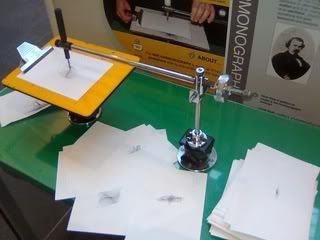
I didn't manage to make anything spectacular, but I couldn't resist taking my two home with me, and pinching three others that someone else had left behind:

Eventually it was time to dig our tickets out of our pockets and head for the planetarium. It's arranged with seats amphitheatre style, and a beautiful domed roof, dotted with a few stars poking through the rainbow colours the six cameras cast along the ceiling. The Powerpoint bit looked straight, because they cleverly cut out a slightly curved (on a flat screen) black rectangle - and then project the powerpoint onto that.
 Sitting and waiting while the guests filed in, I got butterflies in my stomach all over again remembering my own first ever public lecture in this very room. We had a roof of galaxies over our heads: the Hubble Ultra-Deep Field through a fish-eye lens. It looked truly stunning. I told the story of how old they were and how very many galaxies there were in such a tiny, apparently empty patch of sky, as part of my introduction. But I was so nervous that day that Jenny, the manager, told me while showing me how to work the microphone: "And this is the 'off' switch, just in case you need to cough, or to throw up . . ."
(Anyway, I don't suppose it went too badly. When I popped back a couple of weeks later for a Telescope Amnesty event, alone, scruffily dressed, gawky and inconspicuous, I overheard one of the guests I'd talked to last time mentioning loudly that he'd been to my lecture. I was standing right in front of him but he clearly didn't recognise me, but he remembered my name! I was clearly luckier than an artist I'd read about once, who saw a noble lord and a museum attendant standing in front of one of his paintings. He crept up to them to hear what they were saying about it. He overheard the noble lord say, "Of the two, I prefer washing up.")
Lecture: What can we know about the Universe?
"We take it for granted," Russell Stannard said in a clear voice, "that science, by its very nature, is progressive and always will be." But it has not always been so; centuries have passed without many new discoveries in the past, and also our brains and experiments are limited in what they can achieve, so ". . . that process will one day grind to a halt." This does not mean technology, and what we can make, but what science itself is able to tell us. "The Universe will always retain an element of mystery."
There are many things that observation - and deduction where observations are limited, but secondary evidence is available - can tell us. For example, we know about our Sun, the planets, galaxies, clusters, and the expansion of the Universe. Apart from galaxies in our local group, of which there are about 30, all galaxies are moving away from us. If Galaxy A is twice as far from us as Galaxy B, then Galaxy A will move away from us at twice the speed. This means that the Universe is expanding in all directions.
We have been able to calculate from the speed of the expansion that the Universe is 13.7 billion years old. We know that increasing the density of a material such as a gas increases its temperature, and from that we can deduce that the Big Bang and the early Universe must have been terrifically hot - a fireball. There is observable evidence from that, namely the Cosmic Microwave Background.
 (The CMB. Picture credit: startswithabang.com.)
We have been able to measure the chemical composition of the Cosmic Microwave Background, which is almost entirely hydrogen and helium, in a ratio of three to one (in mass, not number of atoms), and its temperature all around the three-dimensional perimeter of our vision, which is surprisingly uniform. It was an interstellar gas, not yet containing any stars.
We cannot look back to the moment of the Big Bang; we cannot say what caused it. To look back in space is to look back in time. But we cannot see the first 300,000 years of the Universe's existence, because no light could get through the cloud of subatomic particles. It was too hot for atoms to form, and the subatomic particles scattered the radiation that atoms can absorb. Theoretically, we could probe gravitational waves and neutrinos - but at least in present-day technology this is impractical.
How close to the Big Bang in time can we make direct observations? No closer - but we can study the features of today's Universe for clues.
One such clue is the (observable) Universe's homogeneity and isotropy. The Cosmic Microwave Background is remarkably uniform in temperature. For any material to be a uniform temperature throughout, it must have had some contact time to equalise. The nature of the Big Bang suggests that this was unlikely to have happened. In 1980, Alan Guth proposed that there was a very brief "quiet time" directly after the Big Bang, which caused connections between all the matter - such as it was - at the time. Expansion followed this later.
However, if this was the case, Hubble expansion predicts that galaxy clusters would not be in the place they are. The theory accounting for that is inflation. Inflation was very brief - lasting from 10 to the minus 36 seconds after the Big Bang, to 10 to the minus 34 seconds after the Big Bang (sorry for the lack of superscript font available!). This theory accurately predicts the density of the Universe.
 (Diagram of inflation. Picture credit: universe-review.ca/R15-17-relativity.htm)
Many scientists have suggested alternative versions of inflation. The main questions to ask are: Are we sure it took place? And which type is right?
Before inflation began, the Universe would have had no volume, and therefore an infinite density. We call this a singularity. Physics cannot handle singularities - they should be impossible. Therefore, trying to talk about them doesn't really make sense. It wasn't just matter that was a singularity, but space itself. This means there was both no matter and space, and also infinite matter and space . . .
Stephen Hawking has pointed out that "time might melt away". You can't have space without time, or vice versa. So we may not be able to talk about the first instant of the Universe's existence at all. But is there an even stranger possibility?
Was there a singularity which exploded? If so - what did it explode into? Russell Stannard pointed out that we think of an explosion as, for example, a terrorist attack in which someone causes an explosion in a crowded area, causing carnage. That is because it explodes into something. But the Big Bang didn't do that. It created space. That space is still being created, and pushing galaxy clusters apart.
But space is nothing - how can nothing move the most massive objects in existence? For physicists, space is not "nothing". A lot goes on in it.
Einstein pointed out that space and time need each other to exist, hence relativity. Time deals with causes and effects. The Big Bang seems to have been an effect; what was its cause? A cause would have needed to have taken place beforehand - but there was no beforehand! The question itself has no meaning. Another question, which people have tried to answer for at least three or four thousand years, is: Why is there a world? Why does it remain in existence?
Why are there any laws of nature at all? Chaos calls for no explanation. ("Does it?" I thought.) Einstein seems to have stated that the most incomprehensible thing about the Universe is its comprehensiveness. To sustain life, the laws of nature have to be complex. Once the Universe undergoes "heat death", life will be impossible anyway. For a start, the Big Bang was very violent, and threw matter out a long way. If it had been less violent, the Universe would have shrunk and collapsed again quite soon, and we would not be here.
 (Star formation in N90 in the Small Magellanic Cloud. Picture credit: the Faulkes Telescope Project.)
Another law of nature is called "g" - the strength of gravity. Gravity causes nebulae to collapse and stars to form. If g was larger, all stars would be massive blue supergiants and might only live for a few million years. We have needed four billion years to evolve, so we are lucky to have a smallish Sun which takes ten billion years to burn all its fuel. If g was smaller, nebulae would not clump together densely enough to reach the million degrees required to start nuclear reactions. (I disagreed with this and asked afterwards, what about more or less dense nebulae evening out the effect? Basically, if g was different enough, that just wouldn't work.)
The bodies of living creatures are very complex, containing heavy elements. Only hydrogen and helium could have survived the Big Bang; heavier nuclei would have been smashed up. Forming a carbon nucleus, for example, requires special conditions (more on that when I write a review of "The Magic Furnace" by Marcus Chown). In other words, heavy elements must be cooked in stars - and then they have to be got out of stars to make us! The way to do that is by a supernova. Supernovae are odd enough, because they are actually an implosion; how can an implosion trigger an explosion? It seems that neutrinos are what carry off all the matter - and neutrinos don't usually have the least effect on matter at all. It's likely that while you're reading this, a few thousand are going right through you. You could bounce a neutrino through the Earth from the UK to Australia 100 billion billion times before it had a 50% chance of knocking into an atom! They are very slippery - any more so and we undoubtedly wouldn't be here.
 (Supernova 1987A. Picture credit: APOD.)
Planets could not exist in the early Universe: there are no planets around first-generation stars. ("What about gas giants?" I should have asked, but forgot.) Planets such as Earth are made of these heavy elements from supernovae, and form in secondary eddies around stars. Conditions for life are delicate. Russell Stannard quoted Freeman Dyson as saying, "The Universe knew we were coming" (it's up to you whether you agree with that, can't say I do . . .). The Anthropic Principle states that we're here because if conditions were any other way, we wouldn't be here to ponder them! Probability (or perhaps logic) leads us then to ask if there are really lots of universes, each with slightly different laws of physics, and we are in the one which is ideal to support life. We can't contact any other Universes, or prove there is a "multiverse" - if we could, they'd be part of this Universe. We also can't prove there isn't one.
Another thing science cannot tell us is how big the Universe is. We can observe things 13.7 billion light years away. But presumably anyone 13.7 billion light years away can see 13.7 billion light years further on. Where is the edge of the Universe? If we went to the edge of the galaxies and looked out into empty space . . . well, that would still be in our Universe. The current thinking is that it is infinite. "I, personally, am very suspicious of the word 'infinite'," Russell Stannard informed us, and went on to tell us a story about a hotel with an infinite number of rooms. The hotel filled up and did very well. So well that the manager decided to build another hotel with an infinite number of rooms. One night, there was a fire in one hotel. They got everyone out, but this infinite number of guests had nowhere to stay that night. They were all feeling in quite a fix until the manager told the infinite number of people in the first hotel to go to their door, look at its number, double it in their minds, and move all their possessions and themselves into the door they'd see. So the infinite number of guests outside went into the rooms occupied by the infinite number of people in the first hotel, and . . . er . . . I think the moral of this story is supposed to be "er".
Back to the Universe. What is its average density? This is an important question, because it decides the fate of the Universe. If it is dense enough, gravity will halt its expansion. It may stop forever and remain static, like a craft in orbit around the Earth; or, if it's a bit denser than that, the galaxies will fall back together, like a football falling back to the pitch, and a "Big Crunch" will occur one day. But if the Universe isn't dense enough for this, it will go on expanding forever.
It seems that matter itself - stars, gas, etc - make up 5% of the density we need for this to happen. Dark matter accounts for more: 28%. (Science may one day tell us what dark matter is, but we have no way of finding out yet.) Our own local group of galaxies should hold together. The violence of the Big Bang was not enough to pull them apart. Not on its own.
The remaining ~70%* of the "critical density" is dark energy. It adds up perfectly to sustain a critical value (which Russell Stannard seems to find very satisfying, while I find it rather bewildering - doesn't it change?). Not all matter was created during the Big Bang, perhaps. Inflation may have created more. Space expansion creates matter . . . But it looks as if the Universe will expand forever. Look back at the inflation picture. The expansion seemed to slow a little somewhere in the middle. Without dark energy, we would fall back together. But dark energy somehow manages to create more of itself all the time - and it pushes the galaxy clusters apart.
(* Yes, you nitpickers, I have spotted that 5%, 28% and 70% add up to more than 100%. I'm afraid that's what I've got written down in my notebook. I don't remember why. We can make some educated guesses . . .)
Why would a vaccuum have a mass (or an energy)? There's a lot going on in it (virtual particles and antiparticles colliding - Hawking radiation - sprang to my mind). The expansion of the Universe is now actually speeding up, just as populations increase exponentially - the more dark energy is created, the more can be created! Dark energy repels, and repulsion vastly increases with time. The calculated value of expansion is 120 orders of magnitude greater than what we observe, which Russell Stannard describes as "embarrassing" (and "BANG!" describes as the probably the greatest ever discrepancy between the observed and the predicted!). Could a mechanism we don't know about be at work? We don't know.
Is there a connection between today's repulsion of clusters and the early inflation?
One final question: is there other life in the Universe? Exoplanets seem to be being discovered every day; but they are too far away to visit. Where do we rank with ET? The brain size has increased at three times the rate of body size in humans. But Russell Stannard does not believe ET is findable, and they will have to contact us. He also said that the human brain is not designed to do science, but to hunt, gather, find mates, ward off predators, etc - so it's actually a huge achievement that we've got where we are today at all.
We are hugely privileged to be living in the scientific age, he concluded. The human race has existed without being in the scientific age for thousands of years. One day, all that can be discovered will have been. That doesn't mean we'll know everything, but we'll have come up against all our limits of science. But right now we're in the middle.
Afterwards Jenny gave us a 15-minute planetarium show, incorporating a lot of three-dimensional graphics from our beloved SDSS. According to her show, the Universe is 92 billion light years across. There was a five-minute interval during which Russell Stannard was surrounded by a crowd of children. Good on you all, I thought from my seat. I hope they grow up to be interested in science forever.
As we filed out I couldn't resist going and bothering him. I thanked him for the lecture and told him I'd been an Uncle Albert fan for about 17 years - though I'd never got over the heroine Gedanken saying she was giving up. He merely smiled. His writing is very exuberant and I thought he'd have something to say. He didn't. He was very quiet: perhaps he'd heard it all before; perhaps he was tired, in which case I hope I didn't tire him further. (He did sign my Uncle Albert books, though!) But I feel very privileged to have finally met someone who made such a difference so many years ago. I hope I've done his talk justice.
Subscribe to:
Posts (Atom)


