Tuesday, 26 January 2010

Why Crispian Jago loves Carl Sagan - and so do so many more

If you haven't yet seen this work of genius from Crispian Jago, hurry along to see what he says here. He already puts it perfectly, so check out his words. Click here to see a large version (that, again, is from Crispian's excellent blog).


It's quite true, from the far-too-little-so-far I've read of his work (oh, my booklist is undergoing inflation!). In "Pale Blue Dot", for example, one minute he's telling us easily and captivatingly about ancient history, next minute it's robots, then it's projects that were nothing to do with space that led on to make wonderful discoveries about space - and vice versa. Did you know it was studying the other planets in our Solar System that led us to discover the greenhouse effect and the hole in the ozone layer?

Never met you, Carl, but I miss you already.

My only problem with this picture is that it only contains 2 or possibly 3 women. But it's great to run through it and see so many familiar faces - and wonder what the unfamiliar ones did. What's more, it's never too late in life to start finding out.

Monday, 25 January 2010

Great pictures around the Solar System

Just thought I'd do quick a round-up of some utterly wonderful pictures I've seen over the last few days. Starting with the Red Planet, which was hanging about low on the horizon to the east the other evening, looking very orange indeed: here is its "layered landscape". From NASA:


A quite different view of a landscape weirdity, reported by Phil Plait and APOD a few days later. Apparently the dark tree-like shapes are cascades of dust, disturbed and falling in an avalanche after the sublimation of frozen carbon dioxide. Personally, I just can't see them as that. My eyes persist in assuring me that they are standing up, nice and vertical against a landscape of a quite different angle - and my brain refuses to accept what is going on. It's like seeing a straight ruler over a lumpy duvet to me, and being told the ruler is the same shape as the cloth. Could somebody explain it in idiot's terms, or do I just need new glasses already? It's amazing anyway . . .


Moving a little outward, here's Jupiter - the world in the Solar System more massive than all other worlds, their moons, and all space debris such as comets and asteroids put together. Go to Phil Plait again for the article, and here to "enjovinate" or embiggen. Marvel at the gas that has formed those twisting, valley-like areas, and try to take in that the Great Red Spot could fit a couple of Earths inside.


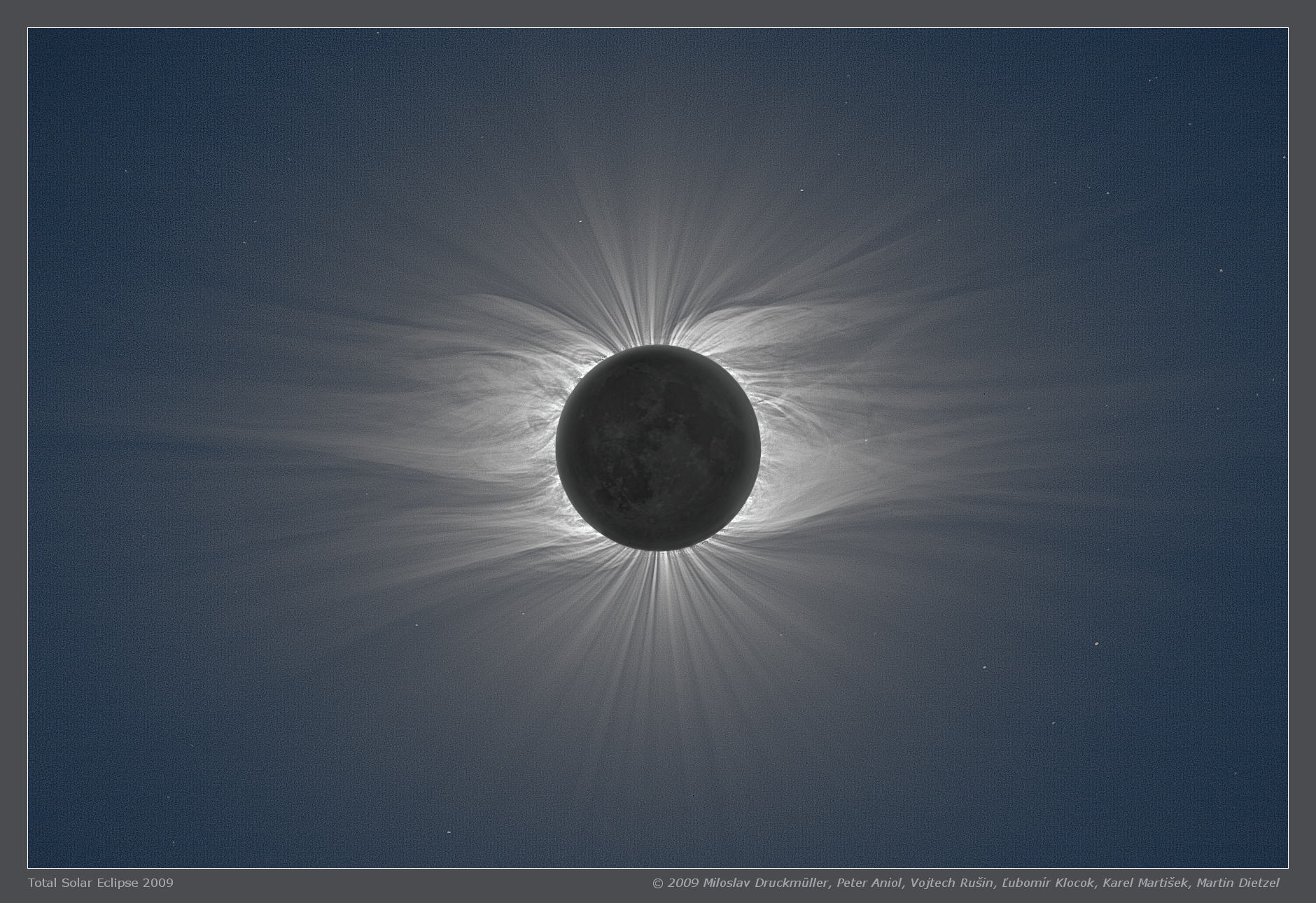
Heading into the very heart of the Solar System, our best friend and local star behind the Moon, where it shows what we don't otherwise see. From the Brno University of Technology, Czech Republic, and another enlargement to play with here.


And finally, I don't know who developed this, but I want one! Tweeted by NASA_SDO. Now that is a proper spacebar.

Tuesday, 19 January 2010

Waste not, want not. What to do after the Tia Maria and cream experiment

So I ended up with two glasses of Tia Maria, one topped with cream, the other mixed with cream, not to mention a little cup of cream flavoured with Tia Maria. Incidentally, that cream had grown an amazing rubbery skin, not protein-y, quite different somehow. Anyway, I figured I'd make a chocolate cake.

Traditional recipe for a chocolate cake:

8oz butter
8oz sugar
4 eggs
8oz self-raising flour
4 tablespoons cocoa powder
1 lid full of vanilla essence

(If you are really desperate for grams, let me know. For me, those are for science, and Imperial is for food.)

Preheat oven to Gas Mark 4.
Grease 2 baking tins. Sift the flour and cocoa powder, and set aside.
Put the butter and sugar together in a bowl. Beat them until they are "creamed" - light and fluffy.
Break the eggs into a small bowl, beat with a knife until they are more or less an even mixture. Stir in the vanilla essence. Add about a third of this egg mixture plus a big spoonful of flour into the beaten butter and sugar, and fold in. Keep adding flour and egg until they are all stirred in.
Spoon this mixture evenly into the tins, and cook for 30 or 40 minutes - times vary depending on oven.

How to make cake like Alice

Same quantities as above apply, except that I'm now not 100% sure I didn't only use 4oz butter. Strangely, this didn't seem to upset anything. The cake was moist and really just right.

Put the butter into a bowl and leave it on the Aga to warm, as it's rock-hard from being in the fridge. Sift the flour, and then suddenly remember to grease the tins. Go and find them. Wash the dust out. Doesn't matter. The mixture needs to start cooking quickly if you've stirred the eggs into it, but before that, it's fine to hang about.

Decide that dark brown sugar would go well in a chocolate cake. Only dark brown sugar available is also rock hard, despite being kept in an air tight box (pah!). Take a cleaver to it, bag and all. Chop as hard as if you were trying to behead Marie Antoinette. As it happens, about 5oz worth is just what comes off, clean as a whistle and certainly cleaner than a head. Put this in a small bowl. Fill another small bowl with water. Put these both in the microwave.

No, I haven't gone nuts here - this is actually a tip from Robert Wolke's wonderful "What Einstein Told His Cook", a hilarious food chemistry book that I must review here one day. Brown sugar goes hard because it dries out and behaves like cement. He recommends leaving it in a really airtight box with a cup of water or just a wet piece of kitchen paper for a few days - but putting it in the microwave is a quick remedy which won't last so long; and you add the water so the poor microwaves have somewhere to go!

Anyway - be delighted with how soft the sugar goes. Think how cool science is. Add it to the butter, find it is about 5oz, and add 3oz caster sugar to top it up. Find a new bag for remaining brown sugar and return it to not very airtight container, making a mental note to do something about it one day, probably whilst next in use. Apply big wooden spoon and find, oops, should have left brown sugar in microwave for longer. Attempt to break lumps with spoon. After some time, remove biggest lumps from mixture and put (with buttery mixture and all) into pestle and mortar. Grind them up. Feel suitably avenged. As for the smaller lumps, they will melt into the cake later.

Find out there is no cocoa powder!! How can this be . . . ? Go through cupboards, find only very weak Tesco drinking chocolate. Unwilling to use. Eventually find some dark chocolate. Attempt to grate it. Seems successful until realise said chocolate appears to have filling. Re-read packet several times. Ooops - it's chilli chocolate! Didn't even know there was such a thing. Hmmmm, cake will be interesting now, but too late, flakes already in mixture. Find some more ordinary dark chocolate. Refuses to grate at more than 1 molecule a minute. Get fed up. Break into pieces into mortar. Put mortar in microwave on low power. Works a treat - even while chocolate looks solid, it melts as soon as touched by spoon. Stir into mixture.

Beat eggs, add these, vanilla essence and flour - at least this bit goes right. Finally, add all of the not-very-creamy glass of Tia Maria, and about half of the creamy one. Stir in. Smells wonderful. Put in Aga. Ha ha, didn't need to preheat it. I love Agas.

Now the kitchen is beautifully messy, and aren't I lucky - I have more chocolate grating to do. Get out a wooden chopping board this time. Grate and grate and grate, and finally use a mezzaluna to chop up the tiny bit that refuses to be grated!!

Pour most of a pint of double cream into a bowl. Get an egg-beater and twizzle it for a while. When it starts thickening just a little, but not much, put the remaining cream and Tia Maria together, along with about 1.5 teaspoonfuls of coffee, into the cool oven of the Aga. When this fails to dissolve the coffee, give up and bung it in microwave on a low temperature. Comes out not looking like faintly caramel-coloured cream anymore, but more like rich dark coffee. Add this to cream. Whip in. Cream turns the most delicious colour and smells very professional. When it's got more solid than liquid, then stir in the grated chocolate (I didn't want to do that too soon or the chocolate particles would only get even smaller). Finish whipping until you can barely get the egg beater out. Get as much cream off this as you can, first with knife, then with fingers. Lick fingers. Put bowl of chocolatey, coffee-y, Tia Maria-y cream into fridge.

Get out cakes when they a) are smelling delicious, b) pull back from the tin, c) spring back perfectly when you poke them and d) skewers stuck into them come out clean. Put onto cake rack (bottoms of tins delightfully sticky and bits of brown sugar haven't let me down - pools of dark toffee!). Allow to cool completely before getting out the bowl of cream . . .


. . . smearing it on top of one cake, then adding the other cake, then admiring it . . .


. . . then eating.


And that, my friends, is an added benefit of the Tia Maria experiment.

The Tia Maria & Cream Experiment

Many years ago I read New Scientist's book "Does Anything Eat Wasps?", one of the questions in which was about an interesting reaction between the liqueur Tia Maria and the thin layer of cream the reader liked poured on top. If said layer is about 2mm thick and is left to stand for a couple of minutes, the reader said, it forms amazing, strange-shaped cells - what forms these, and where is the energy coming from?

Many years ago I was having a quiet drink with a university friend. I had Baileys, and I'm sure that what she had was Tia Maria and orange juice - or at least, one of those two and something else; but anyway, it tasted like chocolate. A few years after that, I tried that combination and it was absolutely revolting, so plainly I'd remembered something wrong. In fact, I was unlucky enough to acquire a nice big bottle of Tia Maria only to discover I don't actually like it very much - and today it suddenly occurred to me that it might actually serve an excellent scientific purpose!

My first mistake was to just go ahead and pour a layer of cream onto a glass full of Tia Maria without reading the book first. I put far too much cream on, and also poured it in in my usual lumberjack style:


This, on the other hand, is not enough:


It should be about 2mm thick, and poured down the inside of the glass. (In fact they recommend poured off a spoon, but my second method worked just as well.)

Well, the first result - with the much-too-thick cream layer - was interesting; there was a doughnut-shaped area in which the liquid was clearly circulating:


Wondering why it wasn't working, I then made another attempt to find the right book - and finally did, then wished I'd done that first. I tried a lot of repairs on that first glass. I tried to get most of the cream out with a spoon. Nothing really seemed to work, except the formation of a few cool holes like the one in the video above. When I couldn't think of anything else to do, I stuck the spoon in and stirred it all up to see what would happen! Nothing much did, except the formation of five or six darker spots on the surface, arranged in a circle.

I then re-read the instructions again, and filled another wine glass, this time with only a little cream poured as described above. With the first few sprinkles, I noticed an interesting "beach-like" effect. It happened too slowly and subtly for the video to work, but you'll see the dark lines appearing around the edge of the cream, creating two quite different cream-scapes:


Actually I took an awful lot of videos, including one of a tiny white speck which was slowly tumbling over and over itself, a millimetre or two below the surface - but I've restricted myself to two. Below is what happened when I added the correct amount of cream . . .


Curious cells formed, the shape of squishy defrosting onion rings. Tia Maria seemed to be rising up from the middle, and the cream seemed to be sinking at the edges!

Anyway, because I botched the first experiment and because I wanted to fill the glasses adequately, to provide sufficient alcohol, I now have plenty of spare creamy Tia Maria. If nobody turns up fast enough to help me with it, my plan is to make a chocolate cake. The less creamy Tia Maria will be added to the mixture; the creamier samples and spooned-off cream will go into whipped cream, as will a little coffee and some grated chocolate!

Now your mouth's watering too much to think, what's actually going on? It's convection. Not the well-known convection caused by molecules of liquid moving around to transport and diffuse heat, a hot place to a cold place - but convection of concentration. The alcohol from the Tia Maria can diffuse through the cream; when it reaches the surface the surface tension plummets. Surrounding areas with high surface tension draw this liquid towards themselves. As the liquid is displaced, Tia Maria moves upwards to fill it, again reducing the surface tension . . . It's a positive feedback mechanism. So it'll go on as long as the Tia Maria feels like it.

This is a particularly lovely story because the reader asked the question back in 1995, and three scientists from my old foreign exchange university, la Universidad de Granada in Spain, actually investigated this and wrote a scientific paper. What a trial those experiments must have been!

You can read about the science here in the Times, and watch a much better experiment - with single cream and Tia Maria on a plate - on this video. And by the way, one day I really hope to acquire a distinctly better camera. I lost my old one about 18 months ago, in London, I think, and have been cursing myself ever since.

(P.S. Did you notice the coaster? All right, here you go. "Rooster" to you folks across the pond . . .)

Wednesday, 13 January 2010

A different sort of sine qua non: Cecilia Payne-Gaposchkin

My post yesterday was about devoted supporters of astronomers, who had a quiet role in an astronomer's discovery or at any rate their ability and inspiration. This morning I was goaded by Marcus Chown - who I couldn't possibly ignore! - into writing about an astronomer herself. She's one I've already written about on the Galaxy Zoo Forum and for She is an Astronomer; this is a copy of the latter, which was written back in October. Marcus Chown tweeted: "My mission in life is to get Cecilia Payne Gaposhkin the recognition she deserves!" And she certainly deserves a lot more than she ever had. So she can go here, too.

Cecilia Payne as pictured on She is an Astronomer.

The Feature of this weekend is the story of one of my favourite historical astronomers, Cecilia Payne-Gaposchkin, who is profiled in on our main page here.

I first read about her quite by accident. She made a crucial discovery about the Sun and all stars, which paved the way to realising how stars burn: that they, unlike the Earth, are made mostly of hydrogen. The experts on stars in her day did not believe her until other scientists began to turn up the same results. This was nothing unusual in her life: she studied at Cambridge but could not earn a degree, because they were not given to women; and the same thing happened in America when she completed her doctorate a few years later. Yet she was never put off, and made huge contributions to astronomy throughout her life. Karen Masters, who heads Galaxy Zoo's "She is an Astronomer" project, wrote this for me:

Her career was littered with small frustrations even given her early seminal work (for which any man would have been feted), but she never seemed to think it mattered. She is quoted as saying: "I simply went on plodding, rewarded by the beauty of the scenery towards an unexpected goal."

I first found out about her whilst reading Arthur Miller's "Empire of the Stars", a biography of Chandrasekhar and the long-disbelieved concepts of black holes, and about fights and put-downs between scientists who, he says, "find themselves in thrall to their intellectual endeavours with a degree of intensity and competitiveness that can exact a high psychological toll . . . [so] sometimes act and react in ways which may seem inexplicable to lesser human beings." That's another story. Although this biography states how unkind and sometimes dishonest Eddington could be to other scientists, he was kind to young Cecilia, an undergraduate at Cambridge starting in 1919:

. . . Cecilia Payne recalled how rude the eminent physicist Ernest Rutherford was to her. He often began his lectures, in which she was usually the sole woman in the audience, by looking her straight in the eye and uttering the word, "Ladies", followed by a long pause, ". . . and gentlemen." Rutherford's daughter, Eileen, a friend of hers, told Payne that Rutherford . . . had said to her, "She isn't interested in you, my dear. She's just interested in me." Payne was so offended that she gave up physics and switched to astronomy, a field that had attracted her ever since hearing Eddington lecture. Eddington immediately set her a problem on the structure of stars and was very helpful to her.

I felt like going back in time and telling her not to bother about such pettishness, until I recalled that Rutherford would probably have been the man who, effectively, decided her future - and would not see her scientific ability as a reason to allow her to achieve anything, or even to let her voice be heard. I'm not telling you this to whinge about someting that happened 90-odd years ago, but to show encouragement to anyone who's feeling the same sort of thing now - and, for those who aren't, to show how much things have, on the whole, improved since then.

The Sun, which Cecilia Payne discovered is composed mostly of hydrogen - taken from this interesting link about stars' energy.

Payne's discovery was essentially applying new theories to the Sun's spectrum: its unique signature of light, certain wavelengths of which are dimmed or exaggerated by cool and hot atoms respectively. But this only shows their presence or absence. In 1920, while Payne was still at Cambridge, Megnad Saha worked out how to calculate the abundances of each element, and the theory was completed by Arthur Milne and Ralph Fowler, also at Cambridge.

Payne, later Payne-Gaposchkin when she married, appears on and off in Miller's book. She appears in a similar vein - not an individual story, like Einstein, but a crucial part of so many larger ones - in Marcus Chown's wonderful "The Magic Furnace", where he effectively picks up the next part of her story:

Cecilia Payne had become fascinated by the problem of decoding the message in starlight while still an undergraduate at Cambridge. However, she was forced to go to America to pursue the problem because of the exclusion of women from British astronomy. Payne enrolled for a doctorate at Radcliffe College, which was on the doorstep of Harvard Observatory, the home of the world's richest collection of stellar spectra. She quickly set about applying Milne and Fowler's method to some of the Harvard spectra, obtaining her first results in 1925. Those results contained a bombshell.

Some of the most prominent lines in the solar spectrum were due to the lightest element, hydrogen. This was unexpected, because Payne's calculations indicated that, at the temperature of the sun's surface, only a minuscule fraction of all hydrogen atoms should be in the necessary state to produce hydrogen lines. The only reasonable explanation was that this fraction must still represent a very substantial numbre of atoms. In other words, hydrogen atoms must be extraordinarily abundant on the sun. Similar logic applied to the second lightest element, helium. In fact, Payne's calculations seemed to be implying that the two lightest elements made up an astonishing 98% of the mass of the sun!

This was surprising because astronomers had, for centuries, simply assumed that the Sun was made of iron - even Eddington's bestseller, "The Internal Constitution of the Stars", published in 1926 and still a classic today, makes that assumption. Until the discovery of spectroscopy, scientists had no reason to realise that the proportion of the elements on Earth (i.e. mostly iron, silicon, oxygen, etc.) was any different in the rest of the Universe.

Chown continues:

It was too incredible to be true. In her doctoral thesis, Payne called the result "spurious". She even went so far, in a scientific journal, as to declare, "The abundance of both hydrogen and helium in stars is improbably high and is almost certainly not real." In rejecting what would one day go down as her greatest discovery, Payne was heavily influenced by Henry Norris Russell, the American astronomer who had discovered red giants . . .

Nevertheless, Russell was eventually forced to admit he had made a mistake. By 1929, the evidence for the super-abundance of hydrogen,in particular, was overwhelming . . . A hydrogen sun also resolved a major problem with Eddington's theory [i.e. that an iron sun, to shine as powerfully as the Sun does, would have to be an incredible 40 million degrees in temperature! Eddington, at first, did not believe Payne either.] . . .

The discovery by Payne . . . had implications for beyond the sun . . . [it] . . . indicated that hydrogen and helium were the most common elements in the entire universe.

Not a minor discovery by any means! But because Payne's results were ignored until more came along, from male scientists, she missed her glory. Nevertheless, some of her colleagues did their best to fight or circumvent the system for her. Harlow Shapley, for instance, specially created the Astronomy Department at Radcliffe, because the Physics Department did not allow women to receive PhDs. (The title of her thesis was "Stellar Atmospheres, A Contribution to the Observational Study of High Temperature in the Reversing Layers of Stars". Otto Struve said that it was "undoubtedly the most brilliant Ph.D. thesis ever written in astronomy".) Shapley also kept her as a "technical assistant", an underpaid position beyond which women could not rise, though in practice she was a working scientist. She was awarded the title of "Astronomer" in 1938; in 1956 she was finally allowed to be called a "Professor"; and, eventually, was the first woman ever to head the department.

A long struggle, but not unsuccessful, so I write this as a message to all of you not to be put off even if things take a long time! Her later work included: high-luminosity stars and the structure of the Milky Way; and variable stars - cataloguing, with her students, over 1,250,000, and then another 2,000,000 in the Magellanic Clouds.

Mira, a variable star, the yellow star just between the two clumps of trees. This picture is from Astronomy Picture of the Day; go there and you can move your mouse over it to see the diagram.

Karen, mentioned above, found me a lovely blog article about Cecilia Payne-Gaposchkin which is worth a read; and, Googling around, I found parts of her autobiography available to read online (with lengthy introductions from people who knew her; you'll have to scroll down a long way to get to her own words! The book's on my Christmas list though!). Of arriving in America, besides amusing anecdotes about the freer culture she encountered there, and her women friends' amiable mirth over her constrained talk and dress, she writes these beautiful lines:

When I arrived in Cambridge, Massachusetts, I had crossed a gulf wider than the Atlantic Ocean. I had left the world of dreams and stepped into reality. Abstract study was a thing of the past; now I moved among the stars.

Also, you may have been wondering why, since Harvard was such a temple of spectra, an Englishwoman was the one who made use of it. It had long been a place where women could do quite respectable work they enjoyed, and Payne, rather than criticising the culture, simply tells us of its differences in a very wise way:

Miss Cannon [Annie Jump Cannon, who headed the department and left an important legacy] was extraordinarily kind to me. She might well have resented a young and inexperienced student who was preumptuous enough to attempt to interpret the spectra that had been her own reserve for many years. She never gave a sign of doing so. "Do you realise," Shapley later asked me, "how easily Miss Cannon could have chucked a monkey wrench into the works for you?" With my arrogance of youth I had not even thought of it; I had even permitted myself to wonder how anyone who had worked with stellar spectra so long could have refrained from drawing any conclusions from them. She was a pure observer, she did not attempt to interpret. As I look back I see how her work has outlasted my early efforts at interpretation.

The Large Cloud of Magellan, from Astronomy Picture of the Day.

Helen has just started a topic about how to get the IAU resolution - to support and encourage female astronomers - to work. To me, this story seems to be not about methods but people: those who are kind; those who accept others who are different, as well as different scientific approaches (Cecilia Payne herself included); those who take on difficult tasks and are willing to break with tradition; those who expect others to achieve highly and set them challenging things to work on; those who look far. In other words, openness, goodwill, and expectations. That's my take, anyway. Please post your ideas.

P.S. From the Galaxy Zoo post - some stars, posted by Citisue and Sophie.

Credit: Sloan Digital Sky Survey.

Credit: Sloan Digital Sky Survey.

Now who shall I write about?

Tuesday, 12 January 2010

Some sine qua nons of astronomy

The She's an Astronomer forum is a bit quiet at the moment, so I thought I'd share a little research with you that I wrote up this morning here as well.

Tuesday 12th January 2010: It couldn't have happened without them

It often seems to me that scientists are portrayed as loners, making their discoveries in the solitude of the ivory tower. I expect this is the case for some; but there are others who worked very closely with other people, or were able to do their work because of loving and dedicated support from someone else. It's been in my mind for a while to write a little about a few of these someone elses, because it seems to me that they shouldn't be forgotten. And some of us are just not cut out to be loners - and that is no failing.

Margrethe Bohr (1890-1984)

Niels Bohr was one of the greatest physicists of all time. He wasn't an astronomer, but the story of atoms and stars is closely interwoven, so astronomy would never have been the same without his work - for example, Eddington's studies of red giants and, in the end, all stars, needed to include Bohr's representations of atoms and electrons.

Bohr originally hired Margrethe Norlund to type up his numerous letters and papers, but they married in 1912 and had six sons. (Tragically, the eldest, Christian, died in a sailing accident and the youngest, Harald, spent many years in a mental hospital as a result of a childhood illness, and died aged about 10. But the others did well, and one of them, Aage, also became a Nobel winning physicist.) Margrethe continued to do Niels's reams of typing, which must have been no mean task: letters and papers flew around Europe as many scientists became involved in the the development of quantum mechanics and new understanding about atoms. But she was far more involved than that: she wasn't a scientist, but Niels discussed his work in great depth with her and used her as a soundboard for his ideas. The Danish government honoured the Bohrs by moving them into a grand residence, which other scientists visited regularly, and Margrethe was known as "the Queen" and "the perfect hostess".

There is a hilarious anecdote from the mid-1920's, in which Heisenberg and Schrödinger's theories of the atom were not yet reconciled and clashing badly. Schrödinger had developed his famous equation which cast electrons as waves, with no need for Heisenberg's matrix mechanics and the quantum jumping on which he and Bohr had been working. Bohr invited Schrödinger to Copenhagen, and argued with him so politely yet so insistently that Schrödinger took to his bed with a fever, during which Bohr continued to argue relentlessly and Margrethe had to nurse him back to health!

Caroline Herschel (1750-1848)

It is always William Herschel who is remembered for the discovery of Uranus - but his sister Caroline was no slight astronomer herself. She discovered at least five comets, including Herschel-Rigollet which is partly named in her honour, and rediscovered and confirmed several others. She also confirmed the existence of M110, which had been depicted in a drawing but not named by Charles Messier. She and Mary Somerville were the first female honorary members of the Royal Astronomical Society, and she was the first female (and last until Vera Rubin) to be awarded their Gold Medal.

Caroline's elder brother had come to England to acquire a position in music, and he invited Caroline to join him and gave her several singing lessons (she was such a good singer that she was asked to perform at the Birmingham festival, but declined). She became fascinated with astronomy when William took it up, and for sixteen years they worked as a partnership. She was, she said, "much hindered in my practice by my help being continually wanted in the execution of the various astronomical contrivances" - but she must have been very devoted all the same. She kept his house, fed him sandwiches at the telescope, performed long calculations relating to their observations, and was once seriously injured by getting caught on a telescope hook. In 1795, William built her a telescope of her own. Later in life she wrote the Catalogue of Stars to update John Flamsteed's work and help William, who needed an up-to-date star index but didn't want to write one; and after William's death Caroline wrote a catalogue of nebulae to assist her nephew John Herschel.

Margaret Huggins (1848-1915)

William and Margaret Huggins were wealthy, capable amateur astronomers. They sold off the family business and built a telescope outside a house in Tulse Hill, just outside London, away from the smog. Their great contribution was stellar spectroscopy. Fraunhofer had catalogued over 500 dark absorption lines in the solar spectrum, and Kirchhoff had finally found out what they were by comparing them to bright emission lines from burning substances: bright and dark lines were particular wavelengths of light being emitted or absorbed by gases. It was therefore possible to tell what types of material were present in a substance if you burnt it - or in stars.

William and Margaret pioneered this new science, recording the spectra of hundreds of stars and jointly publishing papers and the Atlas of Representative Stelar Spectra. William analysed various "nebulae" - many of which were not nebulae at all, but galaxies outside our own (but that's another story) - and discovered that they differed in chemical composition: for example, real nebulae from galaxies made of stars. Margaret, much younger than William, found superheated oxygen in the Orion Nebula (see the tour of Orion!), which was previously thought to be a solid. She once left a note for him: "Dear William: the spectrum you took last night was a bit awful - please try harder tonight"!

They were also helped with the analysis by their neighbour, William Allen Miller, a chemist. They went on studying until they were no longer able. Heather Couper and Nigel Henbest quote John Meadows as telling them: "There's a nice story - or, perhaps, a semi-tragic story - of them sitting in their old age, hand in hand, watching their precious telescope being dismantled because they had become too old to use it."

Charlene and Charon

In 1978, an American astronomer named James Christy was observing Pluto nearly 50 years after its discovery, and was surprised to find that it seemed to be pear-shaped. Others thought it was simply a poor recording because the plate must have been moved - but the stars showed no such elongation. Christy realised he was seeing two objects, and that in fact this planet (as it was known then, though even its discoverer, at the time, didn't really feel it should have been a planet!) had a moon. As its discoverer, Christy had the right to name it if someone else didn't come up with something first, and S/1978 P 1 really wasn't that catchy. Christy wanted to name the new moon after his wife, Charlene, known as "Char". But this did not accord with convention (Herschel had wanted to name Uranus "George" in honour of the King!) - so Christy looked up the traditional mythology and found the name Charon, who took dead souls across the river to Pluto's kingdom. It wasn't until 1986 that this name was accepted, and today it's still pronounced as an "sh" rather than "k" as is the normal, in Charlene's honour.

I couldn't find any information on Charlene herself, but she must have been a great inspiration to her husband! She told Heather Couper and Nigel Henbest: "Many husbands promise their wives the moon, but my husband got it for me".


Many thanks to various Internet sites, especially Wiki.

Inspirations: The History of Astronomy by Heather Couper and Nigel Henbest; Physics and Beyond by Werner Heisenberg; and Copenhagen by Michael Frayn.

Sunday, 10 January 2010

Hundreds gather in mass protest against global warming

From Zeno001, a Twitpic (click to enlarge!)


Utterly adorable. I'll let you know where this was and who made them all when or if I find out!

Snowy Pictures from East to West

Not often we see Britain looking like this, is it? From Nasa's Terra satellite on Thursday.


I've just got back to Wales from London. She is an Astronomer had a meeting on Wednesday, about our website and an upcoming conference in April - of which, I hope, there will be a lot more news soon! The meeting took place at the RAS, a truly lovely building with even lovelier receptionists who find milk and biscuits and take great care of visitors. It was the first time I wasn't hurrying through to a lecture, so I got a good look around. There's a little room on the ground floor just being the reception, where there's a big complicated coffee machine, a million leaflets, comfy chairs, and cushions whose stripes distinctly resemble Jupiter. More intriguingly, there are two little brass instruments with a plaque which explains that they were donated and their purpose isn't 100% clear, but they may have been used in navigation. Upstairs is the conference room, whose walls are books upon books upon books! Helen and I both arrived very early, not being sure what the trains would be up to, she in the most amazing welly boots. The ground was already alternately white and slippery, but the skies opened once more while the meeting progressed. This was the courtyard afterwards:


That evening I also chanced to walk past University College London, whose courtyard also looked pretty cool - in both senses of the word!


(Taken from my phone, whose lens I believe was rather wet. The snowflakes were actually coming down then, but sadly it didn't pick them up. If only I hadn't lost my digital camera the summer before last.)

The day after this, Thursday, I spent on the train between London and west Wales. And had far too much fun snapping more pictures out of the window. The quality, especially of the foreground and where there are reflections on the window, is not great - but I was pleasantly surprised by some of them. Windows reflected, tracks covered . . .


Near Reading, if I remember right:


Didcot Power Station:


As much as engineering works on railway lines are a pain in the neck, I had to feel sorry for this brave guy:


Getting near Bristol now . . .


. . . where I did my best to zoom in on one of the bridges over the Severn.


I wish our train could have gone over a bridge. Not only are bridges and the view below them beautiful, but a freight train broke down in the tunnel ahead of us and kept us sitting around for an hour. The nice train people offered us all complimentary coffee, but not cappuccino.

Near Ferryside, south Wales, is a beautiful estuary - one day I must get off the train there and take some more pictures. Sometimes the tide is in, when it's as if the train floats along the edge of the sea; other times it's out and there is this vast expanse of flatness and windy space. By now, sadly, the light was dimming and very few photographs showed anything - but I hope that even the fuzziness that follows can capture something of that finger-numbing wet openness, so silent yet so full of life:


And to be fair, I also found the sunset rather mesmerizing:


Snowy fields on the other side of the estuary, with the last camera-friendly light:


I was held up by a total of two and a half hours that day - none of the delays, incidentally, were a result of the snow at all. I walked part of the way home - steep hills, stuck cars and slippery roads didn't make picking me up from the station any easy task. Happily, it was an exceptionally clear night and Orion was just rising in front of me. My feet crunched deliciously through the snow, deepest and best for walking right in the middle of our quiet, unlit single-lane road home. Even the Milky Way was faintly visible, more a ghostly-speckled presence than a glittering reality, yet just as gorgeous - running across the sky in exactly the direction I was walking. I'm so glad I hang about with astronomers most of the time. What if I had just huddled beneath my woolly hat, resented the cold and darkness, and forgotten to look up to the Universe?

Monday, 4 January 2010

Congratulations Stellar190: Young Astronomy website

Just a quick break from a long Christmassy silence to announce a new website: Young Astronomers, one of whose new writers is Stellar. As they explain, it's still under construction, but I'm looking forward to seeing what they come up with. So far they have had two brief reviews of 2009, its achievements, and like in the meeting last month a strong emphasis on how the project isn't over: "In no way is all the astronomy fun of the IYA “over”, just the official celebration, we will still continue with all of your favorite projects, and surely the astronomical community will continue to grow!" And today I saw their first article written by a young editor: Cities of Stars by Stellar.

I'm delighted to see more and more online material available for young people, involving them as well as informing. Recently, someone wrote on the Galaxy Zoo Forum: "No one takes 14 year olds seriously" - meaning he or she did not expect their input to be accurate or valuable. It was fortunate that back in the 1930's somebody did expect just that: a young boy named Patrick Moore had been left in charge of an observatory for many nights, had discovered several new craters on the Moon, and had written up his findings in a paper. He submitted it and it was accepted for publication, but he thought he should tell them that he was not exactly ancient. The reply came back: "I note that you are only 14 years old. I don't see that this is relevant."

A few days ago I was in despair at the headline "Boys aged three 'must work more'", and would like to suggest two things to the government. Firstly I suggest that they personally tell every three-year-old boy in the country to work more, and stick around to see that he does. Secondly, I wish to challenge the meaning of "the gender gap". I know this sounds a bit rich from someone very into She's an Astronomer, but most of these barriers are probably only there because children are forced along by age, not by readiness or individual strengths and weaknesses. This is not only cruel, but it shores up more problems later: for instance, someone who isn't good at maths but terrific at (or at least has potential in) writing, or vice versa, or some other combination, may be denied all opportunities because the one hoop they haven't jumped through holds them up. It doesn't occur to teachers to let children who don't do brilliantly at exams try out the extras (or rather, they fear that instead of giving the poor kids a break and some self-esteem, such activities would only "be a burden" and "waste valuable exam preparation time".) I wonder how many more young Patrick Moores we're losing because they learnt to write their name at six rather than at three?

In citizen science, there are no barriers. Age does not matter: a teenager can work alongside a grandparent. I didn't get into it until I was 25, but because it wasn't commandeered by targets, that matters not at all. I see no reason not only why the school genius can't make a terrific contribution to science communication or to astronomy, but the average or bored pupil as well. Astronomy, and science done rather than memorized and examined, is for everybody. So well done to all these wonderful new websites coming out, and may they reach anyone who's ready!

Sunday, 13 December 2009

International Year of Astronomy round-up at the RAS

At Burlington House last Friday, the Royal Astronomical Society got together for two specialist discussion meetings: "Solar Wind-Magnetosphere-Ionosphere Interactions within the Solar System" and "The International Year of Astronomy". I had an absolutely terrific time at the latter. It was a round-up of various things that have been going on during an exceptionally busy year, which I'm now very sorry is so nearly over. But never mind, because the overriding message amounted to: "Don't Stop Now!"

There were, not counting introductions and summaries, 14 short talks by various people involved. I heard for the first time about several cornerstone projects, such as UNAWE which aims to bring astronomy to very young children in underprivileged environments, and the Galileo Teacher Training Programme, to encourage science teachers to become ambassadors and encourage each other to include astronomy in their lessons. Great projects have been put together, such as careers advice for teenagers run by the Guildford Astronomical Society, including female speakers to encourage girls; telescopes set up on the pavements (called "public astronomy events" here in the UK, not "sidewalk astronomy"!), and huge and beautiful space pictures touring the country. Media interest in the International Year of Astronomy was excellent; success in schools was varied; collaboration between science communicators and other organisations has got a massive boost; interesting new facts such as that there is a star called Whasat and that Thomas Harriot actually beat Galileo to using a telescope to observe the skies have been dug up; and many members of the public are, hopefully, more familiar with astronomy than they were before!

MoonWatch in Schools was not a great success. School staff were too hampered by health and safety problems, CRB checks, and so on - it may be that the problem was working out of hours, and that it would be easier to do in the school day. Privately I suspected also that the teachers were simply too stressed and tired to do anything beyond the obligatory minimum demanded by the government. I also got a good snigger by thinking "So much for the promise that all schools would be open until 8pm by autumn 2008" - which seriously was the plan in autumn 2007. The speaker, Steve Owen, went on to tell us that over 200 schools were invited to the Royal Observatory in Greenwich - and not a single one replied, even just to say "no thanks"! I was reminded of a science teachers' meeting at one of the schools I trained at in Cornwall: they had a spare £1600 and wondered what to do with it. They rejected the ideas of new books, science equipment, or a trip anywhere, in favour of a TV to put in the (extremely crowded) corridor to show the pupils science lessons! I suggested getting involved in the Faulkes Telescope Project and got laughed into silence - they clearly hadn't even heard of it, but thought ignorance of anything not demanded by the National Curriculum was tough or clever or something. It was shortly after this that I decided this seriously was not a profession I'd survive in long enough to do any good . . .

On the other hand, about a quarter of secondary schools now have their own telescope! The Society for Popular Astronomy and Dr Helen Walker especially did a great job, Robin Scagell told us, of organising this. Before 2009, very few schools had a telescope, and this made practical astronomy work nigh on impossible. Secondary schools were a priority because primary school children are already enthusiastic and easy to inspire - while secondary school pupils receive far less attention, and are also at the age of making career choices. Secondary school teachers also seldom have much astronomy background, so a free DVD and education pack was provided for them. There was a DVD aimed at inspiring the children, including an interview with Helen and Sir Patrick. Amateurs and professionals were gathered who could act as outside help contacts for teachers.

An ex-headmaster helped with the distribution; SPA had a budget of £15,000 which did not cover enough, but very fortunately the STFC was able to provide another £50,000. The children of the schools were now very proud of their school owning a telescope, and about a third of these set up their own astronomy club. Teachers were asked what they would do with their telescope, and they asked the children for suggestions. (Can you imagine how relieved I felt that interest and enthusiasm is not wiped out of schools everywhere!) Solar observations were not recommended because this is simply too risky. The true value, however, will not become clear for many years: we will know for sure when the children affected by the scheme go to university.

The Royal Observatory of Greenwich appears to have had a great year. In 2008 they had 1.3 million visitors; they predict 2 million by the end of 2009! This includes 17,000 schoolchildren. Most people, the speaker Marek Kekula told us, come to stand with one foot on either side of the meridian - but there is a lot to see while you are there, so one can spring plenty of astronomy on you unexpectedly. The RGO's staff includes professional astronomers, who quickly pick up information: within 12 hours of the discovery of Saturn's new ring, it was incorporated into their planetarium show.

Marek was particularly adamant that astronomy now has a higher profile in the public, that astronomers have developed better communication skills, and we must not lose our momentum. This was a common theme that day. Another was the thrill adults felt from what they were learning - they were often much more excited than their children, who were used to new things every day and who already knew a lot! And yet another was how successful double-events can be: one astronomy, one something else. For instance, live music or sci-fi meetings combined with an astronomy night, or astronomy parades hijacking St Patrick's Day in Ireland. (Apparently it had to be "real" astronomy - little green men, including alien leprechauns, were forbidden . . .)

Then Helen - who I'd finally got to meet after a few months of working for, and who is ever so friendly - got up to talk about She is an Astronomer. We heard some statistics, such as that 13.36% of astronomers in the IAU are women - the figure is only 11.2% in the UK, and 24% in France. It is quite high in Italy, apparently - because science is a low-status job. The thing I found most interesting about her talk was the advice that female astronomers would give to younger ones. It included: find a supportive partner; "train him" (that got a laugh); break your job down into small manageable chunks; get a life; get a mentor. They advised young women not to try to multitask and be good at lots of things, but to find what you are especially good at and stick to it; to be prepared, if your partner is also an astronomer, for the "two-body problem" - the frequent lack of two posts to be near each other, so one of you will often be out of work. They also said to keep your family, especially your children, educated and inspired about what you are doing - children, she reported, are often very supportive of your long absences if they know you are working on something terribly exciting.

Getting a mentor, she said, is often very important. I could well imagine that, for as I blundered unqualified and inexperienced into the world of astronomy it made all the difference in the galaxy that Chris Lintott believed I could do it and, when he had time, would answer my many questions. So Helen aims to set up e-mentoring. I am hoping that the forum can be an informal place to help start that off: indeed, I am pushing for some of the smart questions on that forum, such as getting the IAU resolution working, to be made more public and get more people to post their thoughts and hopefully make friends!

Our next speaker was not an astronomer at all, but Keith Muir, head of tourism, recreation and environment at Galloway Forest Park! This has just won the Dark Sky Park award: the first in the UK, and the fourth in Europe, and it has attracted a great deal of attention and tourism as a result. (Apparently the phrase "Dark Skies" is very popular with journalists.) They cannot enforce dark skies, but had to ask the residents if they minded - these residents were very positive. It was emphasised that this was not about switching lights off, but about obtaining the right sort, and using them the right way. For this reason they are trying to get a good deal with manufacturers on such lights. Chris asked a question after this talk: so many astronomy societies were after him, asking how they could get similar recognition for places in which they used their own telescopes; how did one get such an award and support? One way to get such an award, we were told, was including a lot of public outreach. But far from being an extra burden, it has been a success all round.

We had a great story of how Newbury Astronomy Society took over the world with Twitter, and the making of two terrific videos - these items, I think, deserve a blog post of their own. Chris's talk, he warned us, was "a soapbox waiting to happen". It was a comparison between "old media", such as books and TV, and "new media", i.e. the Internet. (This is my favourite explanation for how differently they work.) For Chris, the International Year of Astronomy has been finding astronomy in unexpected places. Some interesting new projects are planned, for example "Buried Data" will be a website where scientists feeling guilty about the piles of unread data on their desks can upload it for the public to deal with, presumably Galaxy Zoo style! (One of my favourite moments during the day was when someone uploaded some citizen science projects, and mentioned the zoo without even defining it - it's a familiar thing now.) The risk of new media, however, is not reaching anyone new. Unexpected things can appear on the telly, but people choose where they look on the Internet. On the other hand, anything that appears in old media has to bypass journalists anyway . . . As Newbury Astronomical Society proved, Twitter can be a great help to say the least. More about that in another post, I think.

After this the day finished - and things looked highly promising: people now have the confidence to see just how much can be achieved; other people have got interested and are willing to work with us astronomers and science communicators; we must not lose the momentum.

Then it was time for the free open meeting. Some of the topics of the day were discussed in more detail - other talks were new, such the RAS Keith Runcorn thesis prizewinner. This was Dr David Jess, who has been studying the paradox of the ridiculously (at least, unexpectedly) hot corona, around 2000 km above the Sun's surface. Two mechanisms have been suggested which heat it. One is that microflares and nanoflares, undetectable from Earth, may play a major role in transferring energy; another is wave heating, the convection of energy up to great heights which then dissipates as heat. The theories may not be as different as they look - and "in" theories about the Sun change periodically! Sadly, this was about as much as I understood. But there was a tense and interesting moment when a member of the audience asked Ian Robson, an evening speaker, about the STFC. We had just heard that there is "evidence that astronomy is a force in the UK for science motivation and the astronomical community for science education" - the audience member stated that the STFC are capable of doing great damage, including undoing all the good the International Year of Astronomy has done. Ian Robson turned to another audience member and said, "Are you listening?" As it happened, an STFC member got up to respond! He said that times were extremely difficult and that a great many STFC members knew of, and absolutely loathed, "the damage we're doing".

Never a dull moment, eh?