Sunday, 9 January 2011

Where did the Big Bang actually take place?

I get this question every so often, and it suddenly occurs to me that I haven't used this blog to actually explain any science for quite some while.

In some cases, though certainly not all, the question is used almost rhetorically, by someone explaining why they do not choose to believe in the Big Bang. The most common theme is along the lines of: "But the Big Bang was supposed to be an explosion. Explosions destroy things and create disorder. That's the opposite of what you see around you in this ordered Universe." Or even to claim that scientists are lazy: "Nobody has ever even tried to find the centre of the Universe. Where is it?"

I've heard of an excellent article, I think in Scientific American, called something along the lines of "Seven misconceptions about the Big Bang" which I haven't managed to find (I bet somebody else finds it in 1 second after a Google search now I've said this, but there you go! *Update - check the comments.....). Because there are a lot of misconceptions about that subject.

It is true that not all scientists believe it happened. The brilliant Fred Hoyle, for instance - even though he discovered that elements are made by stars, rather than having been there forever, which does lead to the conclusion that the Universe must change over time. It was he who unwittingly coined the term, intended as a joke, on a radio show: he is supposed to have greeted George Gamow, another guest, with "Ah, it's the Big Bang man!" As occasionally happens with good jokes in science, the term stuck.

The word "bang" gives the impression that it must have been noisy, which in turn gives the impression of somebody outside, listening. This is where it gets very hard to imagine, unless you've had a little quiet time to get used to the idea: there wasn't any outside. Not only was it the moment when all matter and radiation were created. It was the moment when space itself was created.

Nor was it big. It was smaller than an atom. (Oh, when you've a moment, do play with this lovely representation of the size of all different things in the Universe!) At first, anyway. It expanded rapidly, of course. It's still doing so.

It was Gamow who realised how things must have been in the early moments of the Universe: that if it was expanding today, it must have been smaller in the past. His imagination allowed him to play the life of the Universe backwards, to when the Universe was tiny; and he also realised that it must have been unbelievably hot, for everything heats upon compression. Gamow and his students Alpher and Herman did groundbreaking work establishing the conditions there and what elements could have formed. They worked out what particles could have been there - mostly photons, but some protons, neutrons and electrons - and their results showed exactly the proportions of hydrogen and helium that make up the Universe today.

(It is of course a lot more complicated than that, since 96% of the substance of the Universe is not the baryonic matter - the matter we learn about and can touch - that I've described above, and there was that pesky business of inflation and other uncertainties. But if you're new to this subject, you can be forgiven for leaving these subjects for the time being.)

It's been possible to work out how long ago the Big Bang took place - not entirely straightforward as the expansion of the Universe has not been constant - and the best estimate, at the moment, is 13.7 billion years old. Galaxy Zoo's current project, Hubble Zoo, reflects that in its classifications. Take this galaxy:

As you see, they've given us a redshift. (Click the picture for a larger version.) Redshift is the stretching out of a light wave. Since space is expanding, the light waves are stretched out - if you have curly hair or a landline phone cord you can model this yourself! It's possible to work out how much waves have been stretched out because common elements found in stars and galaxies give very exact and recognisable spectra - patterns of light, like barcodes - and their peaks and troughs "move" to a measurable extent. You can tell how far the light's come, and how long it's been travelling for:

And therefore, how old the Universe was when that light left that galaxy:
It is fascinating to see, after thousands of classifications, how the galaxies change over time. Some of the most beautiful, ordered, intricate galaxies I've classified tend to be of low redshift - that is to say, near to us, or older. It does appear to be true that the Universe has got more ordered over time. Perhaps it will get more ordered still. Or perhaps there will be more and more galaxy mergers, and things will look less ordered. Or perhaps there are enough reserves of gas to keep the very disordered irregulars appearing for many billenia (yes, I just made up that word) yet. Or perhaps a great deal more will happen.

Hang on, I often hear, so all the galaxies are rushing away from us? Doesn't that mean we're at the centre of the Universe?

Yes, it does mean we're at the centre of the Universe. But it also means that everywhere else is also at the centre of the Universe. Because other galaxies are not only rushing away from us, but also from each other. From everywhere else. (Except of course their own local groups and clusters, which are gravitationally bound together.)

Take these smilies. You're the one in the middle:


The same five smilies, some time later:


The distance between each one has expanded. Now imagine you're at one of the other smilies. You'd still think everyone was rushing away from you. And at any of the others.

Because there isn't any centre to find, any location of an explosion. We're inside that. Everything is. The Big Bang took place right here, where I'm sitting. It took place right where you are, wherever you're reading this. It took place on the other side of the world. And on Saturn. And in the Sun. And in another arm of our galaxy. And in the next galaxy. And across the Universe.

So, various types of experiment and mathematical deduction give good evidence for the Big Bang having happened. And those who claim that we should be able to see it today are right. But not in quite the way they think.

So when you see a beautiful photo like this, the Hubble Ultra-Deep Field, you're looking at a Universe much smaller than it is today. (Click for larger version, on Hubblesite.)

It's at this point that it gets quite hard to wrap one's head around a logical conclusion of looking at a beautiful field like this: that such a field will be there wherever we look, in a great sphere, 13.4 billion light years away. (Beyond that, no galaxies had formed and matter was too hot and dense to let light through.) All around us? Hang on . . .

As the Galaxy Zoo Forum admin, and great skeptic and astronomer, Edd, says:
The problem is that the distant universe is the universe in the distant past, when the universe was small. In some sense, the universe is smaller on the outside than it is on the inside. But it still has to go round us all the way. This screws completely with how things get smaller as they get more distant, and above a certain distance, which is not actually tremendously far on the cosmological scale, things start getting bigger as they get further away. This happens for things where light has been travelling for about 10 billion years to get here.
Edd goes into the mysteries of this a lot further than I'm going to; suffice to say, nobody has yet claimed to me that the Big Bang could not be because of this impossible-to-visualise, head-messing conundrum. I wonder if they ever will?

I myself got very confused about something to do with this, relating to the Cosmic Microwave Background. Let me explain first what that is.

I mentioned earlier that we can't see the first 0.3 billion years of the time of the Universe because there was too much stuff in the way. That was a slight oversimplification. To be precise, atoms had not quite yet formed and the Universe was a plasma. This is a state of matter in which electrons have been torn off their protons and neutrons due to extreme heat. The Sun and stars are just such a plasma; and the Universe was, too. That, of course, means that there are a great many more particles rushing around and getting in the way of light. That's just what happened in the early years of the Universe - and we can still see it today. (The discovery of the Cosmic Microwave Background itself is a great story which I'll leave for another post!) Galaxies were able to form because of temperature fluctuations in this darkening fog:

(Good old Wiki.)

When the temperature had dropped enough for electrons to combine with protons and neutrons and make normal atoms, that's when light was able to shine through. And that's the point when we can start seeing what was going on.

Back to the confused point. I said earlier that the Big Bang took place right here, where we were. If it took place anywhere else, we'd be outside our own Universe. And that's impossible.

So how on Earth - or indeed how in anywhere you like - is the Cosmic Microwave Background 13.4 billion light-years away?

Bill - a beloved addition to the Galaxy Zoo team - explained it wonderfully simply. Light travels around the Universe. It can't stop moving. But it can't go outside the Universe, and it can't just wink out of existence. We are shown a slice of Cosmic Microwave Background from what to us is 13.4 billion light years away - or 13.4 billion light years ago. Now, if you go somewhere else in the Universe (if only we could!) - if we arrive there "now", we would see a different piece of Cosmic Microwave Background. Or if we go to that galaxy I showed you earlier, 5.931 billion light years away - and let's say that we go back in time 5.931 billion years - we would see a slice of Cosmic Microwave Background 7.469 billion light years away. As Bill put it:
Of course it represents material that was relatively close to us when the light left, but it's taken a lot longer for the radiation to get to us across the expanding Universe. So every location is in the middle of its own CMB sphere. Cosmologists wold love to sample someone else's, because there is a certain statistical error in properie sof the CMB whch is associated with only being able to sample one location in the Universe at one time (so-called cosmic scatter).
The discussion on the thread went, sadly, out of my understanding. I expect this post has at least been partly beyond the understanding of some readers - and, to others, grossly oversimplistic and perhaps with some mistakes of my own. Apologies to both! But I hope that some of it at least was useful and thought-provoking. One of the Zooites has as their signature: "The Universe is not only stranger than we imagine, but stranger than we can imagine." It takes a huge amount of brain-bending to imagine some of it; but Nature was not created in order to be comprehensible to us. I just find it thrilling that any of it is!

Friday, 7 January 2011

1081 Apostrophes

That is, astrophotos, but a friend made a treasurable misread - often those (like lyrics you think you hear in songs) are much more enjoyable and thought-provoking than the original thing.

On New Year's Day 2011, Jules set the Zooites a challenge: that every day for a year somebody must post an astrophoto. And we did it. Here's the result.

(Click for larger version.)

My camera is pretty hopeless in the dark; the best it'll do of the Moon for example is a bright speck in complete blurry blue or black - or, even better, a wobbly streak where my hand moved. I took some of the pictures of the sun though.

As she says, there were 28 contributors - most of whom were far more assiduous and successful than me! - and a great many types of photo were taken of different types of astronomical phenomena. Which, of course, does include the Sun. Every so often, if the Sun is low on the horizon and possible to look at through mist or clouds (health warning: actually, you are not supposed to do even this - and never look directly at the Sun when it's bright; it can damage your eyes permanently), it strikes me very deeply that here is a star, a star like any one of those glittering lights in the skies above at night. And this Earth is what a Sun like that can support.

When every one of us was experiencing a cloudy night, we'd photograph our astronomy books, magazines, equipment, gadgets, Astrofest tickets (yes, we get very excited about things like that) and so on. That made up just over 10% of our total. Two of my favourites - and quite possibly some more once I've gone through the thread in enough detail - are going to be part of an astronomy slideshow I'm going to be showing prior to any Skeptics in the Pub talk I give. Here they are: Orion through the trees by Bill Keel and a gorgeous shot of the Moon by Infinity. Many thanks both for their permission and for e-mailing me their best sharpened versions of their artwork.


Sunday, 2 January 2011

Cynical? This kind of reporting could be for you!

I don't know whether to be grateful or bloody mortified by the YourCardiff article that went out on 18th November and which I've only just seen - whoopsie! - having been alerted by the extremely interesting skeptic Peter Harrison (who would have been our December speaker had that miserable ice not got the better of him on a flight of stairs).

The author seems, as the comments thankfully point out, to be blissfully unaware of the difference between skepticism, cynicism and pessimism - they obviously weren't there for my nice little rabble-rousing, intended to be uplifting speech about Science is Vital, which included quite a bit of the philosophy from this post (which I know meant a huge amount to at least one reader - I don't know if they'd want me to say more). To say that "pessimism is alive in the capital" makes for a great opening sentence and spectacularly misses the entire point. I hope this is so obvious that I won't waste further words explaining. I'll just do what I often do and tell a story. One girl in the audience revealed during Q&A that she was an atheist from a very religious family, who were horrified at her nonbelief and constantly wanted to change her. She was here not only to learn but to make friends who liked her the way she was - and believe me, she was vibrant, passionate and lovely! Ray promptly invited her along to AHS. I hope the rest of our audience are getting similar enjoyment and ability to express themselves, even if less dramatically! To me, skepticism is quite the opposite of being weighed down by doom and gloom: it's setting yourself free.

I'm intrigued by the first sentence: "They never said it would happen . . ." Who never said it would happen? Well, I suppose "nobody said it would happen" - until Dean and I did - would be true. (Though on the other hand I've heard many comments of "Wales was just crying out for something like this.") And at least we're described as "selling out" our events. There's actually no particular limit; the room can hold 80, but there are far fewer chairs than that. (In fact we're thinking about seeing if we can borrow lots of plastic lightweight ones.) What really mortifies me is my apparently saying "I recruited Dean". I hope I didn't really say that. (To be fair, when interviewed I often get nervous and say things that I not only never meant to, but had never even occurred to me to think. But I don't think I said that in this instance.) I set up the Facebook group, and Dean was there before I knew what was happening. I hadn't a clue who he was, but he was bloody perfect, and apart from the website and networking bit, he does everything really. We're co-founders, but if anyone's essential, it's him. By the way, he's a neuroscientist as well as a comedian.

But then perhaps it's always a shock to read any description of yourself or your activities in print, until you get used to it. I am very pleased with one thing: they not only spelled our names right, but they linked to our webpage, Facebook group and Twitter account. I am sure it was a well-meant article; perhaps the editors rather than the writer wanted the "unpleasant personality traits" twist! I'm determined not to make the "cynical" or "pessimistic" bit self-fulfilling - critical thinking is the basis of the scientific method, and that's how humanity develops its technology, its healthcare, its education, and its civilisation. Yes, that includes pickiness, hence most of this post . . . but should anyone follow the links, they'll hopefully get a clearer picture for themselves.

It's not as if it's a unique mistake to make about skepticism anyway. It's sad how "belief" - whether of a deity, a dictum, a conspiracy theory or an advertised product - is often assumed to mean "happy" and "agreeable", while "disbelief" or even "questioning", "wanting to know more", is assumed to mean the opposite. The why of that will no doubt come into many posts - probably already has. I'll just say that I suspect the love of obedience has a lot to do with it.

Even if our entire purpose has been thoroughly misrepresented, it's nice that Cardiff has noticed we're here. And if anybody comes along and likes what we do, that's always a massive plus.

Tuesday, 28 December 2010

Vigil for Charlotte Wilson

If you're popping in here on 28th December, please give me a miss this time and head out instead to Richard Wilson's blog - he's @dontgetfooled on twitter, responsible for the Banana Cake of Liberty. Or, please or look up his #titanicexpress tweets. He's holding a 24 hour vigil for his sister Charlotte, who 10 years ago today was murdered in Burundi, just south of Rwanda, in a massacre for which the perpetrators have never been punished.

Obviously I didn't know Charlotte, so I will say the minium; but I can see how much she was adored and appreciated by those who knew her. She was on a Voluntary Services Overseas program; having read biochemistry and gone on to do a doctorate in molecular biology - focussing on the cocksackie virus, related to polio, of course relevant to the region she went to - she was teaching science to pupils who were, she was shocked to learn, "always ill". She has just got engaged and was on a six hour journey on the bus named "Titanic Express", to meet her fiance's family in Rwanda.

But as Amnesty International says:
The Titanic Express was attacked on its way from the Rwandan capital, Kigali, to Burundi’s capital city ten years ago today. Those onboard were separated according to their ethnicity. Hutus were released, while Tutsi passengers and 27-year-old British aid worker Charlotte Wilson were killed. The Burundian authorities and other organisations have attributed responsibility to the armed opposition group Palipehutu-National Liberation Forces (Palipehutu-FNL). The FNL denies involvement. Ten years on, no one has been brought to justice.
Richard wrote a book about her and everything he found about the massacre. His family are still determined to get justice not just for their daughter but for the other victims, and also those who have tried to expose injustice in their country. As his blog says:
Tragically, while the war criminals remain free, one of the Burundian journalists who has done most to highlight the Titanic Express massacre, Jean-Claude Kavumbagu, has been languishing in prison since July. He is facing a criminal trial for “defamation” and “treason” after making critical comments about Burundi’s army.
You can read more at Amnesty International, the Justice for Charlotte Facebook group, a moving statement and subsequent interview at the Guardian, and an article about arms that Richard Wilson wrote five years later.

Richard was one of the first skeptics I encountered on Twitter and whose work I admired from the start. I only met him briefly once, but he struck me as incredibly friendly and cheerful. Until recently I had no idea this had happened. This is just a quick message from me, Richard, and a thoroughly ignorant one as I'm only just starting to catch up on this heartrending story - but just to let you know I'm thinking of you. And I admire the bravery and determination of the family, who are determined not to seek revenge, nor in any way to abandon Charlotte's belief that education and independence were the way forward, but to find out what happened, and why, and to let the world know, so that things need not always be like this.

Monday, 27 December 2010

Opening the doors of the heavens

It must have been the early 1920's. The Great War was over and Arthur Stanley Eddington had just come back from a voyage off West Africa which had made him "the man that proved Einstein right". He was in his office at Cambridge, perhaps working on relativity or on his next major project, the mass-luminosity relationship in stars, which ultimately led to his groundbreaking "The Internal Constitution of the Stars" - when in came the Second Assistant of the Observatory, a man named Henry Green, who said: "There's a woman out there asking questions."

Perhaps the telescope - or one of many? - at Cambridge. Courtesy Society for the History of Astronomy.

It was a public observing night at the Sheepshanks Telescope. Poor Henry Green had no idea why two stars of the same age should be different colours, or several other things she wanted to know, and had come to ask Eddington for help.

When Eddington arrived, the woman was standing near the eyepiece with a child in her arms. She was holding her up to look through the eyepiece and telling her what to look for, and the audience about the Andromeda Spiral, then not known as another galaxy but thought to be a nebula in our own.

She turned round when she heard Eddington "chuckle quietly". She was a large, tall woman with blue-grey eyes, a broad forehead, and slightly poking-out chin. Normally serious and shy to the point of being thought "comical" and "slow", her fascination with astronomy had just prompted her to talk enough to Henry Green that he "left her in charge" of the talk - and her to talk to Eddington now. She had recently attended a lecture he had given on relativity and its astronomical aspects, which had set her imagination afire to the extent that - as she put it decades later - "I knew again the thunderclap that had come from the realization that all motion is relative . . . For three nights, I think, I did not sleep . . . I experienced something very like a nervous breakdown." She had written the lecture down word for word, and decided to switch her studies (various sciences) to physics.

She told Eddington she wanted to be an astronomer. This was not a path open to women at the time (nor would it be for many years); but he did not attempt to dissuade her, and she asked him what she should read. Every book he suggested she had already read. So he invited her to use the Observatory's library, at which she would find the two journals Astrophysical Journal and the Monthly Notices of the Royal Astronomical Society.

Cecilia Payne-Gaposchkin recalls that it was that night that Eddington had "opened the doors of the heavens" to her. And she went on, against many odds, to be known in her lifetime as the greatest woman astronomer of all time.

It's wonderful how a small intervention, or series of interventions, can change the future. It was pretty well by chance that, following a series of disappointments during and after university and planning on switching from teaching English as a Foreign Language to chemistry, I had some free time and decided to indulge myself with a return to astronomy, my long-lost childhood love. It was through getting "BANG!" and finding their question and answer website that it really hit home that anyone could write to scientists with questions, not just the professors' favourite few at university. I'd heard talk of students who did that. I never could think of any questions, much less felt I had the right. As soon as I got back into astronomy, I was brimming with questions. And, as I discovered, Chris was happy to answer them. Not just about the book, but about a Sky at Night. Specifically, I asked how on earth painting an asteroid white would deflect its course. He explained radiation pressure to me and, having a handle, I now knew what to go and look up. He reassured me about bothering him. "It's genuinely great to get feedback," he e-mailed. "We often just cast something out into the ether with no idea whether it works or not."

It's that, really, that made me actively pursue astronomy the way I hadn't even figured out how to pursue environmental science, in four years of doing a degree in the stuff. In spring, by which time I was taking a pre-teaching course in chemistry at Sussex University, I did an afternoon practical alone over lunchtime so I could rush off to a lecture in Oxford. Why didn't I do this at university? I don't know. But in any case, that opened the Galaxy Zoo Forum to me (which in turn opened up She is an Astronomer, article writing, and Skeptics in the Pub!). I've felt that I can not only search for, and ask about, whatever I like in astronomy, but I can also make a contribution. Not to science - well, except my classifying. But to the astronomical community. To education. To, perhaps, setting other people on the path to be scientists. Not only do I love doing this, but I can repay.

In a world where sexism was quite respectable, and Cecilia was disregarded for countless positions at universities across England and America because a woman could not be in charge or would be thought unsafe or unseemly or what have you in an observatory, Eddington (and of course others) gave her little helping hands. Not of course with the work, for at that she excelled. But at getting somewhere. At having confidence. She set up public observing nights at that telescope in Cambridge - and placed a book there with instructions that everyone observing recorded what they saw. That's just the kind of co-operative, practical thing a good scientist does. But you need a certain confidence - a certain feeling of permission - before you can do that. If you feel invisible and ground down, these things are beyond your reach.

As you've probably guessed, I'm currently reading Cecilia Payne-Gaposchkin's autobiography. It's a slim volume, devoted largely to her school and undergraduate education and her early years in the States, with family history at the beginning and philosophical thoughts at the end, and several other essays by her colleagues and her daughter. The passage which contains the story I began this post with was an utter joy to read. I could feel her seizing the moment; I could feel that earthquake of a realisation scientific or personal that sheds light, understanding, and courage.

And I could sense that it might have been a little thing for Eddington. I'm finding there are a great many kind, helpful scientists out there like Chris (and I expect a great many not!), who take the trouble to answer someone's questions, to try and show them things in a new light; and, occasionally, to advise them or to exert influence to get them somewhere else. I can only do these things in the smallest of ways on the Galaxy Zoo Forum - encouraging and sometimes equipping people to write zooite Objects of the Day for example, or passing along their questions or findings to the team - yet I think it does occasionally make an immense difference. Scientists and communicators have an awesome potential nowadays, especially in the age of the Internet. I think it would be harder for some than others. But if you're reading this and you work in science, this is why it's so important to reach the public when you can. It'll get you more audience, more colleagues, and so very much more - joy and otherwise - will come out of your work.

Friday, 24 December 2010

Happy Christmas Blogosphere!


I hope everybody reading this has a lovely Christmas and New Year, whether you celebrate such things or not!

This is my nutpuss Izzy last year "helping" us with the present wrapping, and the border is globular clusters taken from Jules's Starcluster Index on the Galaxy Zoo Forum.

Thank you very much to all of you who've read and especially left me comments and feedback - I promise I'll try and write more in the New Year. Special thanks to Dean without whom I could never have started Wales's first Skeptics in the Pub, and to the zookeepers for endless enjoyable citizen science and a very funny Advent Calendar!

Have a great one!

Thursday, 16 December 2010

Red Banana in the Milky Way


Look what a gorgeous project the Zooniverse has started!


Aren't they beautiful?


These are nebulae in our own galaxy, imaged with the Spitzer Space Telescope and now at the mercy of the zooites - so I have the feeling our entire galaxy will be mapped out in more bubbles than a bubble bath soon.

Remember the barred spirals lecture at Astrofest nearly two years ago? Johann Knapen mentioned then that Spitzer was an infra-red telescope (its webpage says it is designed as such; the lecture, from what I remember, seemed to imply that it could once do shorter wavelengths but its telescope has now warmed up too much to cope with that). I never heard more about the mapping of bars - mind you, we did our own bars project in the end. Anyway, this very same telescope is imaging nebulae in infra-red light - the kind of radiation that we sense as a feel of warmth on our skin.

Not nebulae all over the sky, I should point out. Mostly in towards the plane of our galaxy - the fuzzy pale band you'll see in dark clear skies. It's often impossible to pick out any stars in it because there are so many of them, including a general build-up of distant ones too far away to make out individually but whose collective light stains the sky. (Isn't it infuriating? I tried to find a remotely realistic, recognisable picture, but it's impossible - all of them are ridiculously fancy and long-exposure. Would any relatively normal photographers like to remedy that . . . ?) But that's where most of the nebulae are.

Not all matter is confined to stars. That which floats freely, within galaxies and outside, is not just dark matter, either. A lot is gas, which, if allowed to cool enough, provides fuel for star formation. Ironic that it needs to cool to form such hot things, isn't it? That's because heating gas up makes it fly all over the place - and in order to clump, the atoms and molecules need to be still, close together, and undisturbed. Where enough gas or dust is present to block or scatter light, or indeed to emit its own light, that's a nebula.

There are a great many types of nebula, which I think I'll leave to another blog post; you can check out Hubblesite for an overview. What the Milky Way Project is looking at is those involving star formation.

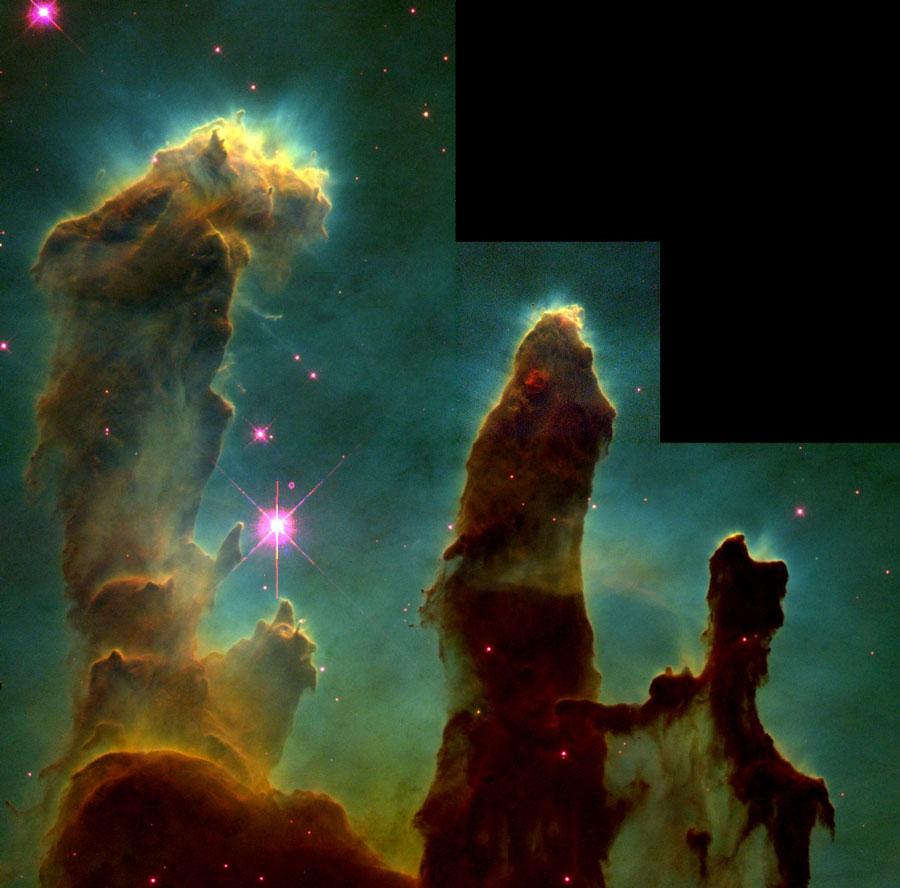
Stars initially form coccooned in dark gas; their births are therefore invisible to us, mysterious, though we are learning to see through their shrouds. The Pillars of Creation are a well-known example. Here they are as the world knows them:


. . . and here they are at the Milky Way Project:


But once they start shining, their solar wind blows off the remaining clouds, leaving a bubble like this:


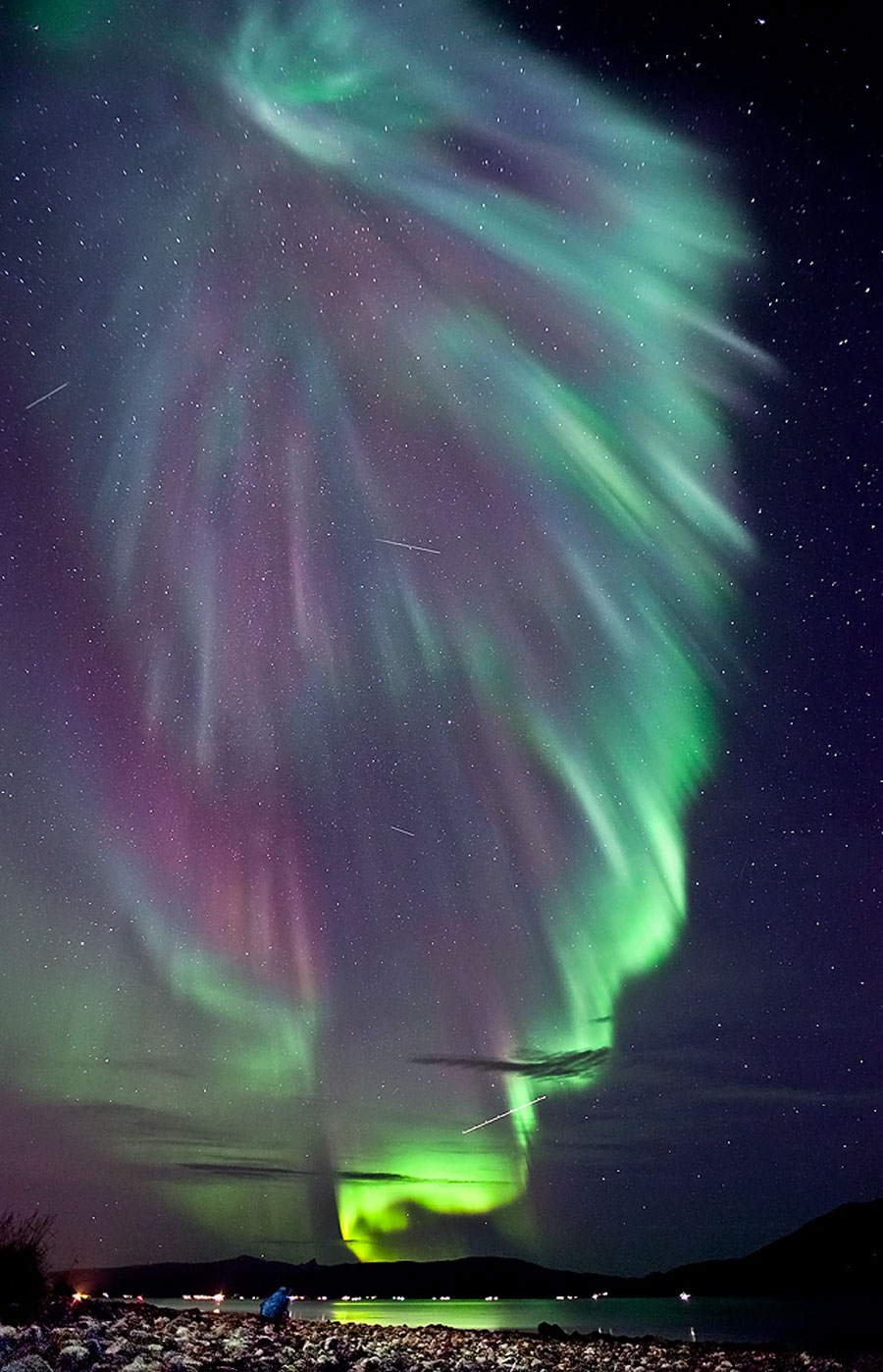
This is the same thing as the solar wind that our Sun creates - a constant thin but powerful wafting of hot charged particles, which extents pretty much halfway to its neighbours (and which Voyager is leaving round about now). It's these charged particles that cause the aurora - and why, without a magnetic field to divert or otherwise channel them, planets such as Mars make biological life difficult on the surface.

(The Aurora over Noway. From, as ever, APOD.)

The Milky Way Project FAQ - a very informative page! - reports that the green and red parts of bubbles are different. In fact, you'll notice that the pictures are mostly red and green. The green light is 3 to 8 µm long - this is, on a logarithmic scale, only just longer than visible light, visible red light being about 0.7µm. The red light is a lot longer and therefore coming from weaker-energy (colder) sources - 24µm.

Different materials emit radiation in different, very specific wavelengths. That means, of course, that two different materials are being looked at. Zookeeper Rob (a.k.a. Orbiting Frog, and an exceptionally amiable person!) explains here that red is general warm dust, such as tiny silicon particles; and that green is polycyclic aromatic hydrocarbons. Do you remember those hexagonal carbon-based molecules from chemistry, where we were first taught to write two lines on alternate faces, and then not to? Polycyclic aromatic carbons are large structures of these, looking a little like strips of chicken wire. Actually if you click the link and scroll down you'll see a sight now getting familiar . . . These are effectively "soot" from stars - star formation bellows out as mixed a bag of by-products as cigarette smoke, but these complex carbon molecules fluoresce in ultra-violet light. Hot young stars of course will produce plenty of this (its wavelength is just a little shorter than visible light, just as the infra-red Spitzer is seeing with is a little longer). So they're an excellent general gas tracker. Zookeeper Chris's current non-Zooniverse research involves star formation and the use of sulphur compounds to track it - they are another good tracer.

I mentioned earlier that gas needs to cool in order for gravity to shrink it and start starforming, for heat and light and stellar wind from stars generally throw things around everywhere - that's why red spirals shut down, as we discovered two years ago. One mystery the Milky Way Project is hoping to solve is why the dust doesn't seem to be being blown around as much as it should be: why is it still there? But knowing what the Zoo projects are like, I bet a large host of unexpected and possibly even un-thought-of questions end up getting answered too!

For example, here's something I found as one of my first images: what is this red banana?


"Some warm gas I think," replies Rob. "A classic, if oddly shaped, fuzzy red object." Damn! Oh well. Only a few get lucky at once. Science is fruitful, but it usually takes a while . . .

Ooops! Once the bad jokes start it's time to get my coat. Please hop aboard, draw bubbles, and join the discussion!

Saturday, 4 December 2010

Flabbergasted

I planned to have a nice, lazy Saturday today. Then I found out about this.

It's the stuff of complex political thrillers, possibly set in a fantasy world, such as George R R Martin's A Song of Ice and Fire. And it would probably sell pretty well, if it was a novel, and if it had a slightly less messy, drawn-out, utterly inhuman and unsatisfying ending.

Because he was unlucky enough to share a name with a suspected terrorist, Khalid El-Masri - a German citizen - was secretly seized by the CIA, held for many months, tortured, malnourished, and generally treated hideously. And this went on even after US authorities knew it was a mistake.

He was interrogated again and again. He began a hunger strike. One day before 4 weeks had elapsed he was granted an interview, at which he was basically told that they did not care if he was innocent; he was staying. All this time, nobody, not even his family, knew where he was or what had happened. It took an intervention from Condoleeza Rice to get him released. And when he was released, he was secretly dumped in rural Albania with no means of getting home. They, too - understandably given his condition - thought he must be a terrorist.

And even though everybody knows now that it was all a horrible mistake, he will never get any kind of compensation, or even an apology.

Apparently, an apology and compensation would require a lawsuit, which would break US secrets. And evidently, procedure and paranoia matter more to the powers that be than the most fundamental decency.

I cannot even begin to comment. I just have no words.

It all took place several years ago, but re-emerged on Wikileaks. Jack of Kent makes the reasonable point that Wikileaks itself, by making itself unaccountable, does not entirely fit the definition of liberal - but at this tearing-my-hair out point, I have to say: so what? It's at moments like these that I feel like I am transported into a nightmare world where everybody fights dirty. Wikileaks is not entirely what I would call honest; but I have more admiration for them than I do for those they expose. In a better world, Wikileaks could be open, as could more of politics . . .

The hideous thing is that while people can campaign admirably on so many issues, I fear that on this, our cries will fast turn to whispers. Largely, I suppose, because there's nothing we can do. We can't change how secret, powerful organisations work. I doubt they'd take much notice of protests or campaigns, other than perhaps to find ways of dealing with those who they think started them. We could try to elect governments who don't support them; but, again, the secrecy prevents us finding out who does - although, as I guess many of us suspected, both Tory and Labour are falling over each other to be first to kneel before the United States.

A friend once told me earnestly, "Countries are like people." I don't think that's true at all. Countries, even dictatorships, are run by many people; and while individuals can be brave and self-sacrificing, entire groups are less likely to do that. If all countries in the world were one person, enough of them would finally gang up together and turn on even the biggest and most frightening bully. But with countries? Catch any diplomat saying to several others, "Let's all tell X we've had enough", unless, of course, X would be a suitably small and weak victim, as Iraq was - and as human rights are.

And so all Germany needed to be silenced was this: "Our intention was not to threaten Germany, but rather to urge that the German government weigh carefully at every step of the way the implications for relations with the US".

It is unbearable to do nothing; if anybody has any ideas, I want to know about them.

(In the unlikely event that this blog ever gets important enough that I should conveninently vanish for typing these words, please could somebody save them?)

Friday, 3 December 2010

Celebrating Ice


I see that, just like last year, a bit of water in its solid form on the ground has, well, ground things to a halt again - apparently it's making even more news than the coming Royal Wedding. It's not stopping the students demonstrating in the open air, though! Oh and I hear we're out of grit? Come and sweep some off Haverfordwest's streets, there's so much I mistook a huge puddle of it for the results of an over-enthusiastic night out . . .

All right, sarcasm over (head over here for more from me if you like that sort of thing).

I have to say a personal thank you to the ice that froze on the inside of my car's windscreen, because it finally cleaned it. I'd dried off some condensation with a cloth bag weeks before, and it had been mucky ever since - despite umpteen cleans with tissue paper, towel, ice scraper, glass cleaner, and you name it - which made driving in the sunset a particular eye-watering nightmare. But every bit of that dirt fell off with the ice!

But look what came out of our bird bath a few days ago . . .


The leaves are actually less obvious to the naked eye than to my mobile's not-very-good camera. I think the ice actually expanded away from them, but retained their veiny patterns, so that it looked like a laser cutting into a piece of glass. Sadly, it's melting now . . .


I noticed that when I arrived home in the rain . . .

Off the topic of ice for a moment, I had one of those headache-inducing-ly annoying days at work today. It was supposed to be my day off, but of course certain people (who don't usually work in my office) decided to summon in me, and someone else who's disabled and doesn't come in on a Friday, all the same for our delightful monthly meeting. What happens in these is that we provide a lot of tea and biscuits, shove all our stuff off our information table for our guests, get yelled at for not doing it fast enough and generally criticised because our desks aren't empty (doh . . . believe it or not, we do do paperwork in my office), put the table somewhere stupid, arrange chairs for those who demand to be waited on hand and foot, apologise when the phone rings because somebody actually needs us, and take minutes while the same two people (neither of whom work at our office) go on and on and on about how sleepless they are about our future and how many idiotic irrelevant things they demand we must do instead of look after the people we're supposed to be serving. You get the picture. Pretty typical office meeting, I should imagine. To be fair, it isn't half as dishonest, unprincipled, bullying, or generally stressful and soul-destroying as the meetings I sat in on when I was teaching . . .

Anyway, today the person who generally takes the minutes and provides the records in my department hadn't turned up. So this task fell to me, as did taking the prolonged public kicking for not knowing the things this person knows, who has been here 15 years longer than me, and because somebody didn't know something that I thought they knew and that wasn't part of my plans so not my job to tell them . . . Again, you get the picture. I'll shut up now.

I then had an icy walk to the car and shopping to do, and my head was pounding. On the roads leading away from the town I work in are signs to one of our local beaches. They point right, while my home lies left (roughly speaking).

So today I thought . . . I will follow those signs.

As soon as I'd parked the car and got out to hear those waves between the still, silent cliffs, I felt better. The wind was painful around my un-scarfed face, it got in under my coat, and the clouds were dark; but the sea was a surprisingly bright blue-green.


This is Broad Haven according to the holiday websites . . .


This is it earlier today . . .


. . . yep . . . lots of water had frozen right there on the stones and sand. I walked on ice puddles which made wonderful noises but did not snap, merely created bubbles and pushed the sand around! (I'm actually really cheesed off - you see that blurry bit on the bottom right? That was an amazing ice puddle in which stones were nestled, but I somehow managed to delete that photo when I got home).

The ice had fascinating effects on the sand. It was wonderful to see where there was both solid and liquid water, and the alien landscapes it was managing to produce . . .


If someone had told you this was a satellite photo of Mars, would you have believed them? I'm afraid I might! But it's just ice and sand. Look at the effects . . .


. . . and just next to the image above:


It's a funny thing, ice. Most materials - as far as I know - contract when they cool. But the water molecule is a very special thing. It's sort of Mickey Mouse shaped, two hydrogen atoms and one oxygen atom. The oxygen atom is much greedier for electrons than the hydrogen atoms are, so they spend, on average, more time with the oxygen - or to put it in another way, their "probability cloud" or where they will be is somewhat skewed towards the oxygen. This means that the oxygen has a negative dipole, the hydrogen a positive one - so, like a magnet, they will be attracted to each other (this wonderful article mentions an old description of two hydrogen atoms desperately in unrequited love with an oxygen atom). But this affects other water molecules too: the oxygen will also be attracted to hydrogen atoms of other water molecules, and vice versa, which makes the general structure stick together very nicely. Most molecules so small, and made of such small atoms as hydrogen and oxygen, would be gas (think of nitrogen, methane, carbon dioxide . . .). But water's a liquid, because of this dipole. And although they slip under and over and around each other a lot, their strong bonding also causes capillary action - just watch rain falling on the window and notice how a new drop will leap into the track of an old one, rather than make a new trail.

But once water goes solid, the molecules form hexagonal lines. Russell Stannard, in his book "Ask Uncle Albert", describes ice molecules (water molecules below freezing point, if you will) as being like long, long lines of people all sitting on each other's laps. This rigidity leaves plenty of gaps between those lines, which is why it expands. That's why, when water trickles into rocks and soil and then expands, we get weathering. I believe that's probably what's happened in the last picture above.

It was also very satisfying scientifically to notice that the water that remained liquid seemed to be coming from under the stones or sand - since ice expands, it's lighter than liquid water, and so it rises. Again, this isn't true of most liquids. But it's made pondlife and icebergs possible. Without this characteristic of water, I bet a lot of Earthly life would be hugely different.

And meanwhile, something's a bit wrong with the cliff . . .


But after only a short time of tramping across the beach I was starving. So I went to the cafe by the road. It was closed, but another was open. I bought scampi and chips and a hot chocolate with whipped cream and marshmallows. While I waited, I chatted with a family already scoffing chips there. They had two utterly adorable and very well-behaved dogs, who let me stroke them like cats, one hand on each. I honestly cannot recommend a better remedy for awful meetings!

Anyway, yes, I took my scampi and chips and hot chocolate and two sachets of tomato ketchup straight out there to the beach again. I went closer to that cliff . . .


And mostly stayed away from the water; can you imagine how slippery it was there? I plonked myself down on a rock, found a little well-like bit to put my hot chocolate in, and gobbled scampi for a while. It was raining slightly but I decided I didn't care. Surprisingly it really wasn't that cold.

Nevertheless, although the huge icicles hanging from the cliff were shedding water and indeed a few chunks of ice onto the sand, clearly the ice wasn't going to melt very fast!


What a sight!


While a chap nearby did a crazy dance, I photographed and photographed, my hand over my mobile to shield it from the rain - also to put it in shadow, since the picture went especially dark whenever I tried to include a bit of sky. I wondered how long it had taken those icicles to form. I remembered a phrase I'd heard in my first year of university, describing Antarctica, which really tickled me: "thermal inertia". I think the gist was that an increased amount of water vapour in the atmosphere would increase the size of Antarctica to some extent, since the water molecules would be likely to stick to it. If the size of Antarctica increases, that will increase its albedo - in other words, it will reflect away more sunlight. Of course, it will also raise the average temperature of Antarctica, too, just the same as if you pour warm water into a bucket of ice.

Another beautiful characteristic of water is its high specific heat capacity or enthalpy of melting. Heat is basically molecules wriggling about frantically due to having plenty of energy. (Absolute zero is of course when they stop moving altogether.) Now, because of the strong attractions between water molecules, it takes quite a lot to make them separate, or wriggle away from each other. That means that you have to put an awful lot of heat in before it'll warm up. The converse is true, too: water will take a long time to freeze, because it's got so much spare energy you had to put in to warm it up in the first place.

And that is why the Earth's surface is (contrary to how it often feels) remarkably similar in temperature all over. OK, OK, so hot countries seem incredibly hot and cold ones seem incredibly cold, but that's because we're adapted to a narrow range of temperatures, and what cosmologically speaking is only a slight variation seems extreme to a biological entity. When water evaporates from the equatorial regions, it carries plenty of heat to the poles. And those cold deep currents that start at the poles and head towards the equator remain cold, which again is useful, because more oxygen can dissolve in cold water - so cold water upwellings are particularly useful for marine and coastal life in the equatorial regions.

In short, if the Earth's oceans were oil, the heat would be far less evenly distributed around the globe!

I love the water molecule. I actually fell in love with it during A level Chemistry, and kept up with it for my A level project and several of my university units. If you want more of what it can do, check out this site - I've linked to it before, but it has some desperately gorgeous close-ups of snowflakes!

I'll leave you with the most spectacular photos of that cliff . . . and by the way, it was very nice to get home!


Friday, 26 November 2010

A letter to the students

Dear students,

I am writing from a dark memory of a time when young people did not do what you do today. I was a teenager in the nineties when the mere mention of politics, or indeed anything that took place out of the classroom or the charts, was considered worse than discussing homework. In 1997 I was 14 and, I now regret to say, very excited about Labour's victory - my classmates could not tell the difference between this and "fancying Tony Blair". To speak up about things that happened outside one's life was "sad". It was just not done.

So I suppose, if we have one thing to thank the Labour government for, it was annoying people enough to make protest a do-able thing. Or, perhaps the introduction of the Internet. Or even better education. Who knows?

I don't know why you are doing things that my generation was too cowardly to do. But well done, and for God's sake don't stop. Democracy is precious, and easy to lose. (I later went on to live in Spain, but abstained from voting for student leaders because I didn't understand enough of the language to make a choice. I didn't feel I had the right to bias the voting with an uninformed opinion. To my fellow students, whose parents probably remembered Franco, my not voting was shocking and distasteful, letting down of a hard-won value.)

I notice you're having to put up with the usual remarks - "these kids are too young to be out of school", "they just wanted to bunk off and have a fun day out", "it's just £7.50 a week once you're rich anyway", and so on.

Why go to school other than to prepare yourselves for the world? Not just to be a consumer, not just to get a job: but to be part of society, to change the world for the better, for nobody else will if you do not. As well as to partake in the greatest joy I know - that of knowledge. As a professor of teaching pointed out to a group of trainee teachers, there are only three groups of people who we tell where to go: criminals; the insane; and children. But you are not in school simply to get you out of the way until you're a grown-up. I know if often feels that way, and that's what you've got to fight. Your education is for you, and for other people too. It is not only your right but your responsibility to fight for it. To those who did - I am so proud of you!

It may be true that the fees would not, in theory, prevent anyone from going to university (the BBC page has a good set of questions and answers you should check out). The MP Tom Watson, and those who agreed with him, got a lot of kicking for "misrepresenting" the situation by pointing out that, if he saved £100 a month for his 5-year-old son, that would still not pay his tuition fees, for they are not upfront. A loan hangs around your neck for many, many years; but it's still better than paying upfront. No, what's going on here is a subtler but pernicious ideology.

Even before it's time to apply, there'd be the worry whilst growing up about whether or not it's worth going anyway. "It won't help you earn back the money you'd spend on it. Such-and-such went into banking without a degree and is now earning so-and-so." It's an off-putter from the start, especially for poorer families. Incentives for poorer students (see that BBC link) sound good but might create a divide, turn it into a situation of charity, and also would not help students whose parents of higher incomes discourage or refuse to help their offspring who want to learn (yes, there are those).

And during, the thing itself: it's become a market. Introduce the market and what matters is money, not education itself. Education becomes a "product", your degree is something you've bought, no longer a labour of love. And it must be paid for in the end. So if you never earn that £21,000 a year, then what? Who does pay? Would your course leaders spend their time preparing you for jobs that do earn this figure, and perhaps throw you out if you're likely to end up on a job that pays less? And what about the marketplace atmosphere itself: as businesses compete, would universities have to work against each other rather than together? Would the corporate branding, the package, the adverts to try and "sell", become the focus rather than what's inside them? More simply: would people concentrate on what looks good rather than on what's to learn, and learning, as a result, suffer? It's hard for a non-economist like me to explain. Perhaps some of you economics students can tell me whether or not I'm right. My feeling is this. We have the National Health Service and I'm bloody proud of it. We do not treat people on the basis of whether or not they have money. A sick person is a human, and a normal human helps another person; end of story. Markets interfere with straight humanity from the heart. I wanted to be a teacher and give education as a gift - no, not even that, for child-rearing is not a gift but something a mother simply does, and that's how I saw learning.

Maybe this is a bad patch before we reach a very different future. Have you noticed those occasional articles about virtual schools and everyone learning online anyway? Maybe that's what'll happen; maybe university will one day no longer be about leaving home. The cost of accommodation and living has risen too. I lived in a cheap hall which I thought was part of the experience; but these were knocked down one by one and more and more students around me spoke snobbishly of their expensive quarters, expressing horror at the idea of sharing a bathroom. Well, these things do have to be paid for. That should be a choice; but what if the cheap choice is no longer available? Tuition fees aren't the only thing to worry about. Actually, going back to myself again (and I probably seem pretty ancient to many of you!), I noticed the lecturers mourning how their courses had to become easier and easier, and only an MSc would be taken seriously, and thought - for goodness sake, university just seems to be a pampered boarding school. That probably is a waste of your time.

But back to this week. Whether your worry is education cuts, or tuition fees, and whatever people think about those: well done. You have to do two things to really make a difference: one is to check the facts, and the other is to make your voice heard. If you only do the former, no amount of learning will make any difference. If you only do the latter, people will continue to get things wrong. (Actually, that'll happen even if you do both, but you know what I mean.)

I want to give some special well dones now, but please don't feel miffed if you simply didn't have the opportunity to do anything heroic; these things often come to you by accident.

I want to especially congratulate these brave girls. The Guardian shows the van being damaged, but the BBC caught this photo, and I do recommend a look through this entire photostream. I notice they've been insulted as much as anyone: "The van had already been smashed up, what are these silly little girls going to do ? Turn back time?" Sadly, the idiots in your classroom may remain idiots for life; believe me, grown-ups can be unutterably stupid too. This grown-up missed your point, I think. You were standing up for peace and responsibility at your own risk. You were being human shields; you made an inexpressably important gesture.

"If they smash it up, it just proves the point that teenagers are out here today for violence," said one of the girls amid the chaos, her eyes darting left and right looking for the next vandal. "If we let the government portray us as violent then there is no way they are going to listen to us."

Well said, young lady.

After watching videos like this, I guess many of you will, understandably, distrust the police for life. Wasn't there supposed to be a time when they wore tall funny-shaped helmets and were helpful, pulling boys' heads out form park railings? (No, I wasn't around then, but I've read about them in books.) I hope things like this won't lead to a complete collapse of any trust between those with authority and those without. That won't get the country or education anywhere. But this is largely for authority to decide. Yes, there certainly were from the sounds of things a few morons and violent people at the protests, who ruined your cause and did nobody any favours but the paranoid. Make it clear those were not the majority.

Young and old learners, students, school pupils, all those who want to learn - I've been reading article after article of what you've been doing. I'm smiling at the BBC's list of your activities around the country, and am intrigued at the UCL takeover (Update: They have a fantastic blog, do check them out!). Honestly, when I was your age I'd given up on my peers ever getting off their navy-blue-skirted bottoms and doing a thing - you have raised the profile of humanity. (Did you know that Paul Lockhart describes you as "the ones most often blamed and least often heard?") But most of all I'm moved by the words of Laurie Penny, who was in the kettle with you and wrote in the Guardian and the New Statesman. I was scared for your welfare, yes. I wish I'd been able to get to you all with food and drink and warmth, not to mention miraculous toilets and medication for those in need. It horrifies me to think of you being out there for so long, essentially deprived of things even a prisoner cannot legally be denied. The humiliation for some, as well as the cold and hunger and other discomfort, must have been terrible. But even then a lad told Laurie Penny not to add a book to the fire to keep you warm, because you're not Nazis. Let safety and comfort be secondary. You knew that, and I expect many of you would do it again.

As a last resort. If you can't go to university, don't stop learning. Something has happened which I hate, and that is the all-or-nothing situation all learners are in: you cannot leave school early, as some people want to do as much as others want to stay, but once you have, that's it. Adult education is very difficult to get into and often terribly expensive. But people have been doing something long before David Cameron came up with his "big society" ideas: they've been learning informally, alone, or together, online. I run Cardiff Skeptics in the Pub and the Galaxy Zoo Forum, both of which are essentially movements for people to discover things together. (Obviously what I say here is from me alone, not from either of these movements. We grown-ups have to clarify these things for each other's benefit.) You can be in on either of these - young Rhys Morgan is a 16-year-old skeptic, and we have young people who learn to classify galaxies and contribute to real science that goes in papers. There are many, many movements like this, peaceful organisations, cheerful groups of people whose brains are filling with beautiful things and who can do a great many things as a result. You'll be welcomed in. If they have to take over education for a time, that's not a good outcome, but it's better than nothing.

Let's all do what we can, our different things, to keep education going.

Much love and praise from Alice, who wanted to be a teacher, and hopes she can be a teacher in other ways.