Friday, 1 April 2011

My New Theory!

Dear all, I wish to announce an extremely important change to this blog, and to my life as a science communicator. First of all, I scrap this science communicator nonsense. They keep telling us that anyone can do science and I did experiments at school 'cause I was forced to in lessons so first and foremost I am a SCIENTIST and I have made DISCOVERIES and anyone who says otherwise is clearly either just gullible or in the pay of selfish academics who want to keep everything for themselves.

I have long had a problem with the lie that is relativity. Check it out for yourself! One minute these boffins are telling you that there is no force called gravity, that it is merely the curvature of spacetime. Next they say that it is a force but it is much smaller than the other forces, clearly ignoring black holes. By "they", well actually I've only heard it from Brian Cox, who was so mean about that most ancient and best proven science, astrology. And then they bring in this idea of tiny particles called "gravitons". How do you need gravitons if gravity is just curving space? As if you can curve nothing. Don't be stupid.

And don't get me started on Dark Matter. They can't even agree on what it is. One minute they say there's all this stuff around our galaxy that changes something to do with the rotation. Then they come up with all these other stupid ideas like MOND, which sounds more like a fashion item than science to me. If science is about making discoveries, why aren't all scientists in agreement with each other? They just want to keep up the pretence of still disagreeing so it doesn't look like they're all one obessive hive minded communist league. And to get funding for silly things like CERN, which recreate conditions from a time that never happened in the first place, when our money could be going to useful things!

It only requires a little thought. Gravitons are particles to do with gravity. When there's lots of matter around, they cluster round the matter or something, and they show gravity. But what if there isn't much stuff around? Like outside galaxies. Well maybe there's still lots of gravitons there. Just because galaxies are clumped together doesn't mean everything else has to be. (I mean, look at the way everyone's expected to be the same.)

So obviously that is what causes galaxies to rotate in a funny way. There's loads of gravitons about the place at the edge of galaxies, looking for a home. So scrap your stupid mathematical models - maths is only a way of intimidating people anyway, it doesn't mean anything - and get promoting my idea for what things are really all about. There's plenty of evidence, just look!

A representation of dark matter in the Bullet Cluster. Read more on Discovery Magazine and BangUniverse.

I would delete all the other stupid gullible posts from this blog that was really just me uncritically swallowing all the rubbish scientists had told me, but I thought I'd let them serve as a warning to you all.

P.S. In other news, skepticism has finally been acknowledged as just another cult, UK Uncut are going to become a political party, and you might see two dentist-requiring Suns in the sky any day now.

Sunday, 13 March 2011

Wandering stars and 24/7

[The] collection of seven gods, seven days, and seven worlds - the Sun, the Moon, and the five wandering planets - entered the perceptions of people everywhere. The number seven began to acquire supernatural connotations. There were seven "heavens", the seven transparent spherical shells, centred on the Earth, that were imagined to make the worlds move. The outermost - the seventh heaven - is where the "fixed" stars were imagined to reside. There are Seven Days of Creation (if we include God's day of rest), seven orifices to the head, seven virtues, seven deadly sins, seven evil demons in Sumerian myth, seven vowels in the Greek alphabet (each affiliated with a planetary god), Seven Governors of Destiny according to the Hermetists, Seven Great Books of Manichaeism, Seven Sacraments, Seven Sages of Ancient Greece, and seven alchemical "bodies" (gold, silver, mercury, lead, tin, and copper - gold still associated with the Sun, silver with the Moon, iron with Mars, etc.). The seventh son of a seventh son is endowed with supernatural powers. Seven is a "lucky" number. In the New Testament's Book of Revelations, seven seals on a scroll are opened, seven trumpets are sounded, seven bowls are filled. St Augustine obscurely argued that for the mystic importance of seven on the grounds that three "is the first whole number that is odd" (what about one?), "four is the first that is even" (what about two?), and "of these . . . seven is composed. And so on. Even in our time these associations linger.

The existence even of the four satellites of Jupiter that Galileo discovered - hardly planets - was disbelieved on the grounds that it challenged the precedence of the number seven. As acceptance of the Copernican system grew, the Earth was added to the list of planets, and the Sun and Moon were removed. Thus, there seemed to be only six planets (Mercury, Venus, Earth, Mars, Jupiter, and Saturn). So learned academic arguments were invented showing why there had to be six. For example, six is the first "perfect" number, equal to the sum of its divisors (1 + 2 + 3). Q.E.D. And anyway, there were only six days of creation, not seven. People found ways to accommodate from seven planets to six . . .
- Carl Sagan, "Pale Blue Dot", 1994
And that was before Harry Potter and the seven Horcruxes, not to mention seven Weasley siblings, and George R R Martin's "A Song of Ice and Fire" series in which a major religion is centred on seven gods and whose holy book is called "The Seven-Pointed Star". Not to mention seven colours in a rainbow. If you can take a really good photograph of one, and distinguish blue from violet in colour, and the two of them each take up as much room as any of the other colours, I'd love to see it - I honestly have yet to see a rainbow like that (much as I like blue and indigo).

Anyway, doing some totally unrelated research, I stumbled upon the Babylonians. I knew they were responsible for 360ยบ , 60 seconds a minute and 60 minutes an hour, and probably for popularising algebra (I recommend Marcus de Sautoy's "The Story of Maths"!), and I knew they were very meticulous astronomers, but I hadn't previously come across the intricacy of their days of the week system.

It was in a book I was reading, and not one recently published, so being an incorrigible skeptic I had to go online to get an independent corroboration. (No, that's honestly nothing to do with the trolls on the Guardian comments pages accusing me of "getting all my information from the Guardian" when in fact I was getting most of it from the Sense About Science website! Although one does wonder what they were doing there if they so despise it . . .) It was quite a trawl. I found plenty of sources confirming that each of the ancient "planets" (in those days, "wandering stars" - stars that did not move across the sky at the same speed as other stars) had its own weekday, such as here, here and here. And I ended up reading part of an interesting book about the origins of weekdays. Following the French Revolution, a ten day week was imposed - but it just didn't work.

Ancient Inventions even claims that "when the Babylonians invented the seven-day week, they anticipated the findings of 20th century biologists. It has recently been discovered that the human body is governed by a seven-day biorhythm, which is detectable from small variations in blood pressue and heartbeat as well as response to infection and even organ transplants. The same biorhythm affects other life-forms, even simple organisms such as bacteria."

I'm not entirely sure I buy this. The only source it cites is a book (which may or may not be correct but I am not going to go and ask my library for before I post this!), but furthermore their wording makes no differentiation between cause and effect. The shells of some coastal critters or other that grew near towns during the Industrial Revolution show layers of growth like tree rings - and every seventh layer is palest, i.e. the ones they grew on Sunday when the factory was shut. (Source: memory of a lecture in my degree. Take with pinch of salt to suit your taste, but I have a nerdy memory for random facts.) Besides, human timekeeping is not to 24 hours - it's longer. This is not even a relic of a past when the Earth was spinning faster, or it would be shorter. And in any case, seven is not a universal special number - in China, for instance, the "lucky number" is eight.

Still, it could be true. I'm guessing the bacteria in question are influenced by the same things humans are influenced by - pollution, for instance, probably occurs at different timescales and intensities at weekends. But you never know.

So, in attempting to research one thing, I came across the Babylonians and their planetary systems and timekeeping, and in attempting to research that, I came across a lot of other things, and I hastily stopped there. Research is great fun, though! And by the way, it isn't something I have a clue how to do academically. So don't feel unqualified to go looking things up.

Sorry, but after all that, the best pages I have to show you are Wikipedia: Planetary Hours and Week-Day Names. The latter at least has obviously had a lot of source verification put into it. (Wiki can actually be very strict - Rick Nowell on the Galaxy Zoo Forum found that creating the "Peas" page was a huge task due to the very tight sourcing rules. My research of the entire project - which was used, for example, in selecting names to go in the acknowledgements on the papers - was disallowed because it was a blog post.)

Anyway, to summarise on the ancient deities to whom the planets were assigned. Sunday of course was the Sun, Monday the Moon - those are obvious. Tuesday is Mars. In Latin languages this is more obvious - for example, in Spanish (a handy reference, since it's similar to Latin and I speak it), Martes. English is based on the Anglo-Saxon/German equivalent, known as Tiw, another god of war. Wednesday, or Miercoles in Spanish, is Mercury (in German, Mittwoch, or midweek - there is an older connection to Woden or Odin). Thursday is Thor or Jupiter (Jueves in Spanish). Friday, Viernes, is Venus, or Freitag or Freya's day. Saturday invariably sounds like Sabbath or Saturn. All well and good, you probably knew some or all of that. But why do they come in that order?

Since all these "heavenly bodies" moved around in their "heavenly shells", they each crossed the background of apparently static stars and made a complete circuit of the heavens. It is easy to instinctively reject this as the Sun and Moon surely do that every 24 hours, except that that's a circuit of the sky - not the entire background of stars, for example starting in the constellation Taurus (to the right of Orion) and all the way around until they get back again. From that point of view they do it in a funny order: the Moon is fastest, then Mercury, then Venus, then the Sun, then Mars, then Jupiter, then Saturn. All right, some of those are in the order in which the planets are really spaced from the Sun. But not all.

But the weekdays don't follow that, or they'd go in the order of Monday, Wednesday, Friday, Sunday, Tuesday, Thursday, Saturday. And this is where the 24 hour timetable comes in.

Each "hour" is supposedly "controlled" by a planet or deity. For example, midnight on Monday is controlled by the Moon. Then after that we go to Saturn - the "god" who takes the longest time to cross the entire heavens (or ecliptic). Then Jupiter, the second-longest. Then Mars, and so on. The table at the bottom of this section shows the system, as does this table I wrote myself to see if it worked before I found that one:
. . . and so on. (The page ran out.)

Of course, one website - I now can't remember which - threw a spanner in the works by claiming that the Babylonians only had 12 hours, which stops the system working. Sources seem to differ as to whether or not they bought into astrology and predictions. On the one hand, one cites as 11th century writer as claiming that "predictions are a new science", and on the other, we've got this really detailed and prescriptive table of what all the hours are supposed to mean - for example, you should ask a lady out on a date during one of Venus's hours. (Detailed and prescriptive is also exactly how I would describe the ridiculously large array of different labels on homeopathic products, all of which basically just contain sugar.) All I can say is, if you ask me on a date at 6am on a Monday morning, I will not rush to my astrological chart and swoon obediently because of some arbitrary rule, I will wonder (unless we have been up all night talking for example) what the heck is going on!

Sadly, most of the websites I found, whilst trying to make some sense of this fascinating history of people who made such detailed records, were trashy horoscope sites, so do please indulge me and let me make a little bit of fun. Some of the discoveries ancient people made, as well as the time and care they took with compiling massive records, are really incredible achievements. Incidentally, just a few of those are what I'll be talking about at Cardiff Skeptics on Monday next week - I hope to see some of you then.

Sunday, 27 February 2011

Why women still need to unite

When I was about five, I was in a children's choir, and one of the causes we raised money for was the Romanian orphans. This was the mid to late eighties. I put my Christmas money in a little white envelope for them and labelled it, in shaky capitals, "For the Romanian orphans, as pocket money". When my parents explained that they were starving, I wanted to send them chocolate biscuits. My parents told me those would probably make them ill.

Years and years later, I now know why it was Romanian orphans in particular - it was because of the persecution of their mothers' bodies, reducing women to livestock, or fields to be ploughed, and these children were born to mothers who couldn't afford to raise them. Abortion was illegal until a woman was over forty-two or had five children already. Women were inspected at their workplaces to see if they were pregnant. Men or women over twenty-five who remained childless were heavily taxed, and I don't doubt made to suffer in other ways as well.

One of the things I remember clearly from Lionel Shriver's haunting novel "We Need to Talk About Kevin" is his mother Eva's disgust at society's attitude to her pregnancy. Suddenly, she felt, she was no longer her own mistress or regarded as such - suddenly, even strangers felt that they had some kind of corporate ownership of her "bump". She was not trusted to care for her baby properly. Her husband in particular, the man she loved, thought he could lay down the law about what she should and should not do. The assumption was not that "society will intervene if you behave carelessly", but "society assumes you do behave carelessly and will therefore intervene constantly and on autopilot". She couldn't even have a quick dance around a room without being read a lecture. I was younger then and thought she was being overly grumpy. Now I only have to look around on the Internet to see how right she was.

Even when someone writes "I don't think the woman's choice alone matters, because there are two people involved", meaning to sound a bit fair on both sides, an alarm bell rings for me. Of course there are two people involved, but it seems to be all too easily assumed these days that the woman herself is incapable - or not a good enough person - to make a decision that would also be good for the baby. It's assumed that the two are automatically in conflict, and therefore everybody's job to leap to the defense of the baby against the woman - in other words, try to take control, when it's her who has to bring the child to birth and then be its mother. I can't think of anything better designed to drive a wedge between a mother and her baby - a bond that biology dictates should be as strong as anything - or at the very least destroy a mother's confidence when she is already at her most vulnerable.

It always surprises me that the cycle of oestrus is supposed to be "primitive", and that the human ability to conceive at any time, regardless of wishes or ability to care for the offspring, is something so advanced and wonderful. In the cases of most animals, I don't know if "wanting" to conceive or not has a meaning the way it does for us, but why do humans conceive so readily when they don't always want to? It seems like a silly mistake of evolution to me, and one that causes untold grief.

If these kind of issues interest you, I recommend you follow @antitheistangie on Twitter. She endures daily threats of murder, rape, the harming of the child she already has, etc. etc. etc. because she has dared - for the sake of other women - to make public the fact that she had an abortion for a variety of what to a Western European like me seem to be very sensible reasons. As far as I know, none of her harrassers are ever even reprimanded, much less brought to justice.

I hope it's clear from other entries on this blog how much I adore children - what I hate is the orders from above how their mothers should raise them, which so frequently run contrary to both the mother's interests and the child's. In this country, women are forbidden as far as is possible to stay at home and look after the kids if that's what they want to do. In America, it seems to be the opposite. Let me take you through a sad life for a woman under the Republicans' plans.

Let's say she's single, and in or aiming at a career, probably planning to have a family when the right partner comes along. And let's say that before she is ready to support a family, she is raped. However, the law has redefined rape. If she is forcibly drugged, or tied down and unable to fight back, that means the rape is her fault and she is not allowed an abortion. (This would also be also the case in, for example, family incest, where the victim is too young or too disempowered to fight.) Furthermore, she would be considered "the accuser", not "the victim" in this crime.

Since all health care has to be paid for, this woman's employer would be punished by the state if her health insurance covered abortion. She might scrape together every penny she has to pay for it herself, but the doctor who would perform the abortion is murdered and the murderer is let off by state law. She might try another place, but the hospital would be quite within its rights to turn her down.

If she miscarries, she could face the death pentalty - even if the baby wasn't properly formed, which often occurs in pregnancies, miscarriage being the usual natural result - unless she could somehow prove that she herself had no hand in the miscarriage. (How any woman could prove this, especially while doubtless sick and weak and also quite possibly grieving, I don't know).

If she bears the child, she has no means of support. She is not supposed to work, and childcare is withdrawn, because she should be at home with the child - but she will not receive any aid or even food. The program Head Start which would be the way she would have got her child into preschool has been terminated. Doubtless it is considered her own fault she was raped, too. In such circumstances the child is horrifically disadvantaged, probably in terms of social stigma as well as economically. Once a perfectly capable, productive lady, she and her child are both condemned by a string of laws to a cycle of difficulty and unhappiness.

All because the law-makers wanted control over this woman's body.

To be fair, these are a variety of proposed state laws I've detailed, rather than laws already in place for one state - but once these get a hold anywhere, would they start spreading? When I read what I could of Margaret Atwood's "The Handmaid's Tale" (I never finished it, I'm afraid), I didn't believe for one minute that freedom could really be lost with such ease and totality. Now I'm reading up on these laws, it seems much more plausible.

Freedom doesn't mean "yeah, let's coldly have lots of abortions". It means, for starters, having access to education, family planning, and contraceptives so you don't need one in the first place (though contraceptives do sometimes fail). To assume that everyone worth anything will stay celibate is not realistic, and excusing rapists from responsibility makes it an even more ridiculous assumption. It means having enough education and confidence to make the best decisions for your offspring, and to be allowed to carry them out.

This is a momentous time for women right now - not just because the Republicans are trying to implement increasingly loony hate-filled laws against them (fortunately the redfining rape one got - hopefully - kicked out), but because of the revolutions in North Africa and the Middle East. Did you see the photos of the Egyptian girls mending the pavements in Tahrir Square? Here are three interviews with young women who found themselves amidst the revolutions, and their hopes for how things will turn out. Women played a part in the revolutions; I cannot hope more strongly that women will continue to play a part in the future of their countries.

Apparently, the horrible case of Lara Logan - who was attacked and gang raped during the Egyptian revolution, and saved by a group of guards and women - is being used as a platform to suggest that women shouldn't be journalists in potentially violent areas. This is rubbish - it sacrifices the woman and all her potential whilst limply accepting that violence is inevitable. (Although it would be a great moment to say "We shouldn't go to war because some people would get killed" - sadly I don't think Logan's detractors, or anyone else who accepts violence, will buy into that one.) Surely it is equally horrible for a man or for a woman to be attacked as she was. If any person gets attacked, that is awful. But it's something we have to speak up and challenge, not run away from. Although I know nothing about Logan and would not dream to speak for her, I imagine that most journalists in such areas feel that the risk of attack is worth it for the sake of informing the world of important events.

To say that she should not go to Egypt is to say, "Violence towards women is inevitable - solution: keep the women at home." (Cecilia Payne-Gaposchkin suffered precisely the same thing - she was frequently turned down from working at observatories because she would be alone in them at night, which apparently wasn't safe for a woman. Being "assaulted by blacks" was apparently the greatest risk, neatly using racism to absolve the sexists of responsibility!)

What is needed is a culture change to make violence less acceptable. That of course is far harder. But I think men too would benefit.

I'm talking a lot about women's rights in this blog post and hope that my male readers don't feel it's in any way to their exclusion. We women are physically weaker and able to bear children, which means we can be preyed on and controlled and abused in ways that men cannot, so we do need some specific laws to protect us. But also, a society which does that to its women will, by definition, have to do it to men too, in case any men disagree that women should go through this. Doubtless such a man would be punished as some kind of sissy or collaborator. (Of course it can work the reverse way - that in a free society, a man might howl at and denounce women's rights, but he's usually just laughed at rather than for example beaten up or jailed.)

Here in the UK, some of the greatest champions of women's rights I know are men. There's nothing odd about that. I'm as pale white as you can get, but I'll get as upset as anyone else when I see racism taking place, for example. A society that welcomes everyone is far more pleasant and constructive than one which reviles non-whites. I think the same can be said of sexism. "Justice will not be served until those who are unaffected are as outraged as those who are."

Any population which penalises and degrades some of its citizens - for their race, or religion, or colour, or for their sex or fertility - is wasting a part of its potential, as well as tying up all its citizens into a system of injustice and unhappiness. Therefore, no matter how good your intentions in wanting to protect all babies, threatening and punishing and controlling their mothers will, to say the least, backfire. And these things need to be stopped.

Saturday, 19 February 2011

Who has the power to change things?

The finger-pointing game in our economic woes took an interesting step upwards today.

We've been hear a great deal about benefit scroungers and have done for as long as I can remember. Immigrants who've fled tyranny; Laura and Dud and Pete who are too sick to work; so on so forth. I think certain powers that be, not to mention the tabloids, would have us all believe that anyone who claims benefits is like "Mick" whose phone in became one of the BBC's most popular stories.

The article appeals to the angry and powerless. "It's free money, I love it," this chap is quoted as saying. What society gives to him is actually tiny compared to what it gives to the banks - but this is a small, sorry target you can hate and perhaps attack. And this is not someone powerful. This is scrouging we might have a hope of stopping.

For the record, no, I don't think what he's doing is right at all. But I think he reveals some rather wider problems:

"All my family have worked all their lives - they worked down pits, in the steelworks, and they've all died from illnesses related to that. And they've had nothing to show for it at the end of it. All that money they've paid in, they've paid out again to the bankers . . . The people who are working today - they're paying for the bankers, their million-pound bonuses every month."

He also remarks that neither he nor his friends can see any future for themselves. Is this simple laziness or is it a problem with education and society that we can work together to address? Maybe some of each.

(On a completely unrelated note, these new cuts and laws to "make work pay" and make it harder for people like Mick to remain on benefits look to me as if they are already firmly in existence. When, after months of unsuccessful job-searching, I finally caved in and applied for jobseeker's allowance, I was made to feel like a criminal: it was difficult, humiliating, protracted, soul-destroying and time-consuming - getting a job would have been a breeze by comparison; and when I finally found one, it was! They even managed to mishear my National Insurance Number over the phone once and use this as an excuse to try and close my claim down. I heard about a young man who tried to hand an employment application form into a shop well before the closing date but was turned away because they'd already had so many - and lost his benefits for three months for "turning down an opportunity". I was also given to understand that my benefits would last less than a year, after which time I would just have to sink or swim. So how does this Mick spend 18 years on them? Does he apply for jobs but not take them? I have no idea. I suspect every Job Centre's system and strictness is different. But that's a question for another time, and probably someone other than me to answer.)

We're warned not to over-tax or rather "punish" the large corporations and the rich, for they are "wealth generators" who will benefit the whole country. If we do not give them everything they want, they will set up their businesses abroad - and that will be wealth gone from Britain, presumably benefitting nasty beardy terrorists and setting up ever more infuriating, obstructionist and expensive call centres who make us want to throw our goddamn mobiles out of the window, except that we need them not only to grab the odd happy minute with a friend but to chase up job after job.

Well, I'm no economist, and I'm prepared to be proved wrong - but I don't think these "wealth generators" are doing quite what they're cracked up to do.

What they've done instead is generate massive inequality. It's so great that many people don't see any point in even attempting to get somewhere. The fact that some (and I would like to know what percentage) are taking advantage of the welfare state does not mean that the welfare state is to blame for society's problems.

Returning to the original subject of problems and blame, today UK Uncut are spending this weekend staging mass protest against Barclays Bank, which have paid a tiny £113 million in tax whilst earning profits of £11.6 billion, £1.5 billion of which went to bonuses - and whose chief Bob Diamond says that "the time for remorse is over" and that banks should, it seems, continue exactly as they have been doing. (If my economics are right, your average taxpayer pays maybe 20% tax, while Barclays pays 1%; and Bob Diamond's pay package this year is over 1000 times what Mick gets, including rent.)

It's quite an imaginative style of protest: "‘teams of UK Uncut volunteers will be entering the banks, occupying them and transforming them into something that people need, but will be cut’. In central London, hundreds are expected to set up a live stand-up comedy show, libraries, and a mothers' breakfast club, all inside different branches of Barclays". As I write, I hear reports that around 40 branches of Barclays have closed. (Update: 50 now - from the Guardian.)

But is all this simply the banks' fault? Not entirely. Because none of what they are doing is against the law. As David Allen Green points out, this campaign is asking for a "voluntary tax". (Although David Cameron demands that charities prop up society and people work for free, bankers are exempt; how other than by offering them high salaries could we expect talented people to stay and do such an important job?)

"This campaign is misconceived to the very point of daftness," writes David Allen Green:

Tax avoidance and minimisation can be addressed by better tax legislation and policy. It really is that simple.

The HMRC is under-resourced, especially compared with the access multinationals have to expert legal and accountancy advice. The UKUncut protesters should campaign for more funding for HMRC and improved tax legislation. If they should be protesting anywhere on a miserable day like today, it should be outside the Treasury.

You can hardly argue with this - but there are complications. In fact, I'm going to be a coward and say that both parties are right.

For one thing, it doesn't seem to me that protesting directly to the treasury or government would do much, other than get the protestors kettled by police (plus someone hot-headed to lose the point and disgrace the entire movement). As Robert Peel said when he repealed the Corn Laws, politics is largely about perception. The government and the banks work together so closely that they've become seen as a single entity. To picket one means to annoy the other.

LatentExistence explains: "Shouting at politicians achieves nothing . . . Making life hard for big business, on the other hand, makes things happen . . . Protesting in high street shops has made more happen than tens of thousands gathering in parliament square has." And you should go and read PatoBlog's post right now. He points out that big businesses have the ear of the government (as we know) and have a special powers to have a voice in laws that affect them. The public are increasingly aware of this - "Tax avoidance is on the public radar to an unprecedented extent, and that's a good thing" - but unaware of what companies and the government do behind closed doors. On the other hand, companies have to compete in a way the government does not. They do rely on "consumer choice", and all the consumers threatening to go somewhere else will have to have some effect. It may be misconceived, ignorant and entirely decorative, but I can't help but feel pleased that I do not have a mobile phone account with Vodafone . . .

One of the commentors on David Allen Green's blogpost states the depressing, well-known mantra: "UKUncut really are stupid. They are campaigning for a company to pay more tax. So to pay that increase in tax the company will raise it prices. So who pays for the tax in the end - the public."

Does that have to be the case? Are the bonuses and the top few salaries always static, out of some immutable law? It would be very difficult to change that, yes. But if we did, profit could be shared more equally among the workforce, for example, so that Mick's point about his family having subsidised the rich need no longer be an uncomfortable possibility.

And some of it could even be used to pay tax. Then the rich really would be wealth generators.

I've said before that the most difficult option of all might end up being the right one. It's wrong to scrounge benefits, but it's also wrong to let a few siphon off a huge percentage of the profits while ordering the poor to run the country for nothing. To challenge this very well-protected system is not easy and I don't even know where to start, but I'm eternally optimistic.

Of course, this post might be riddled with errors - business and economics never were my strong point. But at least curiosity is a start. Thoughts, anybody?

Friday, 18 February 2011

Duck! The sun's throwing bits of itself around!

It's pelting down with rain outside and Cassie the tortoiseshell fluffball is squeaking disconsolately at the cat flap, not wanting to go out in that. I'm irked, too, but for different reasons. There might be an aurora, you see, but there's not a chance of seeing it in this weather. Grrrrrrrrrrrrrr.

On Monday this week, the Sun let off a huge solar flare. That's a massive explosion on its surface. Surprising as it may sound, the Sun has a magnetic field, just as the Earth does - but it's not static. Sometimes, two magnetic fields which previously weren't lined up can suddenly realign themselves, releasing a huge amount of energy. Matter on the surface of the Sun can suddenly be accelerated to close to the speed of light. If the event is powerful enough, this gives rise to a coronal mass ejection - a great burst of matter heading out of the Sun.

Now, at 93 million miles away from the Sun and comparatively extremely small, it's not often the Earth gets in the way of coronal mass ejections. But occasionally we do - and this is just what's happened this week. The matter, of course, does not travel at light speed, so we get a few days' warning.

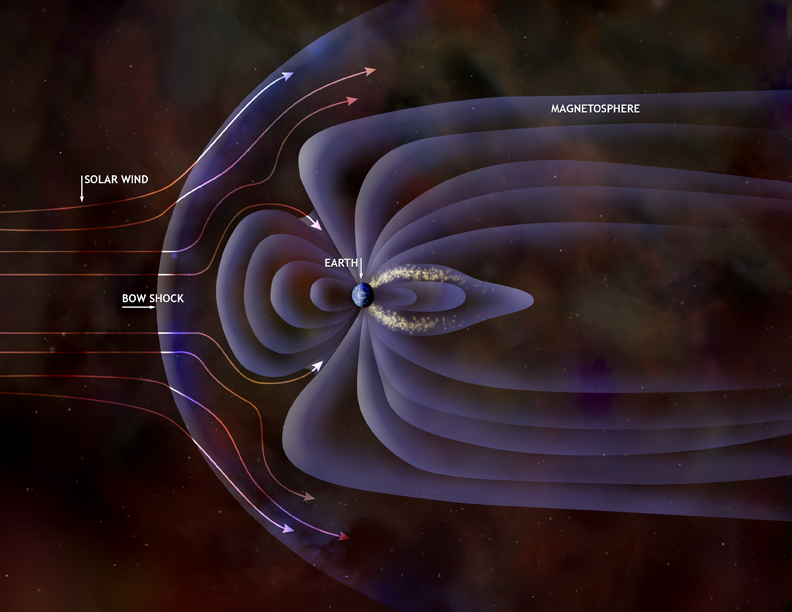
What happens when such a thing hits the Earth? Don't worry. Nothing lethal. Because all these particles are charged, they're affected by magnetic fields - and Earth has one of those too. This is what happens:

(From Chandra.)

Incidentally, Jupiter and Saturn too have spectacular magnetic fields and aurorae - indeed, Saturn's magnetic field might be responsible for all kinds of odd effects among its moons.

Although Earth's magnetic field directs the charged particles away from most of the Earth, it directs them towards the poles. But those don't suffer mass destruction. Rather, they shimmer with the Northern Lights, or the Aurora Boreolis.

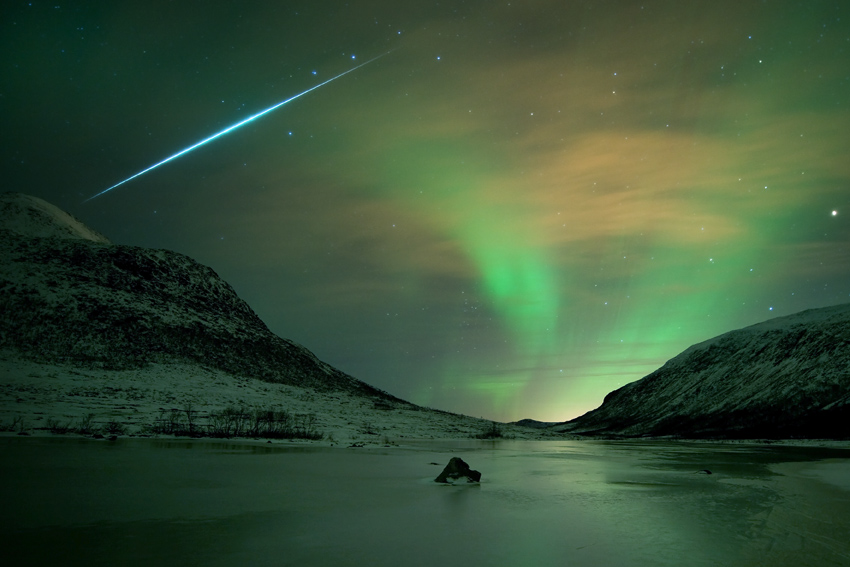
The Aurora over North Norway, from APOD.

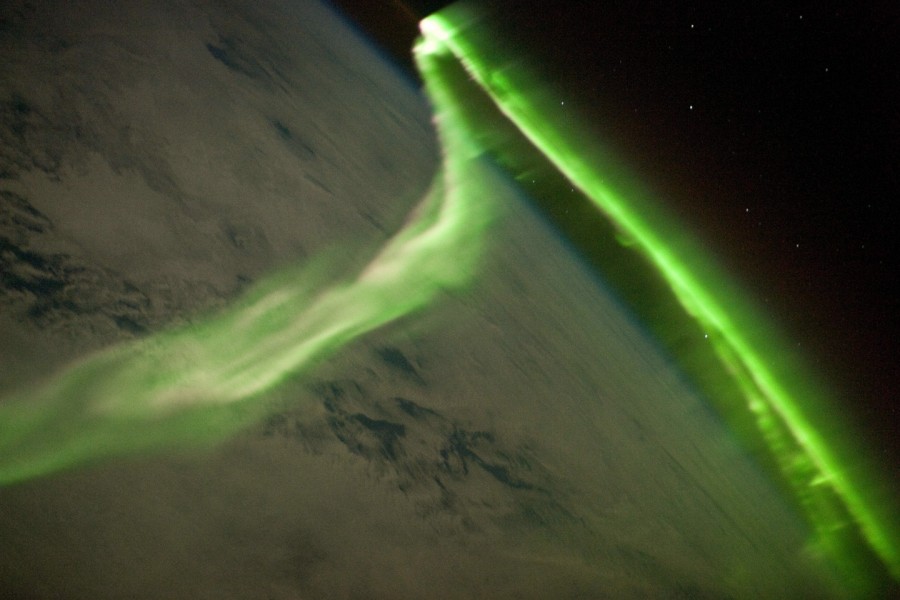
The Aurora from above, photographed by astronauts aboard the Interntional Space Station. APOD.

I went to Norway when I was 20 but have never seen the aurora, and that's one of the things I really long to do. It annoyed me that Philip Pullman turned it into something supernatural in "Northern Lights", but he certainly expressed a silent, throat-tightening beauty about it that made me want to go and see it even more. They move around - I don't know how fast. The green light is from excited oxygen atoms. "Excited", in this case, means that one or more electrons have jumped up to a higher energy state (you can think of that like jumping up to a higher electron shell). More rarely, it emits red light. Nitrogen, too, glows in different colours - blue and red. There's a nice little description of the chemistry here.

A coronal mass ejection is not needed to produce the aurora - it occurs anyway because of the solar wind. The Sun is in fact hurling ionised matter at us all the time. A coronal mass ejection is just a great glut in one go. This can result in the "northern lights" being seen much further south than usual - it seems they have already been seen in Northern Ireland.

The problem with coronal mass ejections is that they can disrupt communications. In November 2003 there was a particularly large one, which was not only hazardous for space observatories such as SOHO but also for aircraft. There's a good write-up in the introduction Dr Stuart Clark's "The Sun Kings" about the things that took place then: radios that aided expeditions, forest firefighters, marine emergency calls and the like became unreliable; aircraft had to fly below 25,000 feet and at a lower latitude than north Scotland; Sweden suffered blackouts; nuclear power plants in America reduced their power in case of damage. Compasses, too, no longer knew which way was north and swung about wildly. As luck would have it, Cassini, ten times further away, got a bashing too!

Infuriatingly, I missed this whole thing. I was in Granada, southern Spain, at the time, on a year abroad for my degree, and only using the Internet in cafes every few days (Galaxy Zoo did not then exist and I didn't even hear of Facebook for another few years). I think it must have been around Halloween - I recall walking round Granada with a friend terrified of masks that night, and listening to her worries about love and commitment. Then the 2006 solar eclipse happened when I went back to Spain for a TEFL course - we would only have seen a partial eclipse, but I missed it then, too.

The most spectacular coronal mass ejection to hit Earth on record is the one that occurred in 1859 - again, as detailed in Stuart Clark's book. In that one, auroras appeared, it seems, all over the planet. You could read a book at night - if you weren't busy being terrified of the end of the world, as it seems many people were. Hilariously, however, there were so many charged particles in the air that this happened:
Boston telegraph operator (to Portland operator): "Please cut off your battery [power source] entirely for fifteen minutes."
Portland operator: "Will do so. It is now disconnected."
Boston: "Mine is disconnected, and we are working with the auroral current. How do you receive my writing?"
Portland: "Better than with our batteries on. - Current comes and goes gradually."
Boston: "My current is very strong at times, and we can work better without the batteries, as the aurora seems to neutralize and augment our batteries alternately, making current too strong at times for our relay magnets. Suppose we work without batteries while we are affected by this trouble."
Portland: "Very well. Shall I go ahead with business?"
Boston: "Yes. Go ahead."
I first heard of this conversation in an Astrofest lecture - it was especially amusing because the lecturer showed us the code used first! In any case, it's rather like an msn conversation with the Internet switched off (so if anyone tells you that the Internet's a new and unnatural thing, remind them about telegrams).

Coronal mass ejections do not appear entirely randomly. The Sun has a cycle of its own: an eleven-year period that alternates between a "quiet" time of mostly steady shining, and a less-quiet time of more sunspots and flares. These changes correspond to changes in solar output - in other words, how much heat and light we get. There have been efforts to link this changing activity with climate change, but the trends are weak - if that. In the short term, it does work to some extent - there have been arguments for decades over whether you can correlate solar activity with the price of wheat. And it is possible that a few decades of warmth or chill (the Little Ice Age; the time Britons grew grapes, etc.) are due to changes in solar activity - but they were not global events but local ones, suggesting that conditions on the Earth itself, just like now, were the driving forces in those cases.

Going back to Stuart Clark again (as you can see, I must finish his book - I'm the dreadful kind of person who starts six books at once and falls asleep while reading them, awarding myself an ever-more-toppling booklist!), he has this to say about studying the Sun and its eleven-year cycle:
Like a heart, the Sun pulsates. This is not a visible movement but rather a gradual buildup in strength and subsequent weakening of the giant magnetic bubble that emanates from within the Sun and surrounds all the planets. As befits a celestial body of some 4.6 billion years in age, each one of these magnetic heartbeats takes a leisurely eleven years, or thereabouts, to complete.

So, in the average career of a scientist, he or she can expect to see this happen four times. This makes understanding the Sun as difficult as a biologist trying to deduce the life cycle of an unknown creature by observing it just long enough to witness four beats of its heart. As a result, solar astronomy is a multigenerational science. Each new cohort works to build a finger legacy of observations for those yet to come.
In any case, things are looking interesting. National Geographic says this is the largest flare for some time. Aviation Week has some mind-boggling pictures of what our local star is up to right now:


Pete Lawrence got an astonishing photograph of the flare. You can also watch a quick clip here on the BBC. And check out AuroraWatch to see if it might be worth nipping outdoors . . . please let me know if you see anything!

PS And if you are really into solar storms, you can now join Solar Stormwatch to map them properly. It's concentrating on past ones - but Zooites work through things very quickly, so you never know, soon enough you may be working on them as they happen!

Thursday, 17 February 2011

"This avoids the need to prove the science . . ."

There was a great deal of laughter on Twitter last night when this panicky e-mail landed in my inbox, leaked by a friend who was one of the recipients, and which I evilly passed on to several dozen skeptics:

Hi everyone

One of the students at college has brought the message below to our attention; so I am passing it on to everybody.

Please read and forward on to people you think may be interested.

Thanks xx Anna

Dear EVERYONE,

This is urgent. TOP PRIORITY!!! The deadline is the 18th of February. The practice of homeopathy by lay homeopaths is at stake, and if the MHRA changes the wording to the document mentioned below, we will ...not be allowed to practice any longer. This will take effect immediately. The new wording which is being suggested by sense against science, and is being considered by the MHRA will effectively put us in catch 22 so that we can no longer give out remedies - basically, it is about the difference between dispensing and prescribing. all homeopaths dispense remedies as a normal part of daily practice. the new rules will mean that it will be illegal to dispense without a license, and only a qualified doctor can make a prescription. without the ability to dispense, all we can do is sit and listen to people's problems, but can do nothing else about it. this will also have an affect on the homeopathic pharmacies, who will only be allowed to dispense licensed remedies (currently, only arnica and possibly one or two others are licensed) unless prescribed by a physician, and this means the potential loss of thousands of remedies. The key words in the version we want, which help keep homeopathy going are "...use within the homeopathic tradition". This avoids the need to prove the science behind prescribing of remedies and allows us to practise as normal.

Could you please send this template to EVERYONE and inundate Ms Farmer with requests to keep the wording as shown below, so that homeopaths can continue to practise homeopathy legally.

Please contact everyone on your database, if you are a homeopath, please send it in yourself and contact all your patients to do the same. we can counteract sense about science with numbers. we just proved we have greater numbers than they do, and that when we mobilise, we can beat them at their own game. last week, they started a poll against homeopathy in an irish newspaper ( see link - http://www.thejournal.ie/do-you-have-faith-in-homeopathy-2011-02/?voted=1) and inundated it with votes against. it was 435 against 67 for. we started a campaign on facebook, and within 24 hours, we shifted the balance of power to what you see here in the link - 67% for 27% against. they gave up and went away with their tails between their legs, and we showed them that people don't want what they have to offer.

Please help us to do this again. many people don't realise this new risk we are facing. it only takes a minute to copy and paste the below template and email it. Apologies in advance if you have acted on this already.

Thank you to everyone in advance - i know if we all work together, we can beat this.


andrea.farmer@mhra.gsi.gov.uk

Ms Andrea Farmer

MHRA, Area 5M

151 Buckingham Palace Road

Victoria, London SW1W 9SZ

Dear Ms Farmer,

I am writing to you about the MHRA consultation document entitled; Review of Medicines Act 1968: informal consultation on issues relating to the PLR regime and homeopathy. As a member of the public who chooses to use homeopathy and benefits from its application/practicing homeopath (delete as applicable), I am deeply concerned by the current orchestrated campaign against homeopathy, which is led by a self-appointed pressure group, Sense About Science, and a number of bloggers.

I consider it to be a fundamental right of any citizen living in a country which purports to be a democracy, to have ready access to the healthcare option of their choice. This includes homeopathy, which as you know is included in the original NHS charter.

I find your statement below acceptable for the new registration labels, and can see no reason to change this statement:

"A homeopathic medicinal product licensed only on the basis of safety, quality and use within the homeopathic tradition"

Yours sincerely,


I'll completely ignore the whole business of competitive polljacking. It's something I find entirely tiresome and pointless - any fool can play at that game and they generally do. As Bertrand Russell said: "The fact that a belief has been widely held is no evidence whatever that it is not absolutely absurd" - and polljacks are hardly proportional census reports. So I'll start with the fact that I guess I can add two homeopathy proofs:

ARGUMENT FROM COMMAND OF ENGLISH
1) My spelling, punctuation and grammar are appalling.
2) This is because I have been concentrating on homeopathy, which is more important.
3) You only notice because you are petty.
4) And also because you have nothing important on your mind.
5) Therefore, homeopathy works.

ARGUMENT FROM ORCHESTRATED CAMPAIGNS
1) Some self-appointed pressure groups and bloggers can orchestrate campaigns.
2) They are self-appointed and therefore wrong.
3) Therefore, their campaigns are wrong, as is the orchestration.
4) I know if we work together we can beat this.
5) Therefore, our campaigns and orchestration are right.
6) Therefore, homeopathy works.

If I understand right, the proposal that has so upset this student is summarised here (feel free to sign - at the time of writing there is a short time left in which to do so). The actual document, which may be the source of the panic, is here.

The points in question are as follows. Point 23 states: "“The MHRA will review the labelling requirements under the NRS to ensure that these deliver clarity as to the status of products and their composition" (i.e. that the composition is sugar and water?).

And the fuss is, I think, over the next three points:

24. The form of wording currently used on the labelling and in the accompanying patient information leaflet under the NRS is

“A homeopathic medicinal product used within the homeopathic tradition for the symptomatic relief of ….”

25. MHRA considers there is scope for this information to be made more specific, particularly for the benefit of those consumers who may be less familiar with the nature of homeopathy. We propose the following more explicit form of wording should be used, on the outer packaging and patient information leaflet:

“A homeopathic medicinal product licensed only on the basis of safety, quality and use within the homeopathic tradition”

26. Information about indications would read:

“A homeopathic medicinal product used within the homeopathic tradition for the symptomatic relief of……”

So as you see, homeopathy is hardly being illegalised. I'm not sure the proposed sentence in point 25 will actually change anything - how many people take the slightest notice of the fact that all adverts for horoscope telephone numbers in newspapers have the disclaimer "For entertainment purporses only"? And that in itself is, in my opinion, a great deal clearer. I fear people need a great deal more education to read label-ese - and if that's taught in schools, I'm afraid I missed it.

That the student ends the first pargraph (the one beginning with "URGENT! TOP PRIORITY!") with "this avoids the need to prove the science behind prescribing of remedies and allows us to practice as normal" rather sums up the whole business.

But what also sums it up is that the whole thing was accepted without question by the professor and passed on just like that. Imagine if a student of any other subject wrote to a professor with a great deal of misinformation, asking for everyone to be informed and to act against the supposed enemy, and the professor, rather than correcting the student or recommending a little more research, simply went ahead! Not only would this be bad practice to the rest of their students and colleagues and the whole academic community, but it would be effectively humiliating the student!

I quote a couple of responses people made when I forwarded on the e-mail to them:

"The MHRA will not change the rules on Friday; homeopaths will still be able to sell their sugar pills. The MHRA are proposing changing the wording for National Rules products. There is ONE such product: Nelson's Arnicare. The changes they (or at least Big Quacka) should be more worried are the revoking of all Product Licences of Right, because with that goes the right to claim it's good for minor and serious medical conditions. She either has not read the consultation document or has completely misunderstood it."

"I'm afraid I saw this as an example of a student getting hold of the wrong end of a stick and leaping into the fray wielding it - even if the fray is entirely of the student's imagining. Very poor that an administrator has picked it up and run with it though. Very professional, right down to the xx. Poor Ms Farmer, who will be inundated with these emails - no doubt many of them still with 'delete as appropriate' in them - and will no doubt form her own opinion of whose is the orchestrated campaign."

You can read more at Zeno's Blog, Don't Homeopanic at Crispian's, and at the Quackometer.

In the kind of democracy the student and the unquestioning professor claim we should have, anyone can dispense any remedy, regardless of what it does - their own faith and shunning of explanations is evidence enough that they are "helping". Is that really the kind of democracy we want? To put it another way, would you want your own doctor to give you whatever vaccinations he or she fancies; your schoolteacher to teach your child any old thing such as religious extremism, rolling down grassy banks or lion-taming? Just the way most people agree on a set of general manners, I think it's only sensible to agree on a set of medical rules - and I'm afraid science, not salespeople's hurt feelings, is the better driver of medicine's progress.

Tuesday, 15 February 2011

We don't have to be either workers or a drain

Today there are enough stories about neglect in our care and health services to make you cry. The NHS "fails to treat the elderly with care and respect," says the BBC, adding four reports by witnesses (workers and patients' relatives) telling condemning stories. "Hungry, thirsty, unwashed . . . Elderly people treated by the NHS were denied even the most basic standards of care," says the Independent.

Before that, Johann Hari wrote a moving piece on the neglect his grandmother went through in one care home after another - and, after the overwhelming response the article received, evidently interviewed many people to search for a solution, which he presents here. And although I loathe to link to the Daily Mail, this account by a nurse of the massive culture change her profession has undergone is infinitely worth a read.

The stories she tells are infuriating - heartbreaking for anyone who might have been through this themselves, or knows anyone else who has - and also, although this sounds less impressive but is true all the same, desperation-inducing to someone like me, who has worked in the NHS and whose immediate family still does. Making people better is something that many doctors, nurses and others give their lives to. Someone in my family is (and has been for many years) on call 24 hours a day, three hundred and sixty-five days a year, and is often at work ten or twelve hours a day to make sure the patients get everything they need on top of the mountains of unutterably pointless, illogical and ill-thought-out - and immediately forgotten, to add insult to injury - forms the managers demand he spends hours a day filling in. It's aged him rapidly. And nothing distresses him, or the others, more than learning of mistakes or poor care.

Joan Woodcock, the author who wrote the article in the Daily Mail, does not mince her words about where things have gone wrong:
I am sure that many of the new generation of nurses are as caring as we were. But what chance do they have of showing it when the hospitals in which they work are run not by experienced nurses but by bureaucrats?

Too often these managers fail to realise that patients are people, not commodities, and that management skills acquired in banks and retail ­business don’t necessarily transfer to the running of NHS hospitals.
She adds: "When matrons were phased out at the end of the 1960s and replaced by managers, things soon began to slide. There was no longer any one person in charge of patient care in each hospital, no one with the authority and respect of those like [the strict and demanding matron]."

I've had a couple of good blogs pointed out to me over Twitter. One called BillyNoJob remarks on a conclusion by John Humphrys: "This is not about professional incompetence. It is about inhumanity, lack of compassion, and the most basic failure of respect for other people." Joan Woodcock and Johann Hari's articles amount to the same thing. BillyNoJob adds, unlike them, that he has witnessed many patients treating hospital staff with rudeness and contempt, too. This is especially so when many staff are immigrants, since care is not - as Johann Hari says, too - rewarding or a profession to which Britons are encouraged to aspire.

This shows two problems: firstly that (as Johann Hari also mentions) care is not well-paid, rewarding or a profession to which Britons are in the least encouraged to aspire; secondly the old business of scapegoating. It is a genuine problem when a health worker's English is not very good, not only in medical terms but in euphemisms and non-verbal messages patients are likely to use a lot in terms of their illness and on intimate subjects. This may be a contributing factor; but the atmosphere of distrust and dislike that the tabloids encourage does not get anyone anywhere.

Johann Hari, among others, emphasises the lack of niceness health care workers show - indeed have time to show - to patients who are bored, frustrated, and have nobody to talk to. This lack of time is ruining things for "Militant Nurse", whose outside life and family and doubtless her own health and energy are suffering as she has to work unpaid overtime just to get even the basic jobs done. The ward is horrifyingly understaffed. She is in a state of understandable rage, made all the worse when the patients misinterpret her shortage of time as a lack of caring, and are grateful to the only other worker who is not equipped with the skills of a nurse and as a consequence does have time to make them a cup of tea. Reading her blog, one wonders what keeps any nurse from looking for another job - other than the lack of other jobs available.

Among lack of time and lack of niceness also lies a lack of willingness to take responsibility. Joan Woodcock's article shows how no one person seems to be responsible for any particular task, and various staff are all too keen to say, "That's X's job, not mine" - and therefore it doesn't get done. "Militant Nurse" notes that the consequence of this is that when a problem has to be addressed, whoever happens to be on the ward when the manager arrives gets the blame.

This is a difficult issue, but I'm going to take a stab at it anyway. (And if I'm wrong, it's better that I at least thought about it than that I accepted possibly flawed conclusions.) Ducking responsibility shows nervousness and a lack of empowerment. A lack of empowerment stems from general distrust. I write about that more here. In short, I get the feeling that the emphasis is on protecting oneself and one's job (which is after all usually one's family's lifeline). The point of the job has been lost in the worry about basic survival, and that makes people selfish and helpless. Maybe selfishness and helplessness is rewarded more than doing the job is. Maybe helplessness looks inoffensive to those who don't like their colleagues to answer back.

A few years ago, in Cornwall, I knew a Hungarian lady who was a care worker - and an academic. She was doing the care work to fund the academia, and she cared a great deal about both. She mentioned at one time that it was difficult to get a new job not because of her inexperience, but quite the opposite. "They prefer naive young girls who don't know what it involves, because they think the rest of us will leave," she explained to me. "I know what it involves - it involves a lot of pee and poo." (She looked after adults with mental health problems.)

I mentioned flawed conclusions just now, and it is important to note that the ombudsman's report was based on ten cases. This looks like I'm making excuses, I know, but we can't judge the entire NHS on ten cases, nor on the four highlighted by the BBC. Reports like Joan Woodcock's, I think, are worth taking seriously (though not as all-encompassing) despite being by only one individual, for she has seen several decades pass and umpteen thousand patients.

Doubtless this report will be sprung on by circling vultures: private companies all too ready to take over; probably alternative medicine sellers who'll claim that their product "treats the whole individual" just as these public services evidently are not; and the government itself, to demonstrate that "the NHS is not working". But the NHS did work for a long time and in most cases it still does - good treatment just doesn't make headlines! Privatising would solve little or none of the above. What's so good about being "treated like a customer"? It only means a hierarchy will be created rather than efficiency - the simpler your disease and the fatter your wallet, the better care you'll get. And vice versa.

You may wonder why these issues worry a 28-year-old so much. It may be partly my medical family, but also because I've known long-term illness for myself - the weakness, the helplessness, the lack of knowledge about your future. For some time, I didn't know if I'd ever get better. I wondered if death would be the better option. Therefore, the thought of getting old and going to one of those care homes absolutely terrifies me - yet it's something that a great many of us will actually have to face.

The worst thing about a long-term illness is feeling useless, a drain on other people, unable to give anything, only to take. I'm really not happy when I'm only taking and not giving - and I don't say this because I think I'm a saint or something, I think that's actually what nearly everybody is like (it just makes you look silly or smug to say so). And I think it's something that we feel more the older we get, and the more we get accustomed we become to working and to looking after others. Who wants to rely on others for everything when they've lived 70 or 80 or 90 years and have worked hard and given a great deal for most of them?

It's peculiar how society is divided very strongly into two classes of people now: those who are working and those who are not. Those who are working are seen as the only useful ones. Those who are not are, frankly, a problem, and their numbers should be brought down. If they can't find a job, they're scum - they should do voluntary work not even for minimum wage, or starve. If they're not working because they're studying, they should pay vast sums - the assumption here being that the studying will only benefit them, not society as a whole. If they're not working because they're too young or too old, they are a pest and a drain because they're taking up other people's resources - and we must find ways to economise on this wasteful problem. Carers are treated shabbily enough. Parents are finding it increasingly hard to find somewhere to put their children while they work - and they're being threatened with very severe punishments if they want to look after their children themselves. (This sort of thing has been going on for some time - I recall there was a plan to punish parents who do not get a job as soon as their child turns one, and another once their child turns three, and another once their child turns seven, and another once their child turns ten. Plans generally come to nothing - in autumn 2007, as a trainee teacher, I was told that by autumn 2008 all schools would legally have to be open until 8pm for babysitting purposes, which of course by autumn 2008 had been completely forgotten - but the constant stream of threats and promises is a constant source of uncertainty, inability to plan properly, and doubtless waste and great stress.)

In short, if you haven't got a job, you're an affront ro the economy - and the ratio of people looking after you to other useless people like you should be as unequal as we can possibly afford.

But having a job versus not having a job is not the only definition of useful. Do you remember that children's book from the 1860's, "What Katy Did"? Katy's sick cousin Helen told her that "a sick person can be the heart of the house", and that they have a unique advantage: "she is always on hand". The Victorian era was a time of vast productivity, and it was a time of masses of different roles taken in society. (I'm not saying it was a time of universal good or that everyone was well looked after.) Why should we all aim to be in the role of the worker? - and if we are not, why is it assumed our only role is as a drain?

If we do not assume that the young, sick, studying or elderly are basically society's unwanted baggage - if we think of them as people who want to give, rather than simply want to take and who we "ought to treat with more respect", I wonder if things would change?

I had this idea a few years ago. It's an amateur idea, if that. It's an idea that you may simply laugh off. It's an idea that has so many possible legal pitfalls that I doubt it would ever get off the ground. It may simply be decoration rather than addressing a fundamental problem. And it might really annoy those who know more than I do. But if I don't share it we will never find out. Here it is.

What about combining care of the very old with care of the very young? For example, a residential care home which doubles as a children's nursery by day? Yes, there would need to be separate areas. But imagine how nice for both parties to have the other one around. The children would have someone to run to if they'd made an amazing tower with blocks, or if they'd fallen and hurt their knee. The elderly residents - who had a "daily activity" in one of Johann Hari's grandmother's homes - would have a bunch of ready-made grandchildren to talk to and listen to, to teach to read, to share their memories with. And they need not look after them all the time!

Fine, this idea has a great deal of untested personal bias. People tend to move across the country now - I never got to know any of my grandparents at all well before they died. But when I was little, I adored the elderly. I knew they had to be treated gently, but for some reason I was convinced they were all magnificent and saintly. I have also never forgotten a passage in Torey Hayden's story "One Child" in which she brings a mute four-year-old to meet a nearly-mute elderly stroke victim, who becomes far more "animated" as soon as he is in the room. Once I started office work, my colleagues only had to bring a little one in for me to develop a huge grin and, if the child wanted to talk to me, to have my full attention and have me make paper aeroplanes for them. Teaching and looking after kids brings me joy like nothing else can. Also I have worked at a call centre where the sick and elderly rang me to book hospital transport, and almost all were so very lonely. I know it wouldn't suit all young or old people. But it's an idea worth thinking about, perhaps?

As well as less in the way of wild promises, inconsistent and target-obsessed management, and general inhumanity, I would like to see people who need care being treated more as people - not just in terms of what they should get, but what they can do. It would have vast effects on self-esteem and morale all around. In my idea, the children's education and social development would benefit, as would I hope the elderly people's happiness (and if they get fed up they should surely be able to retreat to a private sitting-room!). It would hopefully inspire a lot more friendships and family links - perhaps children's parents would be interested in how the elderly people are doing, too. It would stop people being segregated into classrooms, offices or care homes where they only people they meet are others exactly like themselves, which would have to be good for generating mutual respect all round.

Wishy-washy-wisfulness, or a lot more radical than privatisation? I don't pretend this is a solution to all ills. I just think it might be worth a try. If nothing else, my Hungarian carer friend thought the idea had promise - and some of the adults she looked after were helpless in some ways, yet able to find some form of in-depth hobbies and even employment in others. If you work in healthcare, or just care - or even if you don't - I'd be interested to hear what you think.

Sunday, 30 January 2011

England's forests for sale

I declare an interest: I love trees. I don't seem to find that many of them these days, especially not in the same place - and they're often found put there on purpose, or the space around them adapted to our tastes. Here's a little collection, though. Three are in a public woodland, Idless Woods in Cornwall. The others are from Kew Gardens, my old university campus, and a patch of ground near where I live in Wales . . .


This country was not always like that. Once upon a time, it was covered with forests. That was the natural thing. (Is it just me or is our hero in many fairy tales a poor woodcutter?) Have you heard about succession? It was a beautiful little concept I learnt of in first year A level Biology - take a barren area, perhaps rocky, or a beach, with no fertile soil. Start with the faintest sprinkling of a few tiny, hardy plants. As they drive their roots into the ground, they create airholes, a good soil texture (not with particles so large that the water all drains away, such as pure sand, or so small that it clogs and floods like clay), fix nutrients, and generally set up a complex ecosystem. Plants and bacteria and animals - first tiny ones, and later larger ones - find their homes there.

A forest, if I understand correctly, is pretty much the last stage of that. Trees reach for the light. When the rain hammers down from the sky, the trees' leaves break its fall, softening the raindrops' impact on the soil and preventing if from being washed away. Moss grows on trees. Dead leaves provide nutrients for next year. When a tree dies, its dead wood is home to hundreds of creatures. A rainforest is a symbol of perfect recycling and order - evaporation from the plants even often control the weather, and set off predictable and regular cloudbursts - a temperate forest is certainly less dramatic, but the same general processes go on.

But what such a system is not - like so many things ecological - is speedy. A tree takes hundreds of years to grow. Some forest ecosystems have been suggested to be adapted to forest fires. But a wipeout of an area of trees in a forest not so adapted would take years and years to recover. Vast as it may seem, and remote, an ecosystem is a delicate thing.

Gradually, forests were cut or burnt back to make way for farms, and then towns. Gradually, more and more of what is now the UK was invaded by one horde after another, and land became something owned by humans, to do with as they liked. Of course, so many animals have ways of "owning" their territory - by patrolling and spraying it, and chasing off competitors; and I have the feeling from my faraway biology studies there are a great many plant species that barely survive or have been driven to extinction by relentless chomping or wanton destruction by local critters. But ecosystems have had time to adapt to that. No animal, to the best of my knowledge, has the desire or the means to eliminate all plants that grow around it. I think the only time this happens is when a fairly large animal is tethered or enclosed in a small space, and tramples all the grass.

Not that humans generally have, either. We all love to see a bit of greenness. When I was 20 I visited Norway, and my guidebook was pretty exact on how forests were regarded there. (I cannot recommend enough a visit to Bergen on the west coast, and a trek round the forests and up the mountains that surround it. That was one of the most magical days of my life.) A walk in the woods was supposed to cure all stress and misery. There was an indestructable tradition of collective ownership - I think it even had a name (if only I knew where that guidebook was now!) - and of the right of all people to walk through the woods, pretty much anywhere. As long as you were further away than 200m from the nearest fence around a property, you could camp anywhere, too. It's possible that the book was exaggerating or romanticising madly, and I was young and impressionable then; but as I walked through Norwegian woods and met others doing likewise, I felt a sense of almost sacredness, of a collective treasure that nobody could be denied.

This all sounds very woolly and hard to pin down in today's world. Everything has to be owned by someone, and to have some utilitarian, measurable, monetary purpose. To today's government, collective ownership of what forests England has left is something that can be dispensed with. "We're going to make billions of pounds this way! We need to reduce the deficit! Oh, and yes of course they'll be sold to really responsible owners, who'll let you all still enjoy them. In fact, private ownership is a guarantee of improvement. They will be managed more efficiently this way." Or something like that.

I say England, because Wales is keeping out of it for now (I don't know what is going to happen to us, but my hopes are not high) and here is the map of the forests that are up for sale:
(Source)

Just who are these responsible owners? "The controversial decision will pave the way for a huge expansion in the number of Center Parcs-style holiday villages, golf courses, adventure sites and commercial logging operations throughout Britain as land is sold to private companies," reports the Telegraph.

A spokesman for David Cameron claims that "We are not going to sell off our heritage forests to the highest bidder, we are not going to remove public access to forests – there will be strict rules in place to prevent that happening. There is a consultation. We are going to have that consultation and listen to people's views and then come to some conclusions." I'm sorry, spokesman, but I simply don't believe you. Once someone has bought a forest, and it's their property, how are you going to stop them then cutting the whole thing down? You couldn't. And money would have exchanged hands; they'd be your mate. You wouldn't want to upset them. That's the way you people do things.

The government claim the issue is not private versus public ownership, while a large segment of the public argue that it is. Typically, there are the usual howls about how some woods under public ownership haven't managed them perfectly, and therefore privatisation necessarily will. Funny how you never hear the opposite being suggested in cases where private companies do a bad job - apparently, competition is the cure-all to that . . .

(As an aside, this "consultation" about "how we would like our forests sold" is exactly the same as what Labour were fobbing us off with regarding our National Health Service, when they were closing Accident and Emergency departments in the name of efficiency. They designed a survey which asked people all about choice, and then concluded that the public wanted choice. Someone wrote to the Independent to remark that the survey would have failed as A level Psychology coursework. It was like asking, "Do you like tea or coffee?", ignoring those who said "orange juice", and then reporting triumphantly, "Buyers exclusively like hot drinks! Let's dispense with fruit juice in the name of consumer choice!")

OK, I'm stereotyping my head off here, but as another aside, trust them to be going for golf courses. I'd love to see a library, youth club or community centre being the thing to replace a forest. But no, again, if anyone benefits from this sell-off, it will be the ultra-wealthy few.

Our forests are more than pretty trees, more than a nice walk that doesn't get the economy going. They're lifeblood of the biosphere. They're what keeps our soil good, and they help prevent floods. They're the precious remaining homes of millions of innocent creatures. They're a place to keep people sane amidst the stress of a noisy, utilitarian world. They release oxygen and soak up carbon dioxide, maintaining the delicate balance of our atmosphere. They're a tiny bit of our world that has every right to remain. Too much will die if it's lost.

I suppose none of what I've said here can sway anyone who thinks only of money. But I know I'm not alone. About 300,000 people have now signed 38 Degrees's Save Our Forests petition. The National Trust and the Woodland Trust have both made their views clear. I feel horribly conscious that my science on this topic is rusty. And that we'll have difficulty phrasing our arguments in a capitalist, government-impressing, management-speak way. But I don't believe that invalidates them.

It's well summed up here in the Independent, and by a commenter on the BBC website: "Woodland does not 'belong' to people. We are stewards who safeguard it for the benefit of all creatures. The idea of our remaining precious public access woodland being sold off to the super rich to barr families who enjoy being in the woods is totally unthinkable. This government is taking reckless, far-reaching decisions, which will impact on many generations to come. Once the woodland is sold off that's it - there is no going back."

You can catch up with all the media stories here on 38 Degrees - there's quite a bit of history, too, especially on the subject of how the Forestry Commission was set up after the wreck of the First World War. People knew what damage was then. They should bear in mind what damage is now. Modern society needed to progress to a certain extent to realise that human beings should not be put up for sale - perhaps there are other things, and forests fall into that category, that should receive similar exemption.

If you agree, please sign that petition and tell everyone you know. It's particularly interesting that whenever I see it mentioned, or mention it myself, along comes someone else who turns out not to have known and is aghast. Parliament will be making the decision very soon - a lot of people are making their voice known one way or another these days; please add yours!

Update, 12th February 2011: The bill did go through - but now they're rethinking. So there's still time to act.

Update, 17th February: LOOK!!!!!